Thanks for visiting SNEWPapers!
Sign up free today to connect your AI tools to the Library of Congress' newspaper collection.
Constitutional Whig Literary November 26, 1824
Richmond, Virginia
What is this article about?
An account of the last days and death of poet Robert Burns in Dumfries, describing the town's anxious devotion and his final moments.
Quality green show the numbers
Measured from the scan
— how cleanly the OCR engine read the characters
- Mean ink quality
- 99.0% The length-weighted average confidence across the OCR lines — the mean of exactly the per-line scores whose tails the two figures below report. Typical is 99%.
- Illegible ink
- 0.0% Text sitting in OCR-detected lines that scored below 80% confidence — very shaky reads. Weighted by line length, so one long bad line counts for more than a short one.
- Uncertain ink
- 0.0% Text in lines that scored 80–90% — somewhat shaky reads.
- Matches source
- 98.9% How closely the served text matches the raw OCR of the same boxes, letter by letter, after collapsing spacing and case. This measures agreement, not correctness: the OCR is often wrong and the extractor corrects it, so 100% does not mean perfect, and a low figure usually means poor scan text was rewritten rather than that text was lost (length vs source shows loss).
- Length vs source
- 99.24% Below 100% means text was dropped from the OCR; above means text was added to make it read.
Assembled by the extraction model
— whether the stitched-together text holds up; catches layout and segmentation errors, which the scores above cannot see
- Transcription confidence
- 95.0% (typical 96%) How cleanly the extractor could assemble what it was given. Low here with clean ink scores points at layout analysis — the characters were read correctly but grouped or ordered wrongly.
- Comprehension
- 90.0% Whether the piece reads coherently start to finish. Can stay high while transcription confidence drops, when only part of the component is affected.
Clipping
Full Text
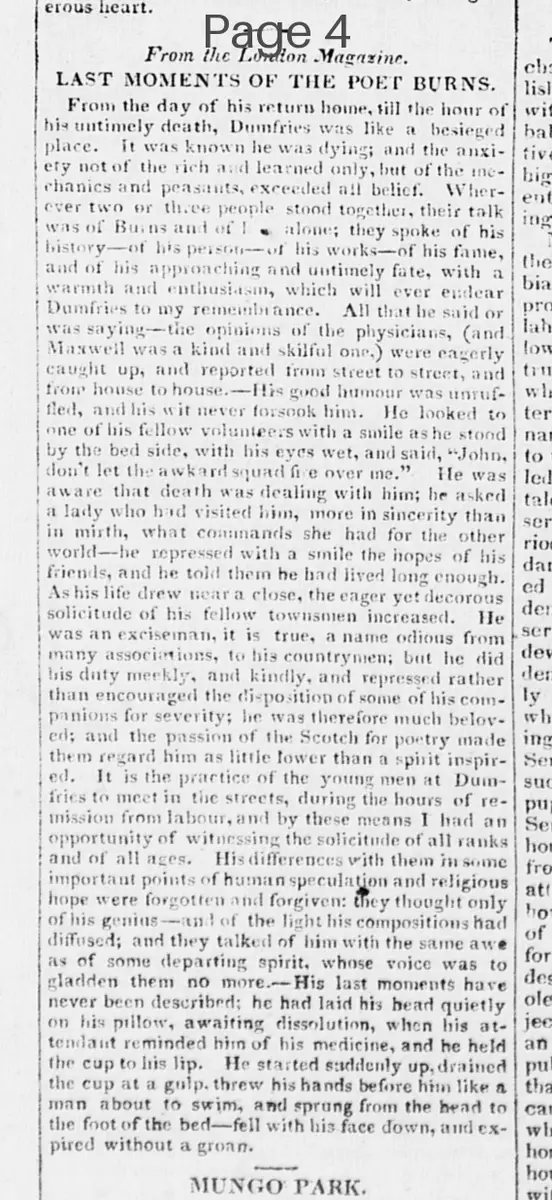
From the London Magazine.
LAST MOMENTS OF THE POET BURNS.
From the day of his return home, till the hour of his untimely death, Dumfries was like a besieged place. It was known he was dying; and the anxiety not of the rich and learned only, but of the mechanics and peasants, exceeded all belief. Wherever two or three people stood together, their talk was of Burns and of him alone; they spoke of his history—of his person—of his works—of his fame, and of his approaching and untimely fate, with a warmth and enthusiasm, which will ever endear Dumfries to my remembrance. All that he said or was saying—the opinions of the physicians, (and Maxwell was a kind and skilful one,) were eagerly caught up, and reported from street to street, and from house to house.—His good humour was unruffled, and his wit never forsook him. He looked to one of his fellow volunteers with a smile as he stood by the bed side, with his eyes wet, and said, "John, don't let the awkward squad fire over me." He was aware that death was dealing with him; he asked a lady who had visited him, more in sincerity than in mirth, what commands she had for the other world—he repressed with a smile the hopes of his friends, and he told them he had lived long enough. As his life drew near a close, the eager yet decorous solicitude of his fellow townsmen increased. He was an exciseman, it is true, a name odious from many associations, to his countrymen; but he did his duty meekly, and kindly, and repressed rather than encouraged the disposition of some of his companions for severity; he was therefore much beloved; and the passion of the Scotch for poetry made them regard him as little lower than a spirit inspired. It is the practice of the young men at Dumfries to meet in the streets, during the hours of remission from labour, and by these means I had an opportunity of witnessing the solicitude of all ranks and of all ages. His differences with them in some important points of human speculation and religious hope were forgotten and forgiven: they thought only of his genius—and of the light his compositions had diffused; and they talked of him with the same awe as of some departing spirit, whose voice was to gladden them no more.—His last moments have never been described; he had laid his head quietly on his pillow, awaiting dissolution, when his attendant reminded him of his medicine, and he held the cup to his lip. He started suddenly up, drained the cup at a gulp, threw his hands before him like a man about to swim, and sprung from the head to the foot of the bed—fell with his face down, and expired without a groan.
What sub-type of article is it?
Essay
What themes does it touch?
Death Mortality
Friendship
What keywords are associated?
Robert Burns
Deathbed
Dumfries
Poetry
What entities or persons were involved?
From The London Magazine
Literary Details
Title
Last Moments Of The Poet Burns.
Author
From The London Magazine
Subject
The Death Of Robert Burns
Form / Style
Narrative Memoir Sketch
Key Lines
John, Don't Let The Awkward Squad Fire Over Me.