Thanks for visiting SNEWPapers!
Sign up free today to connect your AI tools to the Library of Congress' newspaper collection.
The Virginia Gazette Literary December 14, 1739
Richmond, Richmond, Virginia
What is this article about?
A moral essay on the proper observance of Christmas, contrasting the primitive Christians' Agape or Love Feast with the Roman Saturnalia and condemning both excessive austerity and profuse revelry, while urging moderate piety.
Quality green show the numbers
Measured from the scan
— how cleanly the OCR engine read the characters
- Mean ink quality
- 99.0% The length-weighted average confidence across the OCR lines — the mean of exactly the per-line scores whose tails the two figures below report. Typical is 99%.
- Illegible ink
- 0.0% Text sitting in OCR-detected lines that scored below 80% confidence — very shaky reads. Weighted by line length, so one long bad line counts for more than a short one.
- Uncertain ink
- 0.0% Text in lines that scored 80–90% — somewhat shaky reads.
- Matches source
- 96.36% How closely the served text matches the raw OCR of the same boxes, letter by letter, after collapsing spacing and case. This measures agreement, not correctness: the OCR is often wrong and the extractor corrects it, so 100% does not mean perfect, and a low figure usually means poor scan text was rewritten rather than that text was lost (length vs source shows loss).
- Length vs source
- 99.49% Below 100% means text was dropped from the OCR; above means text was added to make it read.
Assembled by the extraction model
— whether the stitched-together text holds up; catches layout and segmentation errors, which the scores above cannot see
- Transcription confidence
- 96.0% (typical 96%) How cleanly the extractor could assemble what it was given. Low here with clean ink scores points at layout analysis — the characters were read correctly but grouped or ordered wrongly.
- Comprehension
- 95.0% Whether the piece reads coherently start to finish. Can stay high while transcription confidence drops, when only part of the component is affected.
Clipping
Full Text
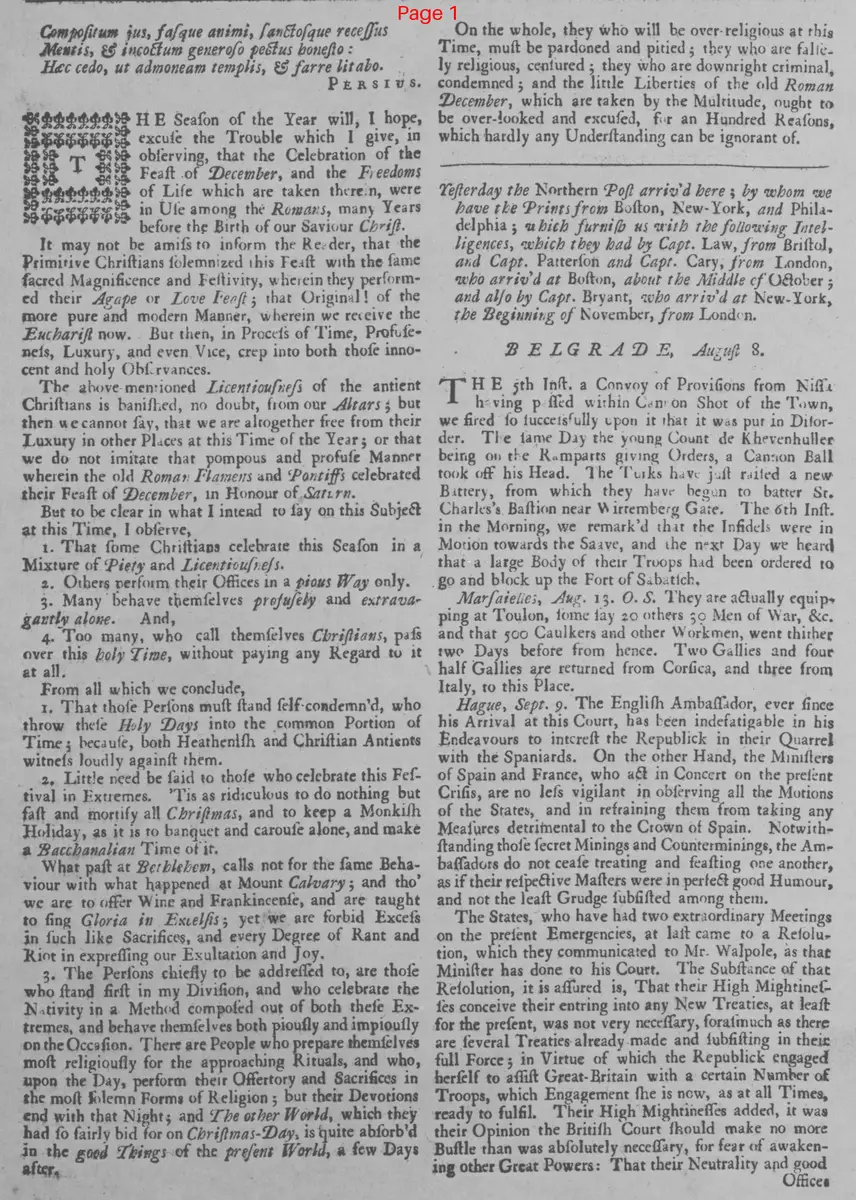
Compositum jus, fasque animi, sanctosque recessus
Mentis, incoctum generoso pectus honesto:
Hac cedo, ut admoneam templis, & farre litabo.
PERSIUS.
THE Season of the Year will, I hope, excuse the Trouble which I give, in observing, that the Celebration of the Feast of December, and the Freedoms of Life which are taken therein, were in Use among the Romans, many Years before the Birth of our Saviour Christ.
It may not be amiss to inform the Reader, that the Primitive Christians solemnized this Feast with the same sacred Magnificence and Festivity, wherein they performed their Agape or Love Feast; that Original of the more pure and modern Manner, wherein we receive the Eucharist now. But then, in Process of Time, Profuseness, Luxury, and even Vice, crept into both those innocent and holy Observances.
The above mentioned Licentiousness of the antient Christians is banished, no doubt, from our Altars; but then we cannot say, that we are altogether free from their Luxury in other Places at this Time of the Year; or that we do not imitate that pompous and profuse Manner wherein the old Roman Flamens and Pontiffs celebrated their Feast of December, in Honour of Saturn.
But to be clear in what I intend to say on this Subject at this Time, I observe,
1. That some Christians celebrate this Season in a Mixture of Piety and Licentiousness.
2. Others perform their Offices in a pious Way only.
3. Many behave themselves profusely and extravagantly alone. And,
4. Too many, who call themselves Christians, pass over this holy Time, without paying any Regard to it at all.
From all which we conclude,
1. That those Persons must stand self-condemn'd, who throw these Holy Days into the common Portion of Time; because, both Heathenish and Christian Antients witness loudly against them.
2. Little need be said to those who celebrate this Festival in Extremes. 'Tis as ridiculous to do nothing but fast and mortify all Christmas, and to keep a Monkish Holiday, as it is to banquet and carouse alone, and make a Bacchanalian Time of it.
What past at Bethlehem, calls not for the same Behaviour with what happened at Mount Calvary; and tho' we are to offer Wine and Frankincense, and are taught to sing Gloria in Excelsis; yet we are forbid Excess in such like Sacrifices, and every Degree of Rant and Riot in expressing our Exultation and Joy.
3. The Persons chiefly to be addressed to, are those who stand first in my Division, and who celebrate the Nativity in a Method composed out of both these Extremes, and behave themselves both piously and impiously on the Occasion. There are People who prepare themselves most religiously for the approaching Rituals, and who, upon the Day, perform their Offertory and Sacrifices in the most solemn Forms of Religion; but their Devotions end with that Night; and The other World, which they had so fairly bid for on Christmas-Day, is quite absorb'd in the good Things of the present World, a few Days after.
On the whole, they who will be over-religious at this Time, must be pardoned and pitied; they who are falsely religious, censured; they who are downright criminal, condemned; and the little Liberties of the old Roman December, which are taken by the Multitude, ought to be over-looked and excused, for an Hundred Reasons, which hardly any Understanding can be ignorant of.
What sub-type of article is it?
Essay
What themes does it touch?
Religious
Moral Virtue
What keywords are associated?
Christmas Observance
Saturnalia
Love Feast
Piety
Excess
Moral Essay
Literary Details
Subject
On The Due Celebration Of Christmas And The Dangers Of Excess, Neglect, Or False Piety
Form / Style
Moral Essay In Elevated Eighteenth Century Prose
Key Lines
The Season Of The Year Will, I Hope, Excuse The Trouble Which I Give, In Observing, That The Celebration Of The Feast Of December, And The Freedoms Of Life Which Are Taken Therein, Were In Use Among The Romans, Many Years Before The Birth Of Our Saviour Christ.
What Past At Bethlehem, Calls Not For The Same Behaviour With What Happened At Mount Calvary; And Tho' We Are To Offer Wine And Frankincense, And Are Taught To Sing Gloria In Excelsis; Yet We Are Forbid Excess In Such Like Sacrifices, And Every Degree Of Rant And Riot In Expressing Our Exultation And Joy.
On The Whole, They Who Will Be Over Religious At This Time, Must Be Pardoned And Pitied; They Who Are Falsely Religious, Censured; They Who Are Downright Criminal, Condemned; And The Little Liberties Of The Old Roman December, Which Are Taken By The Multitude, Ought To Be Over Looked And Excused.