Thank you for visiting SNEWPapers!
Sign up free
Alexandria Gazette & Daily Advertiser Editorial February 18, 1819
Alexandria, Virginia
What is this article about?
Editorial from the St. Louis Enquirer arguing that the Yellowstone expedition will likely provoke war with Missouri River Indians, which would ultimately benefit American expansion, destroy British fur-trade influence, and open the region to American commerce.
Quality green show the numbers
Measured from the scan
— how cleanly the OCR engine read the characters
- Mean ink quality
- 99.0% The length-weighted average confidence across the OCR lines — the mean of exactly the per-line scores whose tails the two figures below report. Typical is 99%.
- Illegible ink
- 0.0% Text sitting in OCR-detected lines that scored below 80% confidence — very shaky reads. Weighted by line length, so one long bad line counts for more than a short one.
- Uncertain ink
- 0.0% Text in lines that scored 80–90% — somewhat shaky reads.
- Matches source
- 98.47% How closely the served text matches the raw OCR of the same boxes, letter by letter, after collapsing spacing and case. This measures agreement, not correctness: the OCR is often wrong and the extractor corrects it, so 100% does not mean perfect, and a low figure usually means poor scan text was rewritten rather than that text was lost (length vs source shows loss).
- Length vs source
- 98.83% Below 100% means text was dropped from the OCR; above means text was added to make it read.
Assembled by the extraction model
— whether the stitched-together text holds up; catches layout and segmentation errors, which the scores above cannot see
- Transcription confidence
- 93.0% (typical 96%) How cleanly the extractor could assemble what it was given. Low here with clean ink scores points at layout analysis — the characters were read correctly but grouped or ordered wrongly.
- Comprehension
- 95.0% Whether the piece reads coherently start to finish. Can stay high while transcription confidence drops, when only part of the component is affected.
Clipping
Full Text
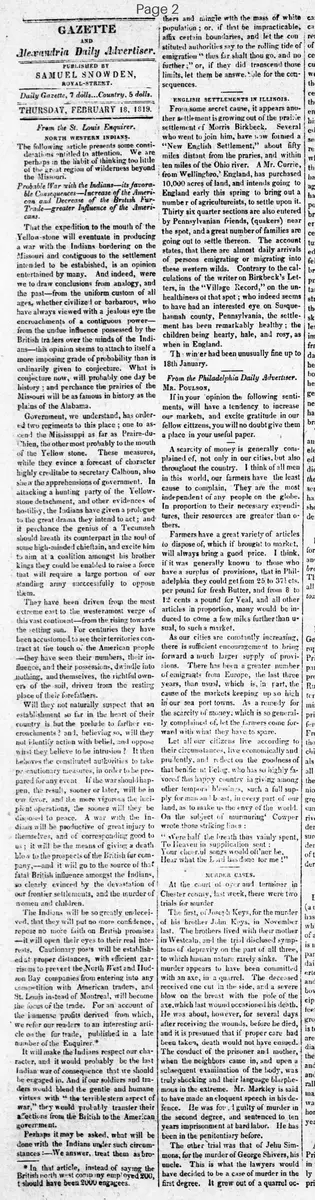
From the St. Louis Enquirer.
NORTH WESTERN INDIANS.
The following article presents some considerations entitled to attention. We are perhaps in the habit of thinking too little of the great region of wilderness beyond the Missouri.
Probable War with the Indians—its favorable Consequences—Increase of the American and Decrease of the British Fur-Trade—greater Influence of the Americans.
That the expedition to the mouth of the Yellow-stone will eventuate in producing a war with the Indians bordering on the Missouri and contiguous to the settlement intended to be established, is an opinion entertained by many. And indeed, were we to draw conclusions from analogy, and the past—from the uniform custom of all ages, whether civilized or barbarous, who have always viewed with a jealous eye the encroachments of a contiguous power—from the undue influence possessed by the British traders over the minds of the Indians—this opinion seems to attach to itself a more imposing grade of probability than is ordinarily given to conjecture. What is conjecture now, will probably one day be history: and perchance the prairies of the Missouri will be as famous in history as the plains of the Alabama.
Government, we understand, has ordered two regiments to this place; one to ascend the Mississippi as far as Prairie-du-Chien, the other most probably to the mouth of the Yellow Stone. These measures, while they evince a forecast of character highly creditable to Secretary Calhoun, also shew the apprehensions of government. In attacking a hunting party of the Yellow-stone detachment, and other evidences of hostility, the Indians have given a prologue to the great drama they intend to act; and if perchance the genius of a Tecumseh should breathe its counterpart in the soul of some high-minded chieftain, and excite him to aim at a coalition amongst his brother kings, they could be enabled to raise a force that will require a large portion of our standing army successfully to oppose them.
They have been driven from the most extreme east to the westernmost verge of this vast continent—from the rising towards the setting sun. For centuries they have been accustomed to see their territories contract at the touch of the American people—they have seen their numbers, their influence, and their possessions, dwindle into nothing, and themselves, the rightful owners of the soil, driven from the resting place of their forefathers.
Will they not naturally suspect that an establishment so far in the heart of their country is but the prelude to farther encroachments? and, believing so, will they not identify action with belief, and oppose what they believe to be intrusion? It then behoves the constituted authorities to take precautionary measures, in order to be prepared for any event. If the war should happen, the result, sooner or later, will be in our favor, and the more vigorous the incipient operations, the sooner will they be disposed to peace. A war with the Indians will be productive of great injury to themselves, and of corresponding good to us; it will be the means of giving a death blow to the prospects of the British fur company,—and it will go to the source of that fatal British influence amongst the Indians, so clearly evinced by the devastation of our frontier settlements, and the murder of women and children.
The Indians will be so greatly undecerved, that they will put no more confidence, repose no more faith on British promises—it will open their eyes to their real interests. Cautionary posts will be established at proper distances, with efficient garrisons to prevent the North West and Hudson Bay companies from entering into any competition with American traders, and St. Louis instead of Montreal, will become the focus of the trade. For an account of the immense profits derived from which, we refer our readers to an interesting article on the fur trade, published in a late number of the Enquirer.*
It will make the Indians respect our character, and it would probably be the last Indian war of consequence that we should be engaged in. And if our soldiers and traders would blend the gentle and humane virtues with 'the terrible stern aspect of war,' they would probably transfer their affections from the British to the American government.
Perhaps it may be asked, what will be done with the Indians under such circumstances:—We answer, treat them as brothers and mingle with the mass of white population; or, if that be impracticable, affix certain boundaries, and let the constituted authorities say to the rolling tide of emigration 'thus far shalt thou go, and no further;' or, if they did transcend those limits, let them be answerable for the consequences.
* In that article, instead of saying the British north west company employed 200, it should have been 2000 engagees.
What sub-type of article is it?
Indian Affairs
Military Affairs
Trade Or Commerce
What keywords are associated?
Northwestern Indians
Yellowstone Expedition
Missouri River
British Fur Trade
Indian War
American Expansion
What entities or persons were involved?
Secretary Calhoun
British Fur Companies
North West Company
Hudson Bay Company
Tecumseh
Missouri River Indians
Editorial Details
Primary Topic
Probable War With Northwestern Indians And Its Consequences
Stance / Tone
Expansionist, Pragmatic, Sympathetic To Eventual Indian Assimilation
Key Figures
Secretary Calhoun
British Fur Companies
North West Company
Hudson Bay Company
Tecumseh
Missouri River Indians
Key Arguments
- The Yellowstone expedition will probably provoke an Indian war
- War would ultimately favor American expansion and give a death blow to British fur trade
- Cautionary posts and garrisons should be established
- Indians should be treated as brothers and assimilated, or assigned fixed boundaries