Thank you for visiting SNEWPapers!
Sign up free
The Virginia Gazette Foreign News November 12, 1736
Richmond, Richmond, Virginia
What is this article about?
A letter from Edinburgh reports the criminal trial of Capt. Porteous, commander of the City Guard, for firing on a crowd at Andrew Wilson's execution, killing and wounding many; his defense claims he acted under orders to repel force by force and that the soldiers fired without his command.
Quality green show the numbers
Measured from the scan
— how cleanly the OCR engine read the characters
- Mean ink quality
- 99.0% The length-weighted average confidence across the OCR lines — the mean of exactly the per-line scores whose tails the two figures below report. Typical is 99%.
- Illegible ink
- 0.0% Text sitting in OCR-detected lines that scored below 80% confidence — very shaky reads. Weighted by line length, so one long bad line counts for more than a short one.
- Uncertain ink
- 0.0% Text in lines that scored 80–90% — somewhat shaky reads.
- Matches source
- 97.33% How closely the served text matches the raw OCR of the same boxes, letter by letter, after collapsing spacing and case. This measures agreement, not correctness: the OCR is often wrong and the extractor corrects it, so 100% does not mean perfect, and a low figure usually means poor scan text was rewritten rather than that text was lost (length vs source shows loss).
- Length vs source
- 99.48% Below 100% means text was dropped from the OCR; above means text was added to make it read.
Assembled by the extraction model
— whether the stitched-together text holds up; catches layout and segmentation errors, which the scores above cannot see
- Transcription confidence
- 96.0% (typical 96%) How cleanly the extractor could assemble what it was given. Low here with clean ink scores points at layout analysis — the characters were read correctly but grouped or ordered wrongly.
- Comprehension
- 90.0% Whether the piece reads coherently start to finish. Can stay high while transcription confidence drops, when only part of the component is affected.
Clipping
Full Text
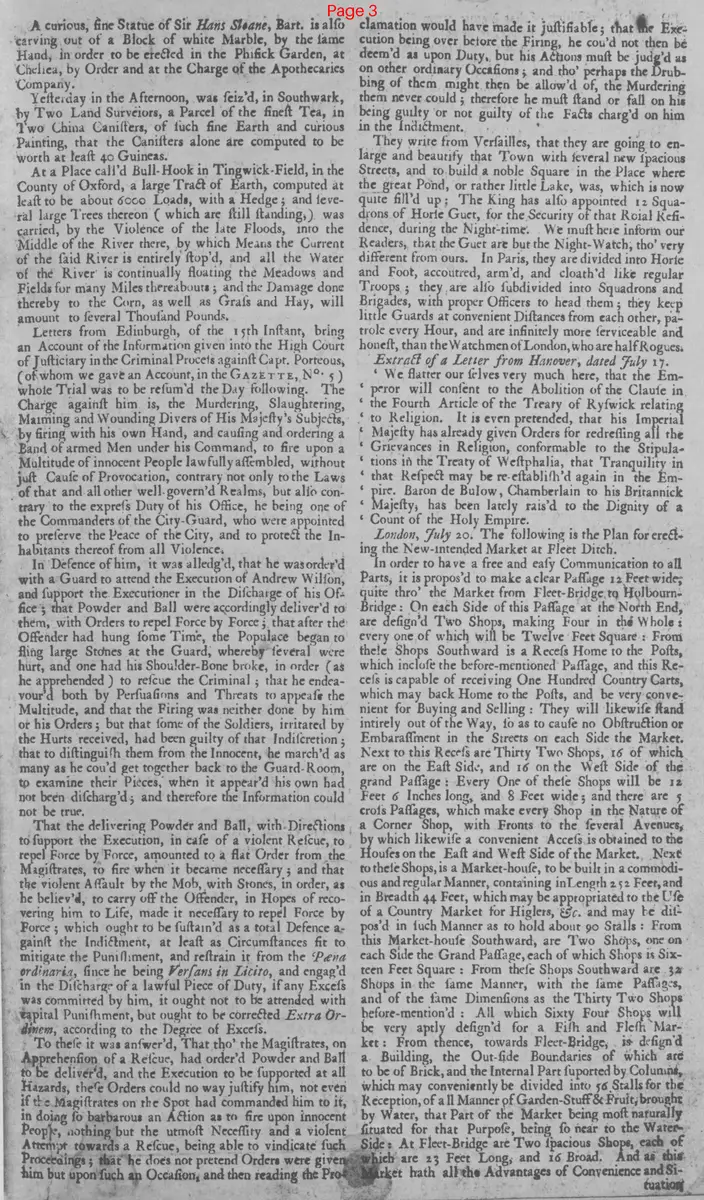
Letters from Edinburgh, of the 15th Instant, bring an Account of the Information given into the High Court of Justiciary in the Criminal Process against Capt. Porteous, (of whom we gave an Account, in the Gazette, No. 5) whose Trial was to be resumed the Day following. The Charge against him is, the Murdering, Slaughtering, Maiming and Wounding Divers of His Majesty's Subjects, by firing with his own Hand, and causing and ordering a Band of armed Men under his Command, to fire upon a Multitude of innocent People lawfully assembled, without just Cause of Provocation, contrary not only to the Laws of that and all other well govern'd Realms, but also contrary to the express Duty of his Office, he being one of the Commanders of the City-Guard, who were appointed to preserve the Peace of the City, and to protect the Inhabitants thereof from all Violence.
In Defence of him, it was alledg'd, that he was order'd with a Guard to attend the Execution of Andrew Wilson, and support the Executioner in the Discharge of his Office; that Powder and Ball were accordingly deliver'd to them, with Orders to repel Force by Force; that after the Offender had hung some Time, the Populace began to fling large Stones at the Guard, whereby several were hurt, and one had his Shoulder-Bone broke, in order (as he apprehended) to rescue the Criminal; that he endeavour'd both by Persuasions and Threats to appease the Multitude, and that the Firing was neither done by him or his Orders; but that some of the Soldiers, irritated by the Hurts received, had been guilty of that Indiscretion; that to distinguish them from the Innocent, he march'd as many as he cou'd get together back to the Guard-Room, to examine their Pieces, when it appear'd his own had not been discharg'd; and therefore the Information could not be true.
That the delivering Powder and Ball, with Directions to support the Execution, in case of a violent Rescue, to repel Force by Force, amounted to a flat Order from the Magistrates, to fire when it became necessary; and that the violent Assault by the Mob, with Stones, in order, as he believ'd, to carry off the Offender, in Hopes of recovering him to Life, made it necessary to repel Force by Force; which ought to be sustain'd as a total Defence against the Indictment, at least as Circumstances fit to mitigate the Punishment, and restrain it from the Pena ordinaria, since he being Versans in Licito, and engag'd in the Discharge of a lawful Piece of Duty, if any Excess was committed by him, it ought not to be attended with capital Punishment, but ought to be corrected Extra Ordinem, according to the Degree of Excess.
To these it was answer'd, That tho' the Magistrates, on Apprehension of a Rescue, had order'd Powder and Ball to be deliver'd, and the Execution to be supported at all Hazards, these Orders could no way justify him, not even if the Magistrates on the Spot had commanded him to it, in doing so barbarous an Action as to fire upon innocent People, nothing but the utmost Necessity and a violent Attempt towards a Rescue, being able to vindicate such Proceedings; that he does not pretend Orders were given him but upon such an Occasion, and then reading the Proclamation would have made it justifiable; that the Execution being over before the Firing, he cou'd not then be deem'd as upon Duty, but his Actions must be judg'd as on other ordinary Occasions; and tho' perhaps the Drubbing of them might then be allow'd of, the Murdering them never could; therefore he must stand or fall on his being guilty or not guilty of the Facts charg'd on him in the Indictment.
What sub-type of article is it?
Crime
What keywords are associated?
Captain Porteous Trial
Edinburgh City Guard
Riot Shooting
Andrew Wilson Execution
Criminal Trial
What entities or persons were involved?
Captain Porteous
Andrew Wilson
Where did it happen?
Edinburgh
Foreign News Details
Primary Location
Edinburgh
Event Date
The 15th Instant
Key Persons
Captain Porteous
Andrew Wilson
Outcome
charge of murdering, slaughtering, maiming and wounding divers of his majesty's subjects by firing on a lawful assembly; trial to be resumed the following day.