Thanks for visiting SNEWPapers!
Sign up free today to connect your AI tools to the Library of Congress' newspaper collection.
Gazette Of The United States Literary September 11, 1790
New York, New York, New York
What is this article about?
A character sketch of Benjamin Franklin tracing his rise from journeyman printer to celebrated scientist and American statesman, his electrical research, his efforts to prevent the breach between England and America, and the honors paid after his death.
Quality green show the numbers
Measured from the scan
— how cleanly the OCR engine read the characters
- Mean ink quality
- 99.0% The length-weighted average confidence across the OCR lines — the mean of exactly the per-line scores whose tails the two figures below report. Typical is 99%.
- Illegible ink
- 0.0% Text sitting in OCR-detected lines that scored below 80% confidence — very shaky reads. Weighted by line length, so one long bad line counts for more than a short one.
- Uncertain ink
- 0.0% Text in lines that scored 80–90% — somewhat shaky reads.
- Matches source
- 96.14% How closely the served text matches the raw OCR of the same boxes, letter by letter, after collapsing spacing and case. This measures agreement, not correctness: the OCR is often wrong and the extractor corrects it, so 100% does not mean perfect, and a low figure usually means poor scan text was rewritten rather than that text was lost (length vs source shows loss).
- Length vs source
- 99.04% Below 100% means text was dropped from the OCR; above means text was added to make it read.
Assembled by the extraction model
— whether the stitched-together text holds up; catches layout and segmentation errors, which the scores above cannot see
- Transcription confidence
- 95.0% (typical 96%) How cleanly the extractor could assemble what it was given. Low here with clean ink scores points at layout analysis — the characters were read correctly but grouped or ordered wrongly.
- Comprehension
- 92.0% Whether the piece reads coherently start to finish. Can stay high while transcription confidence drops, when only part of the component is affected.
Clipping
Full Text
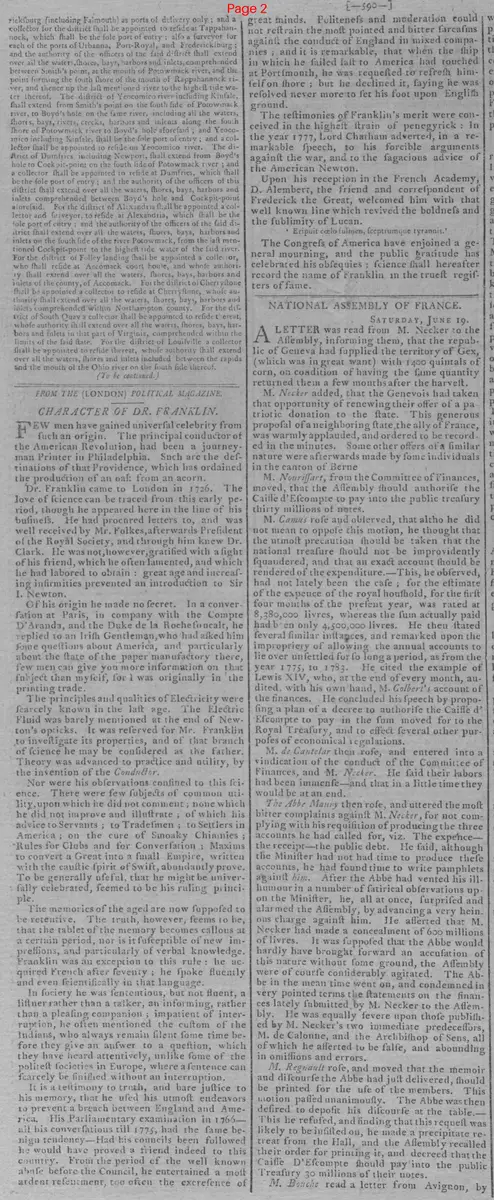
FROM THE (LONDON) POLITICAL MAGAZINE.
CHARACTER OF DR. FRANKLIN.
FEW men have gained universal celebrity from such an origin. The principal conductor of the American Revolution, had been a journeyman printer in Philadelphia. Such are the destinies of that Providence, which has ordained the production of an oak from an acorn.
Dr. Franklin came to London in 1726. The love of science can be traced from this early period, though he appeared here in the line of his business. He had procured letters to, and was well received by Mr. Folkes, afterwards President of the Royal Society, and through him knew Dr. Clark. He was not, however, gratified with a sight of his friend, which he often lamented, and which he had labored to obtain: great age and increasing infirmities prevented an introduction to Sir I. Newton.
Of his origin he made no secret. In a conversation at Paris, in company with the Comte D'Aranda, and the Duke de la Rochefoucauld, he replied to an Irish gentleman, who had asked him some questions about America, and particularly about the state of the paper manufactory there, few men can give you more information on that subject than myself, for I was originally in the printing trade.
The principles and qualities of electricity were scarcely known in the last age. The electric fluid was barely mentioned at the end of Newton's Opticks. It was reserved for Mr. Franklin to investigate its properties, and of that branch of science he may be considered as the father. Theory was advanced to practice and utility, by the invention of the Conductor.
Nor were his observations confined to this science. There were few subjects of common utility, upon which he did not comment; none which he did not improve and illustrate; of which his advice to Servants; to Tradesmen; to Settlers in America; on the cure of Smoky Chimneys; Rules for Clubs and for Conversation; Maxims to convert a Great into a small Empire, written with the caustic spirit of Swift, abundantly prove. To be generally useful, that he might be universally celebrated, seemed to be his ruling principle.
The memories of the aged are now supposed to be retentive. The truth, however, seems to be, that the tablet of the memory becomes callous at a certain period, nor is it susceptible of new impressions, and particularly of verbal knowledge. Franklin was an exception to this rule: he acquired French after seventy; he spoke fluently and even scientifically in that language.
In society he was sententious, but not fluent, a listener rather than a talker, an informing, rather than a pleasing companion; impatient of interruption, he often mentioned the custom of the Indians, who always remain silent some time before they give an answer to a question, which they have heard attentively, unlike some of the politest societies in Europe, where a sentence can scarcely be finished without an interruption.
It is a testimony to truth, and bare justice to his memory, that he used his utmost endeavors to prevent a breach between England and America. His Parliamentary examination in 1766; all his conversations till 1775, had the same benign tendency. Had his councils been followed he would have proved a friend indeed to this country. From the period of the well known abuse before the Council, he entertained a most ardent resentment, too often the excrescence of great minds. Politeness and moderation could not restrain the most pointed and bitter sarcasms against the conduct of England in mixed companies; and it is remarkable, that when the ship in which he sailed last to America had touched at Portsmouth, he was requested to refresh himself on shore; but he declined it, saying he was resolved never more to set his foot upon English ground.
The testimonies of Franklin's merit were conceived in the highest strain of panegyric: In the year 1777, Lord Chatham adverted, in a remarkable speech, to his forcible arguments against the war, and to the sagacious advice of the American Newton.
Upon his reception in the French Academy, D'Alembert, the friend and correspondent of Frederick the Great, welcomed him with that well known line which revived the boldness and the sublimity of Lucan.
Eripuit cælo fulmen, sceptrumque tyrannis.
The Congress of America have enjoined a general mourning, and the public gratitude has celebrated his obsequies; science shall hereafter record the name of Franklin in the truest registers of fame.
What sub-type of article is it?
Essay
What keywords are associated?
Benjamin Franklin
Character Sketch
Electricity
American Revolution
Science
Literary Details
Title
Character Of Dr. Franklin
Subject
Character Sketch Of Benjamin Franklin
Form / Style
Biographical Essay Reprinted From A Political Magazine
Key Lines
Few Men Have Gained Universal Celebrity From Such An Origin.
Eripuit Cælo Fulmen, Sceptrumque Tyrannis.