Thanks for visiting SNEWPapers!
Sign up free today to connect your AI tools to the Library of Congress' newspaper collection.
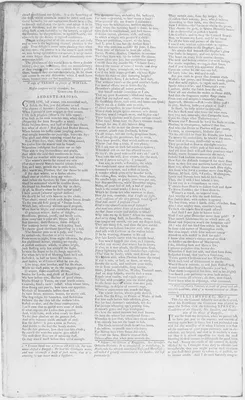
The Virginia Gazette Poem March 4, 1773
Williamsburg, Virginia
Cautionary note: racial slurs ('woolpated slaves', 'Mulatto') and mild sexual innuendo
What is this article about?
A long satirical verse epistle praising winter and condemning summer, addressed to a comrade, blending classical allusions, humorous arguments, and contemporary references.
Quality green show the numbers
Measured from the scan
— how cleanly the OCR engine read the characters
- Mean ink quality
- 99.0% The length-weighted average confidence across the OCR lines — the mean of exactly the per-line scores whose tails the two figures below report. Typical is 99%.
- Illegible ink
- 0.2% Text sitting in OCR-detected lines that scored below 80% confidence — very shaky reads. Weighted by line length, so one long bad line counts for more than a short one.
- Uncertain ink
- 0.0% Text in lines that scored 80–90% — somewhat shaky reads.
- Matches source
- 96.1% How closely the served text matches the raw OCR of the same boxes, letter by letter, after collapsing spacing and case. This measures agreement, not correctness: the OCR is often wrong and the extractor corrects it, so 100% does not mean perfect, and a low figure usually means poor scan text was rewritten rather than that text was lost (length vs source shows loss).
- Length vs source
- 100.25% Below 100% means text was dropped from the OCR; above means text was added to make it read.
Assembled by the extraction model
— whether the stitched-together text holds up; catches layout and segmentation errors, which the scores above cannot see
- Transcription confidence
- 96.0% (typical 96%) How cleanly the extractor could assemble what it was given. Low here with clean ink scores points at layout analysis — the characters were read correctly but grouped or ordered wrongly.
- Comprehension
- 92.0% Whether the piece reads coherently start to finish. Can stay high while transcription confidence drops, when only part of the component is affected.
Clipping
Full Text
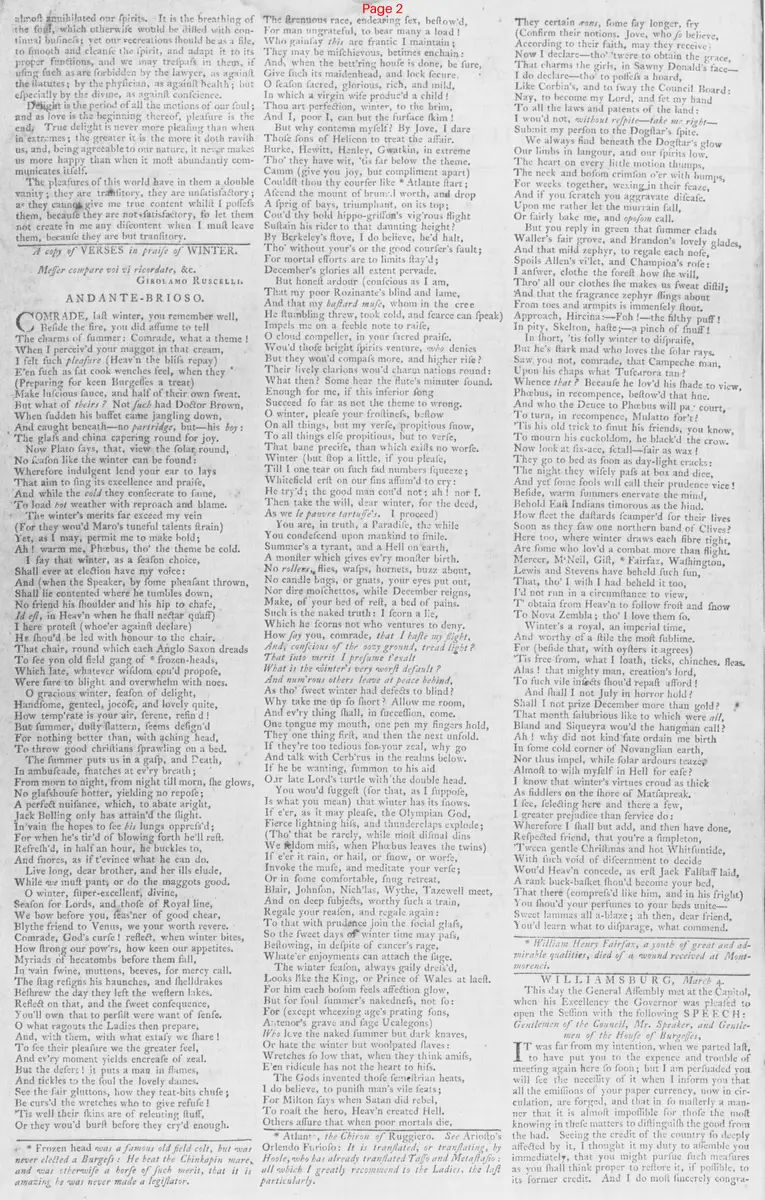
A copy of VERSES in praise of WINTER.
Messer compare, voi vi ricordate, &c.
GIROLAMO RUSCELLI.
ANDANTE-BRIOSO.
COMRADE, last winter, you remember well,
Beside the fire, you did assume to tell
The charms of summer: Comrade, what a theme!
When I perceived your maggot in that cream,
I felt such pleasure (Heav'n the bliss repay)
E'en such as fat cook wenches feel, when they
(Preparing for keen Burgesses a treat)
Make luscious sauce, and half of their own sweat.
But what of theirs? Not such had Doctor Brown,
When sudden his buffet came jangling down,
And caught beneath—no partridge, but—his boy:
The glass and china capering round for joy.
Now Plato says, that, view the solar round,
No season like the winter can be found:
Wherefore indulgent lend your ear to lays
That aim to sing its excellence and praise,
And while the cold they consecrate to fame,
To load hot weather with reproach and blame.
The winter's merits far exceed my vein
(For they would Maro's tuneful talents strain)
Yet, as I may, permit me to make bold;
Ah! warm me, Phœbus, tho' the theme be cold.
I say that winter, as a season choice,
Shall ever at election have my voice:
And (when the Speaker, by some pheasant thrown,
Shall lie contented where he tumbles down,
No friend his shoulder and his hip to chase,
Id est, in Heav'n when he shall nectar quaff)
I here protest (whoe'er against declare)
He should be led with honour to the chair.
That chair, round which each Anglo Saxon dreads
To see yon old field gang of * frozen-heads,
Which late, whatever wisdom could propose,
Were sure to blight and overwhelm with noes.
O gracious winter, season of delight,
Handsome, genteel, jocose, and lovely quite,
How temp'rate is your air, serene, refined!
But summer, dusty slattern, seems designed
For nothing better than, with aching head,
To throw good Christians sprawling on a bed.
The summer puts us in a gasp, and Death,
In ambuscade, snatches at ev'ry breath;
From morn to night, from night till morn, she glows,
No glasshouse hotter, yielding no repose;
A perfect nuisance, which, to abate aright,
Jack Bolling only has attained the flight.
In vain she hopes to see his lungs oppressed;
For when he's tired of blowing forth he'll rest
Refreshed, in half an hour, he buckles to,
And snores, as if t'evince what he can do.
Live long, dear brother, and her ills elude,
While we must pant, or do the maggots good.
O winter, super-excellent, divine,
Season for Lords, and those of Royal line,
We bow before you, seasoner of good cheer,
Blythe friend to Venus, we your worth revere.
Comrade, God's curse! reflect, when winter bites,
How strong our pow'rs, how keen our appetites.
Myriads of hecatombs before them fall,
In vain swine, muttons, beeves, for mercy call.
The stag resigns his haunches, and shelldrakes
Beshrew the day they left the western lakes.
Reflect on that, and the sweet consequence,
You'll own that to persist were want of sense.
O what ragouts the Ladies then prepare,
And, with them, with what ecstasy we share!
To see their pleasure we the greater feel,
And ev'ry moment yields increase of zeal.
But the dessert! it puts a man in flames,
And tickles to the soul the lovely dames.
See the fair gluttons, how they tit-bits choose;
Be cursed the wretches who to give refuse!
'Tis well their skins are of relenting stuff,
Or they would burst before they cried enough.
The strenuous race, endearing sex, bestowed,
For man ungrateful, to bear many a load!
Who gainsay this are frantic I maintain;
They may be mischievous, betimes enchain:
And, when the bett'ring house is done, be sure,
Give such its maidenhead, and lock secure.
O season sacred, glorious, rich, and mild,
In which a virgin wife produced a child!
Thou art perfection, winter, to the brim,
And I, poor I, can but the surface skim!
But why contemn myself? By Jove, I dare
Those sons of Helicon to treat the affair.
Burke, Hewitt, Henley, Gwatkin, in extreme
Though they have wit, 'tis far below the theme.
Camm (give you joy, but compliment apart)
Couldst thou thy courser like * Atlante start;
Ascend the mount of brumal worth, and drop
A sprig of bays, triumphant, on its top;
Could thy bold hippo-griffon's vig'rous flight
Sustain his rider to that daunting height?
By Berkeley's stove, I do believe, he'd halt,
Though without your's or the good courser's fault;
For mortal efforts are to limits stayed;
December's glories all extent pervade.
But honest ardour (conscious as I am,
That my poor Rozinante's blind and lame,
And that my bastard muse, whom in the cree
He stumbling threw, took cold, and scarce can speak)
Impels me on a feeble note to raise,
O cloud compeller, in your sacred praise.
Would those bright spirits venture, who denies
But they would compass more, and higher rise?
Their lively clarions would charm nations round:
What then? Some hear the flute's minuter sound.
Enough for me, if this inferior song
Succeed so far as not the theme to wrong.
O winter, please your frostiness, bestow
On all things, but my verse, propitious snow,
To all things else propitious, but to verse,
That bane precise, than which exists no worse.
Winter (but stop a little, if you please,
Till I one tear on such sad numbers squeeze;
Whitefield erst on our sins assumed to cry:
He tried; the good man could not; ah! nor I.
Then take the will, dear winter, for the deed,
As we le pauvre Tartuffe's. I proceed)
You are, in truth, a Paradise, the while
You condescend upon mankind to smile.
Summer's a tyrant, and a Hell on earth,
A monster which gives ev'ry monster birth.
No rollers, flies, wasps, hornets, buzz about,
No candle bugs, or gnats, your eyes put out,
Nor dire moschettos, while December reigns,
Make, of your bed of rest, a bed of pains.
Such is the naked truth: I scorn a lie,
Which he scorns not who ventures to deny.
How say you, comrade, that I haste my flight,
And, conscious of the oozy ground, tread light?
That into merit I presume t'exalt
What is the Winter's very worst default?
And num'rous others leave at peace behind,
As though sweet winter had defects to blind?
Why take me up so short? Allow me room,
And ev'ry thing shall, in succession, come.
One tongue my mouth, one pen my fingers hold.
They one thing first, and then the next unfold.
If they're too tedious for your zeal, why go
And talk with Cerberus in the realms below.
If he be wanting, summon to his aid
Or late Lord's turtle with the double head.
You would suggest (for that, as I suppose,
Is what you mean) that winter has its snows.
If e'er, as it may please, the Olympian God,
Fierce lightning hiss, and thunderclaps explode;
(Though that be rarely, while most dismal dins
We seldom miss, when Phœbus leaves the twins)
If e'er it rain, or hail, or snow, or worse,
Invoke the muse, and meditate your verse;
Or in some comfortable, snug retreat,
Blair, Johnson, Nich'las, Wythe, Tazewell meet,
And on deep subjects, worthy such a train,
Regale your reason, and regale again:
To that with prudence join the social glass,
So the sweet days of winter time may pass,
Bestowing, in despite of cancer's rage,
Whate'er enjoyments can attach the sage.
The winter season, always gaily dressed,
Looks like the King, or Prince of Wales at least.
For him each bosom feels affection glow,
But for foul summer's nakedness, not so:
For (except wheezing age's prating sons,
Antenor's grave and sage Ucalegons)
Who love the naked summer but dark knaves,
Or hate the winter but woolpated slaves:
Wretches so low that, when they think amiss,
E'en ridicule has not the heart to hiss.
The Gods invented those semestrian heats,
I do believe, to punish man's vile feats;
For Milton says when Satan did rebel,
To roast the hero, Heav'n created Hell.
Others assure that when poor mortals die,
They certain sins, some say longer, fry
(Confirm their notions, Jove, who so believe,
According to their faith, may they receive)
Now I declare—though 'twere to obtain the grace,
That charms the girls, in Sawny Donald's face—
I do declare—though to possess a hoard,
Like Corbin's, and to sway the Council Board:
Nay, to become my Lord, and set my hand
To all the laws and patents of the land:
I would not, without respite—take me right—
Submit my person to the Dogstar's spite.
We always find beneath the Dogstar's glow
Our limbs in languor, and our spirits low.
The heart on every little motion thumps,
The neck and bosom crimson o'er with bumps,
For weeks together, waxing in their fever,
And if you scratch you aggravate disease.
Upon me rather let the murrain fall,
Or fairly bake me, and opossum call.
But you reply in green that summer clads
Waller's fair grove, and Brandon's lovely glades,
And that mild zephyr, to regale each nose,
Spoils Allen's violet, and Champion's rose:
I answer, clothe the forest how she will,
Through all our clothes she makes us sweat distil;
And that the fragrance zephyr flings about
From toes and armpits is immensely stout.
Approach, Hircina:—Foh!—the filthy puff!
In pity, Skelton, haste;—a pinch of snuff!
In short, 'tis folly winter to dispraise,
But he's stark mad who loves the solar rays.
Saw you not, comrade, that Campeche man,
Upon his chaps what Tuscarora tan?
Whence that? Because he loved his shade to view,
Phœbus, in recompense, bestowed that hue.
And who the Deuce to Phœbus will pay court,
To turn, in recompense, Mulatto for't?
'Tis his old trick to smut his friends, you know,
To mourn his cuckoldom, he blacked the crow.
Now look at six-ace, set all—fair as wax!
They go to bed as soon as day-light cracks:
The night they wisely pass at box and dice,
And yet some fools will call their prudence vice!
Besides, warm summers enervate the mind,
Behold East Indians timorous as the hind.
How fleet the dastards scampered for their lives
Soon as they saw one northern band of Clives?
Here too, where winter draws each fibre tight,
Are some who loved a combat more than flight.
Mercer, McNeil, Gift, * Fairfax, Washington,
Lewis and Stevens have beheld such fun,
That, though I wish I had beheld it too,
I'd not run in a circumstance to view,
T' obtain from Heav'n to follow frost and snow
To Nova Zembla; though I love them so.
Winter's a royal, an imperial time,
And worthy of a style the most sublime.
For (beside that, with oysters it agrees)
'Tis free from, what I loath, ticks, chinches, fleas.
Alas! that mighty man, creation's lord,
To such vile insects should repast afford!
And shall I not July in horror hold?
Shall I not prize December more than gold?
That month salubrious like to which were all,
Bland and Siqueyra would the hangman call?
Ah! why did not kind fate ordain me birth
In some cold corner of Novanglian earth,
Nor thus impel, while solar ardours tease,
Almost to wish myself in Hell for ease?
I know that winter's virtues crowd as thick
As fiddlers on the shore of Matsapreak.
I see, selecting here and there a few,
I greater prejudice than service do:
Wherefore I shall but add, and then have done,
Respected friend, that you're a simpleton,
'Tween gentle Christmas and hot Whitsuntide,
With such void of discernment to decide
Would Heav'n concede, as erst Jack Falstaff said,
A rank buck-basket should become your bed,
That there (compressed like him, and in his fright)
You should your perfumes to your beds unite—
Sweet Lammas all a-blaze; ah then, dear friend,
You'd learn what to disparage, what commend.
* Frozen head was a famous old field colt, but was never elected a Burgess: He beat the Chinkapin mare, and was otherwise a horse of such merit, that it is amazing he was never made a legislator.
* Atlante, the Chiron of Ruggiero. See Ariosto's Orlando Furioso: It is translated, or translating, by Hoole, who has already translated Tasso and Metastasio; all which I greatly recommend to the Ladies, the last particularly.
* William Henry Fairfax, a youth of great and admirable qualities, died of a wound received at Montmorenci.
What sub-type of article is it?
Satire
Light Verse
Verse Letter
What themes does it touch?
Nature Seasons
Satire Society
What keywords are associated?
Verses In Praise Of Winter
Satire On Summer
Seasonal Humor
Heroic Couplets
Winter Vs Summer
Girolamo Ruscelli
What entities or persons were involved?
Girolamo Ruscelli.
Poem Details
Title
A Copy Of Verses In Praise Of Winter.
Author
Girolamo Ruscelli.
Subject
A Mock Heroic Verse Epistle Defending Winter And Disparaging Summer.
Form / Style
Rhymed Heroic Couplets In Iambic Pentameter
Key Lines
Comrade, Last Winter, You Remember Well, / Beside The Fire, You Did Assume To Tell / The Charms Of Summer: Comrade, What A Theme!
O Winter, Super Excellent, Divine, / Season For Lords, And Those Of Royal Line
Winter's A Royal, An Imperial Time, / And Worthy Of A Style The Most Sublime.