Thank you for visiting SNEWPapers!
Sign up free
The New Hampshire Gazette Letter to Editor October 30, 1761
Portsmouth, Rockingham, New Hampshire
What is this article about?
An open letter to New Hampshire voters urges them to choose wise, honest representatives, and warns against electing men who buy votes, have weak understanding, are timid, neglect attendance, or live immoral lives.
Quality green show the numbers
Measured from the scan
— how cleanly the OCR engine read the characters
- Mean ink quality
- 99.0% The length-weighted average confidence across the OCR lines — the mean of exactly the per-line scores whose tails the two figures below report. Typical is 99%.
- Illegible ink
- 0.0% Text sitting in OCR-detected lines that scored below 80% confidence — very shaky reads. Weighted by line length, so one long bad line counts for more than a short one.
- Uncertain ink
- 0.0% Text in lines that scored 80–90% — somewhat shaky reads.
- Matches source
- 96.69% How closely the served text matches the raw OCR of the same boxes, letter by letter, after collapsing spacing and case. This measures agreement, not correctness: the OCR is often wrong and the extractor corrects it, so 100% does not mean perfect, and a low figure usually means poor scan text was rewritten rather than that text was lost (length vs source shows loss).
- Length vs source
- 99.79% Below 100% means text was dropped from the OCR; above means text was added to make it read.
Assembled by the extraction model
— whether the stitched-together text holds up; catches layout and segmentation errors, which the scores above cannot see
- Transcription confidence
- 97.0% (typical 96%) How cleanly the extractor could assemble what it was given. Low here with clean ink scores points at layout analysis — the characters were read correctly but grouped or ordered wrongly.
- Comprehension
- 95.0% Whether the piece reads coherently start to finish. Can stay high while transcription confidence drops, when only part of the component is affected.
Clipping
Full Text
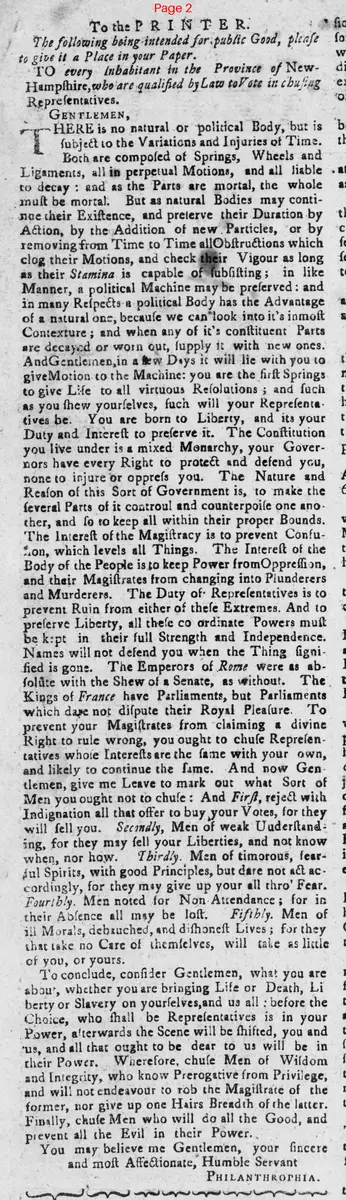
To the PRINTER.
The following being intended for public Good, please to give it a Place in your Paper.
TO every Inhabitant in the Province of New Hampshire, who are qualified by Law to Vote in choosing Representatives.
GENTLEMEN,
HERE is no natural or political Body, but is subject to the Variations and Injuries of Time. Both are composed of Springs, Wheels and Ligaments, all in perpetual Motions, and all liable to decay: and as the Parts are mortal, the whole must be mortal. But as natural Bodies may continue their Existence, and preserve their Duration by Action, by the Addition of new Particles, or by removing from Time to Time all Obstructions which clog their Motions, and check their Vigour as long as their Stamina is capable of subsisting; in like Manner, a political Machine may be preserved: and in many Respects a political Body has the Advantage of a natural one, because we can look into it's inmost Contexture; and when any of it's constituent Parts are decayed or worn out, supply it with new ones. And Gentlemen, in a few Days it will lie with you to give Motion to the Machine: you are the first Springs to give Life to all virtuous Resolutions; and such as you shew yourselves, such will your Representatives be. You are born to Liberty, and its your Duty and Interest to preserve it. The Constitution you live under is a mixed Monarchy, your Governors have every Right to protect and defend you, none to injure or oppress you. The Nature and Reason of this Sort of Government is, to make the several Parts of it controul and counterpoise one another, and so to keep all within their proper Bounds. The Interest of the Magistracy is to prevent Confusion, which levels all Things. The Interest of the Body of the People is to keep Power from Oppression, and their Magistrates from changing into Plunderers and Murderers. The Duty of Representatives is to prevent Ruin from either of these Extremes. And to preserve Liberty, all these co ordinate Powers must be kept in their full Strength and Independence. Names will not defend you when the Thing signified is gone. The Emperors of Rome were as absolute with the Shew of a Senate, as without. The Kings of France have Parliaments, but Parliaments which dare not dispute their Royal Pleasure. To prevent your Magistrates from claiming a divine Right to rule wrong, you ought to choose Representatives whose Interests are the same with your own, and likely to continue the same. And now Gentlemen, give me Leave to mark out what Sort of Men you ought not to choose: And First, reject with Indignation all that offer to buy your Votes, for they will sell you. Secondly, Men of weak Understanding, for they may sell your Liberties, and not know when, nor how. Thirdly, Men of timorous, fearful Spirits, with good Principles, but dare not act accordingly, for they may give up your all thro' Fear. Fourthly, Men noted for Non-Attendance; for in their Absence all may be lost. Fifthly, Men of ill Morals, debauched, and dishonest Lives; for they that take no Care of themselves, will take as little of you, or yours.
To conclude, consider Gentlemen, what you are about, whether you are bringing Life or Death, Liberty or Slavery on yourselves, and us all: before the Choice, who shall be Representatives is in your Power, afterwards the Scene will be shifted, you and us, and all that ought to be dear to us will be in their Power. Wherefore, choose Men of Wisdom and Integrity, who know Prerogative from Privilege, and will not endeavour to rob the Magistrate of the former, nor give up one Hair's Breadth of the latter. Finally, choose Men who will do all the Good, and prevent all the Evil in their Power.
You may believe me Gentlemen, your sincere and most Affectionate, Humble Servant
PHILANTHROPIA.
What sub-type of article is it?
Persuasive
Political
Open Letter
What themes does it touch?
Politics
Constitutional Rights
What keywords are associated?
New Hampshire Election
Choosing Representatives
Voter Advice
Political Integrity
Preserving Liberty
Open Letter
What entities or persons were involved?
The Inhabitants Of New Hampshire Qualified To Vote
Philanthropia
Letter to Editor Details
Author
Philanthropia
Recipient
The Inhabitants Of New Hampshire Qualified To Vote
Main Argument
Urges voters to choose representatives of wisdom and integrity who will preserve liberty, and lists five kinds of men to reject: vote-buyers, the weak-minded, the timid, non-attenders, and the immoral.
Notable Details
- compares political bodies to natural bodies subject to decay
- cites Roman emperors and French parliaments as warnings
- five categories of men not to choose
- 'choose Men of Wisdom and Integrity'