Thanks for visiting SNEWPapers!
Sign up free today to connect your AI tools to the Library of Congress' newspaper collection.
The Rhode Island American, And General Advertiser Literary June 4, 1819
Providence, Providence, Rhode Island
Possibly incomplete: this story may be missing part of its text, or continue from or into another issue.
What is this article about?
Section II of a treatise on agriculture, continued, analyzing the state of agriculture in Europe — especially Great Britain — with statistics on land use and causes of defective husbandry.
Quality yellow This piece continues elsewhere and does not read completely on its own. show the numbers
Measured from the scan
— how cleanly the OCR engine read the characters
- Mean ink quality
- 98.0% The length-weighted average confidence across the OCR lines — the mean of exactly the per-line scores whose tails the two figures below report. Typical is 99%.
- Illegible ink
- 0.0% Text sitting in OCR-detected lines that scored below 80% confidence — very shaky reads. Weighted by line length, so one long bad line counts for more than a short one.
- Uncertain ink
- 0.0% Text in lines that scored 80–90% — somewhat shaky reads.
- Matches source
- 98.63% How closely the served text matches the raw OCR of the same boxes, letter by letter, after collapsing spacing and case. This measures agreement, not correctness: the OCR is often wrong and the extractor corrects it, so 100% does not mean perfect, and a low figure usually means poor scan text was rewritten rather than that text was lost (length vs source shows loss).
- Length vs source
- 98.65% Below 100% means text was dropped from the OCR; above means text was added to make it read.
Assembled by the extraction model
— whether the stitched-together text holds up; catches layout and segmentation errors, which the scores above cannot see
- Transcription confidence
- 93.0% (typical 96%) How cleanly the extractor could assemble what it was given. Low here with clean ink scores points at layout analysis — the characters were read correctly but grouped or ordered wrongly.
- Comprehension
- 85.0% Whether the piece reads coherently start to finish. Can stay high while transcription confidence drops, when only part of the component is affected.
Clipping
Full Text
FROM THE ALBANY ARGUS.
TREATISE ON AGRICULTURE.
SECTION II.
On the actual state of Agriculture in Europe.
[CONTINUED.]
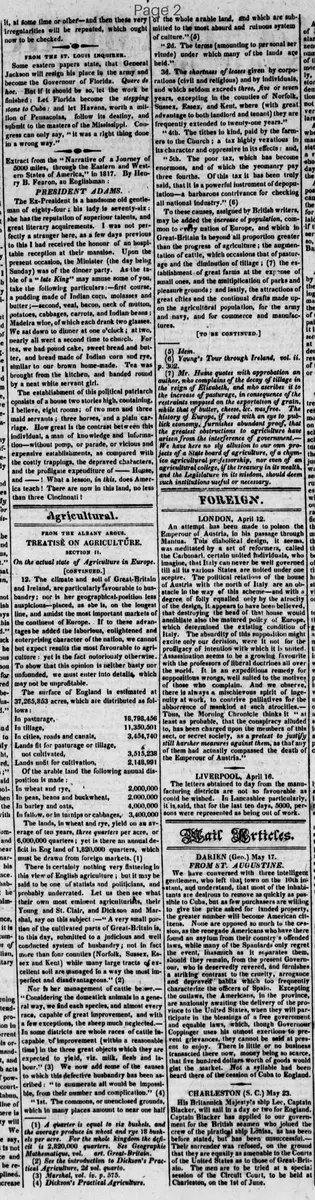
12. The climate and soil of Great-Britain and Ireland, are particularly favourable to husbandry; nor is her geographical-position less auspicious—placed, as she is, on the longest line, and amidst the most important markets of the continent of Europe. If to these advantages be added the laborious, enlightened and enterprising character of the nation, we cannot but expect results the most favourable to agriculture: yet is the fact notoriously otherwise. To show that this opinion is neither hasty nor unfounded, we must enter into details which may not be unprofitable.
The surface of England is estimated at 37,265,853 acres, which are distributed as follows:
In pasturage, 18,798,456
In tillage, 11,350,501
In cities, roads and canals, 3,454,740
Lands fit for pasturage or tillage, not cultivated, 3,515,238
Lands unfit for cultivation, 2,148,991
Of the arable land the following annual disposition is made:
In wheat and rye, 2,000,000
In peas, beans and buckwheat, 2,000,000
In barley and oats, 4,000,000
In fallow, or in turnips or cabbages, 3,400,000
The lands, in wheat and rye, yield on an average of ten years, three quarters per acre, or 6,000,000 quarters; yet is there an annual deficit in England of 1,820,000 quarters, which must be drawn from foreign markets. (1)
There is certainly nothing very flattering in this view of English agriculture; but it may be said to be one of statists and politicians, and probably underrated. Let us then see what their own most eminent agriculturists, their Young and St. Clair, and Dickson and Marshall, say on this subject:—"A very small portion of the cultivated parts of Great-Britain is, to this day, submitted to a judicious and well conducted system of husbandry; not in fact more than four counties (Norfolk, Sussex, Essex and Kent) while many large tracts of excellent soil are managed in a way the most imperfect and disadvantageous."(2)
Nor is her management of cattle better.—"Considering the domestick animals in a general way, we find each species, and almost every race, capable of great improvement, and with a few exceptions, the sheep much neglected.—In some districts are whole races of cattle incapable of improvement (within a reasonable time) in the three great objects which they are expected to yield, viz. milk, flesh and labour."(3) We now add some of the causes to which this defective husbandry has been ascribed: "to enumerate all would be impossible, from their number and complication." (4)
"1st. The commons, or unenclosed grounds, which in many places amount to near one half of the whole arable land, and which are submitted to the most absurd and ruinous system of culture."(5)
"2d. The terms (amounting to personal servitude) under which many of the lands are held."
"3d. The shortness of leases given by corporations (civil and religious) and by individuals, and which seldom exceeds three, five or seven years, excepting in the counties of Norfolk Sussex, Essex, and Kent, where (with great advantage to both landlord and tenant) they are frequently extended to twenty-one years."
"4th. The tithes in kind, paid by the farmers to the Church; a tax highly vexatious in its character and oppressive in its effects: and,
"5th. The poor tax, which has become enormous, and of which the yeomanry pay three fourths. Of this tax it has been truly said, that it is a powerful instrument of depopulation—a barbarous contrivance for checking all national industry."(6)
To these causes, assigned by British writers may be added the increase of population, common to every nation of Europe, and which in Great-Britain is beyond all proportion greater than the progress of agriculture; the augmentation of cattle, which occasions that of pasturage and the diminution of tillage; (7) the establishment of great farms at the expense of small ones, and the multiplication of parks and pleasure grounds; and lastly, the attractions of great cities and the continual drafts made upon the agricultural population, for the army and navy, and for commerce and manufactures.
[TO BE CONTINUED.]
(1) A quarter is equal to six bushels, and the average produce in wheat and rye 18 bushels per acre. For the whole kingdom the deficit is 2,820,000 quarters. See Geographie Mathematique, vel. art. Great-Britain.
(2) See the introduction to Dickson's Practical Agriculture, 2d vol. quarto.
(3) Marshal, vol. iv. p. 575.
(4) Dickson's Practical Agriculture.
(5) Idem.
(6) Young's Tour through Ireland, vol. ii. p. 302.
(7) Mr. Hume quotes with approbation an author, who complains of the decay of tillage in the reign of Elisabeth, and who ascribes it to the increase of pasturage, in consequence of the restraints imposed on the exportation of grain, while that of butter, cheese, &c. was free. The history of Europe, if read with an eye to publick economy, furnishes abundant proof, that the greatest obstructions to agriculture have arisen from the interference of government.—We have here no sly allusion to our own projects of a State board of agriculture, of a chymico agricultural professorship, nor even of an agricultural college, if the treasury in its wealth, and the Legislature in its wisdom, should deem such institutions useful or necessary.
What sub-type of article is it?
Essay
Instructional
What themes does it touch?
Agriculture Rural
Political
What keywords are associated?
Agriculture
Great Britain
Husbandry
Land Statistics
Tillage
Literary Details
Title
Treatise On Agriculture
Subject
The Actual State Of Agriculture In Europe, With A Detailed Account Of English Land Distribution And The Causes Of Poor Husbandry
Form / Style
Didactic Treatise With Statistics And Footnotes
Key Lines
The Climate And Soil Of Great Britain And Ireland, Are Particularly Favourable To Husbandry
A Very Small Portion Of The Cultivated Parts Of Great Britain Is, To This Day, Submitted To A Judicious And Well Conducted System Of Husbandry