Thank you for visiting SNEWPapers!
Sign up free
The Virginia Gazette Literary October 21, 1737
Richmond, Richmond, Virginia
What is this article about?
A reflective essay on the power of custom, arguing that habit and education shape human opinions and manners, with examples of strange national customs and a concluding warning about early bias.
Quality green show the numbers
Measured from the scan
— how cleanly the OCR engine read the characters
- Mean ink quality
- 99.0% The length-weighted average confidence across the OCR lines — the mean of exactly the per-line scores whose tails the two figures below report. Typical is 99%.
- Illegible ink
- 0.0% Text sitting in OCR-detected lines that scored below 80% confidence — very shaky reads. Weighted by line length, so one long bad line counts for more than a short one.
- Uncertain ink
- 0.0% Text in lines that scored 80–90% — somewhat shaky reads.
- Matches source
- 96.17% How closely the served text matches the raw OCR of the same boxes, letter by letter, after collapsing spacing and case. This measures agreement, not correctness: the OCR is often wrong and the extractor corrects it, so 100% does not mean perfect, and a low figure usually means poor scan text was rewritten rather than that text was lost (length vs source shows loss).
- Length vs source
- 99.14% Below 100% means text was dropped from the OCR; above means text was added to make it read.
Assembled by the extraction model
— whether the stitched-together text holds up; catches layout and segmentation errors, which the scores above cannot see
- Transcription confidence
- 97.0% (typical 96%) How cleanly the extractor could assemble what it was given. Low here with clean ink scores points at layout analysis — the characters were read correctly but grouped or ordered wrongly.
- Comprehension
- 92.0% Whether the piece reads coherently start to finish. Can stay high while transcription confidence drops, when only part of the component is affected.
Clipping
Full Text
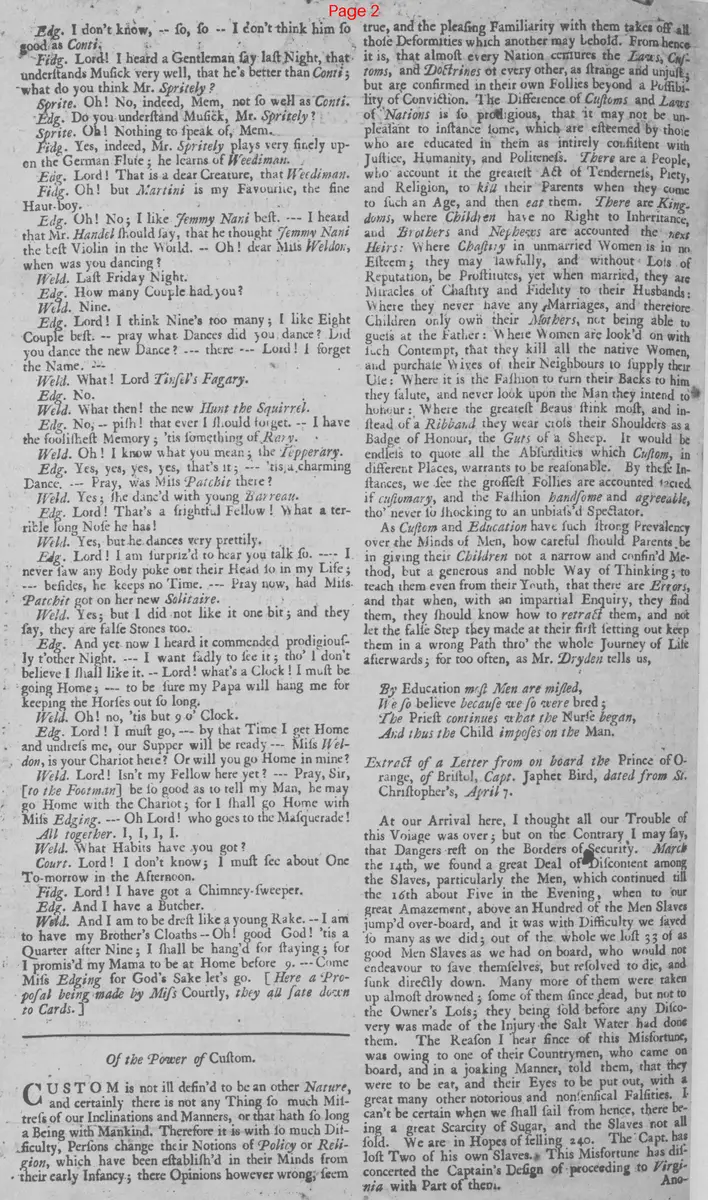
Of the Power of Custom.
CUSTOM is not ill defin'd to be another Nature, and certainly there is not any Thing so much Mistress of our Inclinations and Manners, or that hath so long a Being with Mankind. Therefore it is with so much Difficulty, Persons change their Notions of Policy or Religion, which have been establish'd in their Minds from their early Infancy; their Opinions however wrong, seem true, and the pleasing Familiarity with them takes off all those Deformities which another may behold. From hence it is, that almost every Nation censures the Laws, Customs, and Doctrines of every other, as strange and unjust; but are confirmed in their own Follies beyond a Possibility of Conviction. The Difference of Customs and Laws of Nations is so prodigious, that it may not be unpleasant to instance some, which are esteemed by those who are educated in them as intirely consistent with Justice, Humanity, and Politeness. There are a People, who account it the greatest Act of Tenderness, Piety, and Religion, to kill their Parents when they come to such an Age, and then eat them. There are Kingdoms, where Children have no Right to Inheritance, and Brothers and Nephews are accounted the next Heirs: Where Chastity in unmarried Women is in no Esteem; they may lawfully, and without Loss of Reputation, be Prostitutes, yet when married, they are Miracles of Chastity and Fidelity to their Husbands: Where they never have any Marriages, and therefore Children only own their Mothers, not being able to guess at the Father: Where Women are look'd on with such Contempt, that they kill all the native Women, and purchase Wives of their Neighbours to supply their Use: Where it is the Fashion to turn their Backs to him they salute, and never look upon the Man they intend to honour: Where the greatest Beaus stink most, and instead of a Ribband they wear cross their Shoulders as a Badge of Honour, the Guts of a Sheep. It would be endless to quote all the Absurdities which Custom, in different Places, warrants to be reasonable. By these Instances, we see the grossest Follies are accounted sacred if customary, and the Fashion handsome and agreeable, tho' never so shocking to an unbiass'd Spectator.
As Custom and Education have such strong Prevalency over the Minds of Men, how careful should Parents be in giving their Children not a narrow and confin'd Method, but a generous and noble Way of Thinking; to teach them even from their Youth, that there are Errors, and that when, with an impartial Enquiry, they find them, they should know how to retract them, and not let the false Step they made at their first setting out keep them in a wrong Path thro' the whole Journey of Life afterwards; for too often, as Mr. Dryden tells us,
By Education most Men are misled,
We so believe because we so were bred;
The Priest continues what the Nurse began,
And thus the Child imposes on the Man.
What sub-type of article is it?
Essay
What themes does it touch?
Moral Virtue
Social Manners
What keywords are associated?
Custom
Education
Prejudice
National Customs
Moral Reflection
Literary Details
Title
Of The Power Of Custom
Subject
Reflection On The Influence Of Custom And Education On Human Beliefs And Conduct
Form / Style
Reflective Prose Essay With A Concluding Verse Quotation
Key Lines
Custom Is Not Ill Defin'd To Be Another Nature
By Education Most Men Are Misled, / We So Believe Because We So Were Bred; / The Priest Continues What The Nurse Began, / And Thus The Child Imposes On The Man.