Thanks for visiting SNEWPapers!
Sign up free today to connect your AI tools to the Library of Congress' newspaper collection.
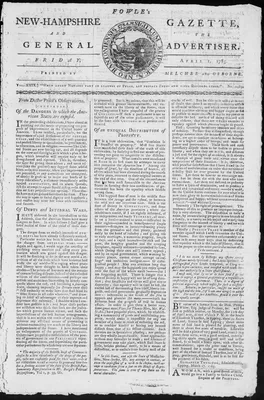
Fowle's New Hampshire Gazette And General Advertiser Literary April 1, 1785
Portsmouth, Rockingham, New Hampshire
Possibly incomplete: this story may be missing part of its text, or continue from or into another issue.
What is this article about?
Richard Price's essay warns the American states of dangers to their new republic: public debt, internal wars, inequality of property, hereditary titles, primogeniture, and foreign trade, urging them to preserve equality and liberty.
Quality green show the numbers
Measured from the scan
— how cleanly the OCR engine read the characters
- Mean ink quality
- 98.0% The length-weighted average confidence across the OCR lines — the mean of exactly the per-line scores whose tails the two figures below report. Typical is 99%.
- Illegible ink
- 0.2% Text sitting in OCR-detected lines that scored below 80% confidence — very shaky reads. Weighted by line length, so one long bad line counts for more than a short one.
- Uncertain ink
- 0.3% Text in lines that scored 80–90% — somewhat shaky reads.
- Matches source
- 95.61% How closely the served text matches the raw OCR of the same boxes, letter by letter, after collapsing spacing and case. This measures agreement, not correctness: the OCR is often wrong and the extractor corrects it, so 100% does not mean perfect, and a low figure usually means poor scan text was rewritten rather than that text was lost (length vs source shows loss).
- Length vs source
- 99.17% Below 100% means text was dropped from the OCR; above means text was added to make it read.
Assembled by the extraction model
— whether the stitched-together text holds up; catches layout and segmentation errors, which the scores above cannot see
- Transcription confidence
- 94.0% (typical 96%) How cleanly the extractor could assemble what it was given. Low here with clean ink scores points at layout analysis — the characters were read correctly but grouped or ordered wrongly.
- Comprehension
- 95.0% Whether the piece reads coherently start to finish. Can stay high while transcription confidence drops, when only part of the component is affected.
Clipping
Full Text
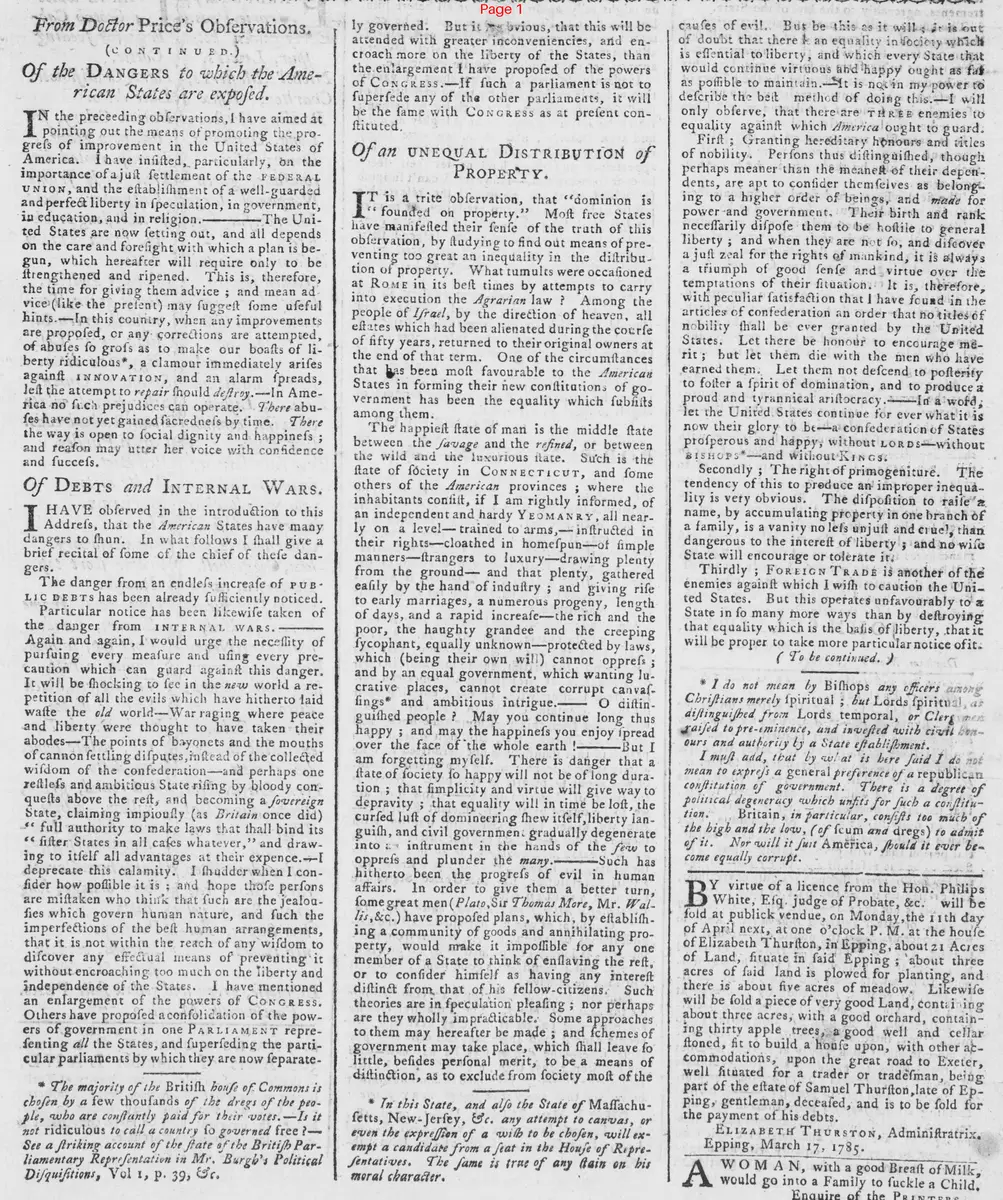
From Doctor Price's Observations.
(CONTINUED.)
Of the DANGERS to which the American States are exposed.
IN the preceding observations, I have aimed at pointing out the means of promoting the progress of improvement in the United States of America. I have insisted, particularly, on the importance of a just settlement of the FEDERAL union, and the establishment of a well-guarded and perfect liberty in speculation, in government, in education, and in religion.—The United States are now setting out, and all depends on the care and foresight with which a plan is begun, which hereafter will require only to be strengthened and ripened. This is, therefore, the time for giving them advice; and mean advice (like the present) may suggest some useful hints.—In this country, when any improvements are proposed, or any corrections are attempted, of abuses so gross as to make our boasts of liberty ridiculous*, a clamour immediately arises against Innovation, and an alarm spreads, lest the attempt to repair should destroy.—In America no such prejudices can operate. There abuses have not yet gained sacredness by time. There the way is open to social dignity and happiness; and reason may utter her voice with confidence and success.
Of DEBTS and INTERNAL WARS.
We have before us dangers to shun. In what follows I shall give a brief recital of some of the chief of these dangers.
The danger from an endless increase of PUBLIC DEBTS has been already sufficiently noticed. Particular notice has been likewise taken of the danger from INTERNAL WARS.—
Again and again, I would urge the necessity of pursuing every measure and using every precaution which can guard against this danger. It will be shocking to see in the new world a repetition of all the evils which have hitherto laid waste the old world—War raging where peace and liberty were thought to have taken their abodes—The points of bayonets and the mouths of cannon settling disputes, instead of the collected wisdom of the confederation—and perhaps one restless and ambitious State rising by bloody conquests above the rest, and becoming a sovereign State, claiming impiously (as Britain once did) "full authority to make laws that shall bind its sister States in all cases whatever," and drawing to itself all advantages at their expense.—I deprecate this calamity. I shudder when I consider how possible it is; and hope those persons are mistaken who think that such are the jealousies which govern human nature, and such the imperfections of the best human arrangements, that it is not within the reach of any wisdom to discover any effectual means of preventing it without encroaching too much on the liberty and independence of the States. I have mentioned an enlargement of the powers of Congress. Others have proposed a consolidation of the powers of government in one PARLIAMENT representing all the States, and superseding the particular parliaments by which they are now separately governed. But it is obvious, that this will be attended with greater inconveniencies, and encroach more on the liberty of the States, than the enlargement I have proposed of the powers of Congress.—If such a parliament is not to supersede any of the other parliaments, it will be the same with Congress as at present constituted.
Of an UNEQUAL DISTRIBUTION of PROPERTY.
It is a trite observation, that "dominion is founded on property." Most free States have manifested their sense of the truth of this observation, by studying to find out means of preventing too great an inequality in the distribution of property. What tumults were occasioned at Rome in its best times by attempts to carry into execution the Agrarian law? Among the people of Israel, by the direction of heaven, all estates which had been alienated during the course of fifty years, returned to their original owners at the end of that term. One of the circumstances that has been most favourable to the American States in forming their new constitutions of government has been the equality which subsists among them.
The happiest state of man is the middle state between the savage and the refined, or between the wild and the luxurious state. Such is the state of society in Connecticut, and some others of the American provinces; where the inhabitants consist, if I am rightly informed, of an independent and hardy YEOMANRY, all nearly on a level—trained to arms,—instructed in their rights—cloathed in homespun—of simple manners—strangers to luxury—drawing plenty from the ground—and that plenty, gathered easily by the hand of industry; and giving rise to early marriages, a numerous progeny, length of days, and a rapid increase—the rich and the poor, the haughty grandee and the creeping sycophant, equally unknown—protected by laws, which (being their own will) cannot oppress; and by an equal government, which wanting lucrative places, cannot create corrupt canvassings* and ambitious intrigue.—O distinguished people! May you continue long thus happy; and may the happiness you enjoy spread over the face of the whole earth!—But I am forgetting myself. There is danger that a state of society so happy will not be of long duration; that simplicity and virtue will give way to depravity; that equality will in time be lost, the cursed lust of domineering shew itself, liberty languish, and civil government gradually degenerate into an instrument in the hands of the few to oppress and plunder the many.—Such has hitherto been the progress of evil in human affairs. In order to give them a better turn, some great men (Plato, Sir Thomas More, Mr. Wallis, &c.) have proposed plans, which, by establishing a community of goods and annihilating property, would make it impossible for any one member of a State to think of enslaving the rest, or to consider himself as having any interest distinct from that of his fellow-citizens. Such theories are in speculation pleasing; nor perhaps are they wholly impracticable. Some approaches to them may hereafter be made; and schemes of government may take place, which shall leave so little, besides personal merit, to be a means of distinction, as to exclude from society most of the causes of evil. But be this as it will, there is no doubt but that there is an equality in society which is essential to liberty, and which every State that would continue virtuous and happy ought as far as possible to maintain. It is not in my power to describe the best method of doing this.—I will only observe, that there are THREE enemies to equality against which America ought to guard.
First; Granting hereditary honours and titles of nobility. Persons thus distinguished, though perhaps meaner than the meanest of their dependents, are apt to consider themselves as belonging to a higher order of beings, and made for power and government. Their birth and rank necessarily dispose them to be hostile to general liberty; and when they are not so, and discover a just zeal for the rights of mankind, it is always a triumph of good sense and virtue over the temptations of their situation. It is, therefore, with peculiar satisfaction that I have found in the articles of confederation an order that no titles of nobility shall be ever granted by the United States. Let there be honour to encourage merit; but let them die with the men who have earned them. Let them not descend to posterity to foster a spirit of domination, and to produce a proud and tyrannical aristocracy. In a word; let the United States continue for ever what it is now their glory to be—a confederation of States prosperous and happy, without Lords—without Bishops*—and without Kings.
Secondly; The right of primogeniture. The tendency of this to produce an improper inequality is very obvious. The disposition to raise a name, by accumulating property in one branch of a family, is a vanity no less unjust and cruel, than dangerous to the interest of liberty; and no wise State will encourage or tolerate it.
Thirdly; FOREIGN TRADE is another of the enemies against which I wish to caution the United States. But this operates unfavourably to State in so many more ways than by destroying that equality which is the basis of liberty, that it will be proper to take more particular notice of it.
(To be continued.)
* The majority of the British house of Commons is chosen by a few thousands of the dregs of the people, who are constantly paid for their votes.—Is it not ridiculous to call a country so governed free? See a striking account of the state of the British Parliamentary Representation in Mr. Burgh's Political Disquisitions, Vol. 1, p. 39, &c.
* In this State, and also the State of Massachusetts, New-Jersey, &c. any attempt to canvas, or even the expression of a wish to be chosen, will exempt a candidate from a seat in the House of Representatives. The same is true of any taint on his moral character.
* I do not mean by Bishops any officers among Christians merely spiritual; but Lords spiritual, as distinguished from Lords temporal, or Clergymen raised to pre-eminence, and invested with civil honours and authority by a State establishment. I must add, that by what is here said I do not mean to express a general preference of a republican constitution of government. There is a degree of political degeneracy which unfits for such a constitution. Britain, in particular, consists too much of the high and the low, (of scum and dregs) to admit of it. Nor will it suit America, should it ever become equally corrupt.
What sub-type of article is it?
Essay
What themes does it touch?
Political
Liberty Freedom
Commerce Trade
What keywords are associated?
American Republic
Public Debt
Internal War
Equality
Liberty
Foreign Trade
Civic Virtue
Hereditary Titles
What entities or persons were involved?
Doctor Price
Literary Details
Title
Of The Dangers To Which The American States Are Exposed
Author
Doctor Price
Subject
Advice To The American States On Dangers Threatening Their New Republic
Form / Style
Political Philosophical Essay In Prose
Key Lines
Let The United States Continue For Ever What It Is Now Their Glory To Be—A Confederation Of States Prosperous And Happy, Without Lords—Without Bishops—And Without Kings.
There Is Danger That A State Of Society So Happy Will Not Be Of Long Duration; That Simplicity And Virtue Will Give Way To Depravity; That Equality Will In Time Be Lost...
It Will Be Shocking To See In The New World A Repetition Of All The Evils Which Have Hitherto Laid Waste The Old World...