Thanks for visiting SNEWPapers!
Sign up free today to connect your AI tools to the Library of Congress' newspaper collection.
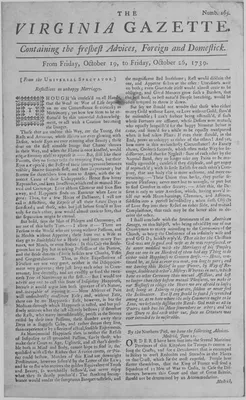
The Virginia Gazette Literary October 19, 1739
Richmond, Richmond, Virginia
What is this article about?
A moral essay on the causes of unhappy marriages—ill-grounded passion, mercenary matches, and neglect after love—concluding with an 'American savage's' critique of Christian marriage.
Quality green show the numbers
Measured from the scan
— how cleanly the OCR engine read the characters
- Mean ink quality
- 99.0% The length-weighted average confidence across the OCR lines — the mean of exactly the per-line scores whose tails the two figures below report. Typical is 99%.
- Illegible ink
- 0.0% Text sitting in OCR-detected lines that scored below 80% confidence — very shaky reads. Weighted by line length, so one long bad line counts for more than a short one.
- Uncertain ink
- 0.5% Text in lines that scored 80–90% — somewhat shaky reads.
- Matches source
- 96.04% How closely the served text matches the raw OCR of the same boxes, letter by letter, after collapsing spacing and case. This measures agreement, not correctness: the OCR is often wrong and the extractor corrects it, so 100% does not mean perfect, and a low figure usually means poor scan text was rewritten rather than that text was lost (length vs source shows loss).
- Length vs source
- 99.18% Below 100% means text was dropped from the OCR; above means text was added to make it read.
Assembled by the extraction model
— whether the stitched-together text holds up; catches layout and segmentation errors, which the scores above cannot see
- Transcription confidence
- 98.0% (typical 96%) How cleanly the extractor could assemble what it was given. Low here with clean ink scores points at layout analysis — the characters were read correctly but grouped or ordered wrongly.
- Comprehension
- 95.0% Whether the piece reads coherently start to finish. Can stay high while transcription confidence drops, when only part of the component is affected.
Clipping
Full Text
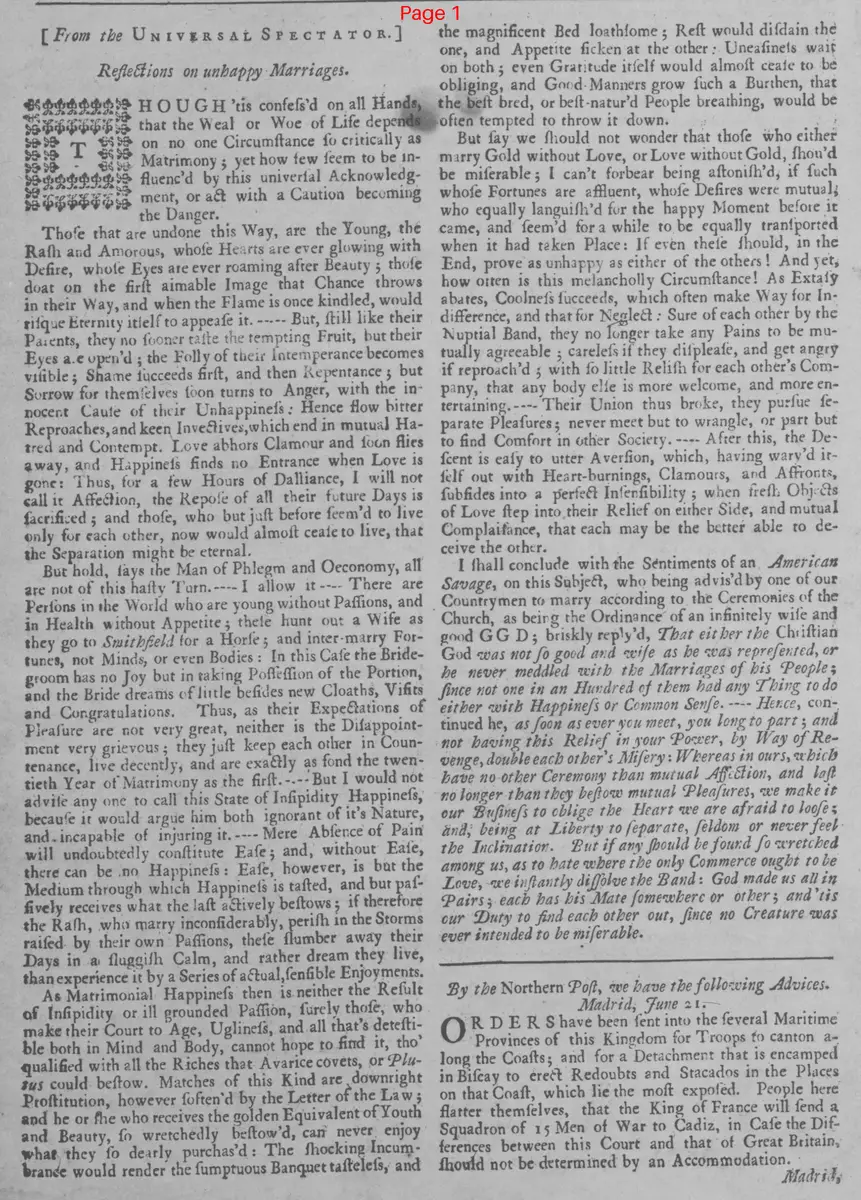
[From the Universal SPECTATOR.]
Reflections on unhappy-Marriages.
THOUGH 'tis confess'd on all Hands, that the Weal or Woe of Life depends on no one Circumstance so critically as Matrimony; yet how few seem to be influenced by this universal Acknowledgment, or act with a Caution becoming the Danger.
Those that are undone this Way, are the Young, the Rash and Amorous, whose Hearts are ever glowing with Desire, whose Eyes are ever roaming after Beauty; those doat on the first amiable Image that Chance throws in their Way, and when the Flame is once kindled, would risque Eternity itself to appease it. ----- But, still like their Parents, they no sooner taste the tempting Fruit, but their Eyes are open'd; the Folly of their Intemperance becomes visible; Shame succeeds first, and then Repentance; but Sorrow for themselves soon turns to Anger, with the innocent Cause of their Unhappiness: Hence flow bitter Reproaches, and keen Invectives, which end in mutual Hatred and Contempt. Love abhors Clamour and soon flies away, and Happiness finds no Entrance when Love is gone: Thus, for a few Hours of Dalliance, I will not call it Affection, the Repose of all their future Days is sacrificed; and those, who but just before seem'd to live only for each other, now would almost cease to live, that the Separation might be eternal.
But hold, says the Man of Phlegm and Oeconomy, all are not of this hasty Turn.----I allow it ---- There are Persons in the World who are young without Passions, and in Health without Appetite; these hunt out a Wife as they go to Smithfield for a Horse; and inter-marry Fortunes, not Minds, or even Bodies : In this Case the Bridegroom has no Joy but in taking Possession of the Portion, and the Bride dreams of little besides new Cloaths, Visits and Congratulations. Thus, as their Expectations of Pleasure are not very great, neither is the Disappointment very grievous; they just keep each other in Countenance, live decently, and are exactly as fond the twentieth Year of Matrimony as the first.---But I would not advise any one to call this State of Insipidity Happiness, because it would argue him both ignorant of it's Nature, and incapable of enjoying it.---- Mere Absence of Pain will undoubtedly constitute Ease; and, without Ease, there can be no Happiness: Ease, however, is but the Medium through which Happiness is tasted, and but passively receives what the last actively bestows; if therefore the Rash, who marry inconsiderably, perish in the Storms raised by their own Passions, these slumber away their Days in a sluggish Calm, and rather dream they live, than experience it by a Series of actual, sensible Enjoyments.
As Matrimonial Happiness then is neither the Result of Insipidity or ill grounded Passion, surely those, who make their Court to Age, Ugliness, and all that's detestable both in Mind and Body, cannot hope to find it, tho qualified with all the Riches that Avarice covets, or Plutus could bestow. Matches of this Kind are downright Prostitution, however soften'd by the Letter of the Law; and he or she who receives the golden Equivalent of Youth and Beauty, so wretchedly bestow'd, can never enjoy what they so dearly purchas'd: The shocking Incumbrance would render the sumptuous Banquet tasteless, and the magnificent Bed loathsome; Rest would disdain the one, and Appetite sicken at the other: Uneasiness wait on both; even Gratitude itself would almost cease to be obliging, and Good-Manners grow such a Burthen, that the best bred, or best-natur'd People breathing, would be often tempted to throw it down.
But say we should not wonder that those who either marry Gold without Love, or Love without Gold, shou'd be miserable; I can't forbear being astonish'd, if such whose Fortunes are affluent, whose Desires were mutual, who equally languish'd for the happy Moment before it came, and seem'd for a while to be equally transported when it had taken Place: If even these should, in the End, prove as unhappy as either of the others! And yet, how often is this melancholy Circumstance! As Extasy abates, Coolness succeeds, which often make Way for Indifference, and that for Neglect: Sure of each other by the Nuptial Band, they no longer take any Pains to be mutually agreeable; careless if they displease, and get angry if reproach'd; with so little Relish for each other's Company, that any body else is more welcome, and more entertaining.----Their Union thus broke, they pursue separate Pleasures; never meet but to wrangle, or part but to find Comfort in other Society. ---- After this, the Descent is easy to utter Aversion, which, having weary'd itself out with Heart-burnings, Clamours, and Affronts, subsides into a perfect Insensibility; when fresh Objects of Love step into their Relief on either Side, and mutual Complaisance, that each may be the better able to deceive the other.
I shall conclude with the Sentiments of an American Savage, on this Subject, who being advis'd by one of our Countrymen to marry according to the Ceremonies of the Church, as being the Ordinance of an infinitely wise and good GOD; briskly reply'd, That either the Christian God was not so good and wise as he was represented, or he never meddled with the Marriages of his People; since not one in an Hundred of them had any Thing to do either with Happiness or Common Sense.---- Hence, continued he, as soon as ever you meet, you long to part; and not having this Relief in your Power, by Way of Revenge, double each other's Misery: Whereas in ours, which have no other Ceremony than mutual Affection, and last no longer than they bestow mutual Pleasures, we make it our Business to oblige the Heart we are afraid to lose; and, being at Liberty to separate, seldom or never feel the Inclination. But if any should be found so wretched among us, as to hate where the only Commerce ought to be Love, we instantly dissolve the Band: God made us all in Pairs; each has his Mate somewhere or other; and 'tis our Duty to find each other out, since no Creature was ever intended to be miserable.
What sub-type of article is it?
Essay
What themes does it touch?
Moral Virtue
Social Manners
Love Romance
What keywords are associated?
Unhappy Marriages
Matrimony
Moral Reflection
Marriage Advice
Passion And Prudence
What entities or persons were involved?
From The Universal Spectator
Literary Details
Title
Reflections On Unhappy Marriages
Author
From The Universal Spectator
Subject
On The Causes And Miseries Of Unhappy Marriages
Form / Style
Reflective Moral Essay In The Spectator Tradition
Key Lines
Love Abhors Clamour And Soon Flies Away, And Happiness Finds No Entrance When Love Is Gone
As Matrimonial Happiness Then Is Neither The Result Of Insipidity Or Ill Grounded Passion
God Made Us All In Pairs; Each Has His Mate Somewhere Or Other; And 'Tis Our Duty To Find Each Other Out, Since No Creature Was Ever Intended To Be Miserable