Thank you for visiting SNEWPapers!
Sign up free
Fowle's New Hampshire Gazette And General Advertiser Letter to Editor April 15, 1785
Portsmouth, Rockingham, New Hampshire
What is this article about?
A reader signing as 'Honestus' declines to reveal his name, responds to the 'Countryman' controversy, and defends a public figure against insinuations involving the Fort William and Mary powder, fishing rights, and a coach gift, urging the public to dismiss malicious rumors.
Quality green show the numbers
Measured from the scan
— how cleanly the OCR engine read the characters
- Mean ink quality
- 99.0% The length-weighted average confidence across the OCR lines — the mean of exactly the per-line scores whose tails the two figures below report. Typical is 99%.
- Illegible ink
- 0.0% Text sitting in OCR-detected lines that scored below 80% confidence — very shaky reads. Weighted by line length, so one long bad line counts for more than a short one.
- Uncertain ink
- 0.3% Text in lines that scored 80–90% — somewhat shaky reads.
- Matches source
- 95.68% How closely the served text matches the raw OCR of the same boxes, letter by letter, after collapsing spacing and case. This measures agreement, not correctness: the OCR is often wrong and the extractor corrects it, so 100% does not mean perfect, and a low figure usually means poor scan text was rewritten rather than that text was lost (length vs source shows loss).
- Length vs source
- 99.41% Below 100% means text was dropped from the OCR; above means text was added to make it read.
Assembled by the extraction model
— whether the stitched-together text holds up; catches layout and segmentation errors, which the scores above cannot see
- Transcription confidence
- 93.0% (typical 96%) How cleanly the extractor could assemble what it was given. Low here with clean ink scores points at layout analysis — the characters were read correctly but grouped or ordered wrongly.
- Comprehension
- 88.0% Whether the piece reads coherently start to finish. Can stay high while transcription confidence drops, when only part of the component is affected.
Clipping
Full Text
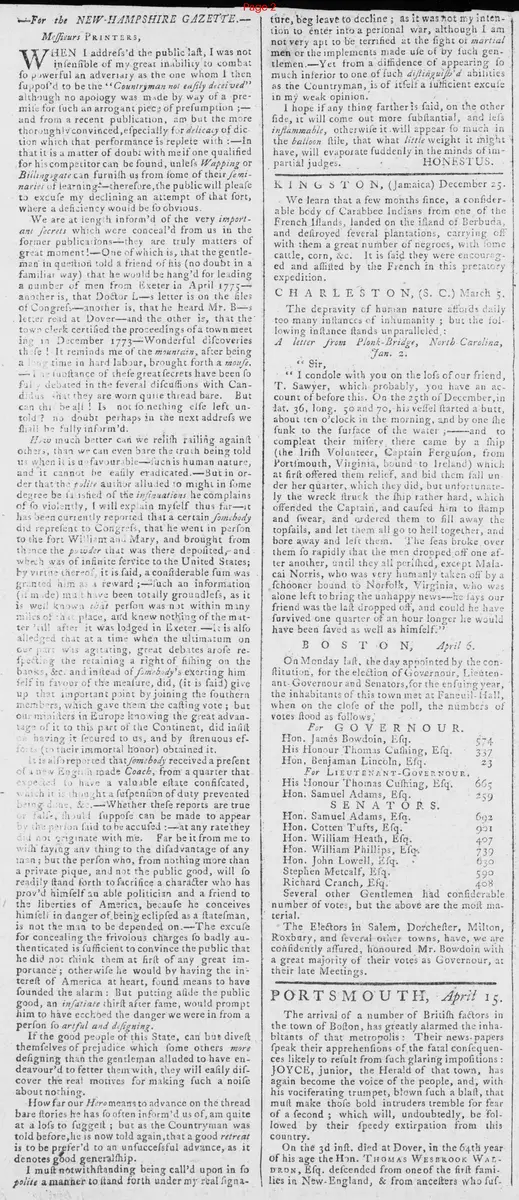
-For the New-Hampshire Gazette.-
Messieurs Printers,
Insensible of my great inability to combat so powerful an adversary as the one whom I then suppos'd to be the "Countryman not easily deceived," although no apology was made by way of a premise for such an arrogant piece of presumption; and from a recent publication, am but the more thoroughly convinced, especially for delicacy of diction which that performance is replete with: In that it is a matter of doubt with me if one qualified for his competitor can be found, unless Wapping or Billingsgate can furnish us from some of their seminaries of learning—therefore, the public will please to excuse my declining an attempt of that sort, where a deficiency would be so obvious.
We are at length inform'd of the very important secrets which were conceal'd from us in the former publications—they are truly matters of great moment!—One of which is, that the gentleman in question told a friend of his (no doubt in a familiar way) that he would be hang'd for leading a number of men from Exeter in April 1775—another is, that Doctor L—s letter is on the files of Congress—another is, that he heard Mr. B—s letter read at Dover—and the other is, that the town clerk certified the proceedings of a town meeting in December 1773—Wonderful discoveries these! It reminds me of the mountain, after being a long time in hard labour, brought forth a mouse.
The substance of these great secrets have been so fully debated in the several discussions with Candidus that they are worn quite threadbare. But can this be all! Is not something else left untold? no doubt perhaps in the next address we shall be fully inform'd.
How much better can we relish railing against others, than we can even bear the truth being told us when it is unfavorable—such is human nature, and it cannot be easily eradicated.—But in order that the polite author alluded to might in some degree be satisfied of the insinuations he complains of so violently, I will explain myself thus far—it has been currently reported that a certain somebody did represent to Congress, that he went in person to the fort William and Mary, and brought from thence the powder that was there deposited,—and which was of infinite service to the United States; by virtue thereof, it is said, a considerable sum was granted him as a reward; such an information (if made) must have been totally groundless, as it is well known that person was not within many miles of that place, and knew nothing of the matter 'till after it was lodged in Exeter.—It is also alleged that at a time when the ultimatum on our part was agitating, great debates arose respecting the retaining a right of fishing on the banks, &c. and instead of somebody's exerting himself in favour of the measure, did, (it is said) give up that important point by joining the southern members, which gave them the casting vote; but our ministers in Europe knowing the great advantage of it to this part of the Continent, did insist on having it secured to us, and by strenuous efforts (to their immortal honor) obtained it.
It is also reported that somebody received a present of a new English made Coach, from a quarter that expected to have a valuable estate confiscated, which it is thought a suspension of duty prevented being done, &c.—Whether these reports are true or false, should suppose can be made to appear by the person said to be accused:—at any rate they did not originate with me. Far be it from me to wish saying any thing to the disadvantage of any man; but the person who, from nothing more than a private pique, and not the public good, will so readily stand forth to sacrifice a character who has prov'd himself an able politician and a friend to the liberties of America, because he conceives himself in danger of being eclipsed as a statesman, is not the man to be depended on.—The excuse for concealing the frivolous charges so badly authenticated is sufficient to convince the public that he did not think them at first of any great importance; otherwise he would by having the interest of America at heart, found means to have sounded the alarm: But putting aside the public good, an insatiate thirst after fame, would prompt him to have echoed the danger we were in from a person so artful and designing.
If the good people of this State, can but divest themselves of prejudice which some others more designing than the gentleman alluded to have endeavour'd to fetter them with, they will easily discover the real motives for making such a noise about nothing.
How far our Hero means to advance on the threadbare stories he has so often inform'd us of, am quite at a loss to suggest; but as the Countryman was told before, he is now told again, that a good retreat is to be prefer'd to an unsuccessful advance, as it denotes good generalship.
I must notwithstanding being call'd upon in so polite a manner to stand forth under my real signature, beg leave to decline; as it was not my intention to enter into a personal war, although I am not very apt to be terrified at the sight of martial men or the implements made use of by such gentlemen.—Yet from a diffidence of appearing so much inferior to one of such distinguished abilities as the Countryman, is of itself a sufficient excuse in my weak opinion.
I hope if any thing further is said, on the other side, it will come out more substantial, and less inflammable, otherwise it will appear so much in the balloon style, that what little weight it might have, will evaporate suddenly in the minds of impartial judges. HONESTUS.
What sub-type of article is it?
Persuasive
Political
Satirical
What themes does it touch?
Politics
What keywords are associated?
Honestus Letter
Countryman Exchange
Political Accusations
New Hampshire Politics
Sullivan Defense
What entities or persons were involved?
Messieurs Printers
Honestus
Letter to Editor Details
Author
Honestus
Recipient
Messieurs Printers
Main Argument
Declines to enter a personal war with 'Countryman' while defending an able politician against unsubstantiated charges, arguing the accusations are trivial, threadbare, and motivated by private pique rather than public good.
Notable Details
- references the Fort William and Mary powder episode
- mentions fishing rights on the banks
- alleges a coach gift from a quarter expecting a confiscated estate
- refuses to appear under his real signature
- uses satire: 'the mountain... brought forth a mouse'