Thank you for visiting SNEWPapers!
Sign up free
The Virginia Gazette Letter to Editor September 16, 1773
Williamsburg, Virginia
Possibly incomplete: this story may be missing part of its text, or continue from or into another issue.
What is this article about?
A Virginia reader argues against paper money, blaming it for inflation, high exchange, banishment of gold and silver, forgeries, and corruption of morals, and objects to a recent £36,834 emission as unnecessary and harmful.
Quality yellow The extractor was unsure its transcription reads as real language, even though the scan measures clean. show the numbers
Measured from the scan
— how cleanly the OCR engine read the characters
- Mean ink quality
- 99.0% The length-weighted average confidence across the OCR lines — the mean of exactly the per-line scores whose tails the two figures below report. Typical is 99%.
- Illegible ink
- 0.0% Text sitting in OCR-detected lines that scored below 80% confidence — very shaky reads. Weighted by line length, so one long bad line counts for more than a short one.
- Uncertain ink
- 0.4% Text in lines that scored 80–90% — somewhat shaky reads.
- Matches source
- 96.15% How closely the served text matches the raw OCR of the same boxes, letter by letter, after collapsing spacing and case. This measures agreement, not correctness: the OCR is often wrong and the extractor corrects it, so 100% does not mean perfect, and a low figure usually means poor scan text was rewritten rather than that text was lost (length vs source shows loss).
- Length vs source
- 99.31% Below 100% means text was dropped from the OCR; above means text was added to make it read.
Assembled by the extraction model
— whether the stitched-together text holds up; catches layout and segmentation errors, which the scores above cannot see
- Transcription confidence
- 90.0% (typical 96%) How cleanly the extractor could assemble what it was given. Low here with clean ink scores points at layout analysis — the characters were read correctly but grouped or ordered wrongly.
- Comprehension
- 95.0% Whether the piece reads coherently start to finish. Can stay high while transcription confidence drops, when only part of the component is affected.
Clipping
Full Text
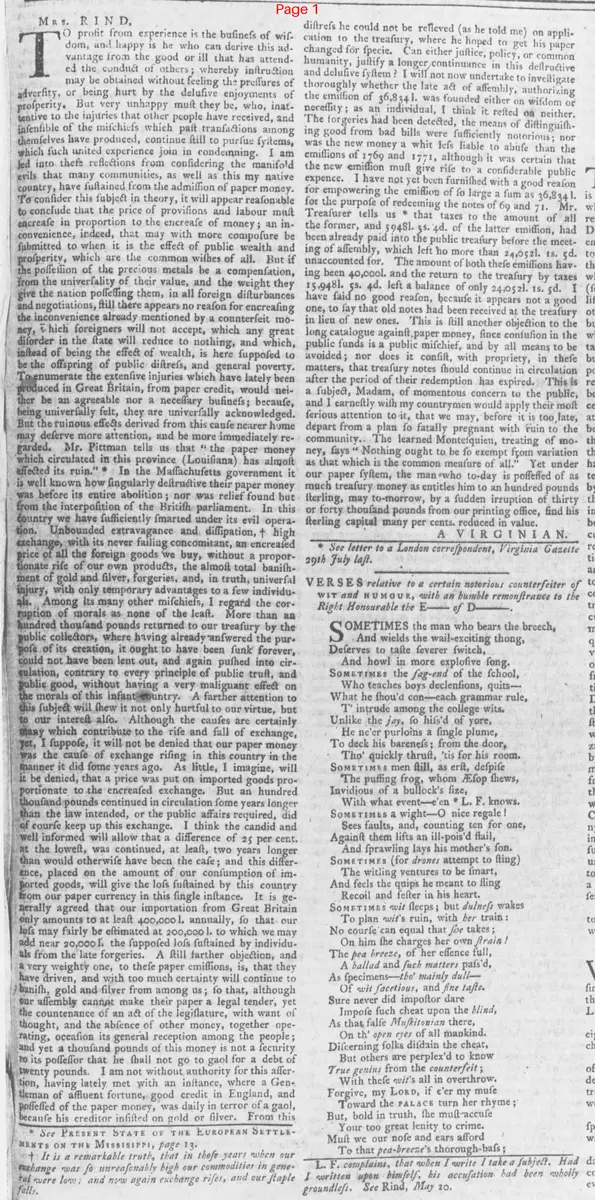
Mrs. Rind,
To profit from experience is the business of wisdom, and happy is he who can derive this advantage from the good or ill that has attended the conduct of others; whereby instruction may be obtained without feeling the pressures of adversity, or being hurt by the delusive enjoyments of prosperity. But very unhappy must they be, who, inattentive to the injuries that other people have received, and insensible of the mischiefs which past transactions among themselves have produced, continue still to pursue systems, which such united experience join in condemning. I am led into these reflections from considering the manifold evils that many communities, as well as this my native country, have sustained from the admission of paper money.
To consider this subject in theory, it will appear reasonable to conclude that the price of provisions and labour must encrease in proportion to the encrease of money; an inconvenience, indeed, that may with more composure be submitted to when it is the effect of public wealth and prosperity, which are the common wishes of all. But if the possession of the precious metals be a compensation, from the universality of their value, and the weight they give the nation possessing them, in all foreign disturbances and negotiations, still there appears no reason for encreasing the inconvenience already mentioned by a counterfeit money, which foreigners will not accept, which any great disorder in the state will reduce to nothing, and which, instead of being the effect of wealth, is here supposed to be the offspring of public distress, and general poverty.
To enumerate the extensive injuries which have lately been produced in Great Britain, from paper credit, would neither be an agreeable nor a necessary business; because, being universally felt, they are universally acknowledged. But the ruinous effects derived from this cause nearer home may deserve more attention, and be more immediately regarded. Mr. Pittman tells us that "the paper money which circulated in this province (Louisiana) has almost effected its ruin."* In the Massachusetts government it is well known how singularly destructive their paper money was before its entire abolition; nor was relief found but from the interposition of the British parliament. In this country we have sufficiently smarted under its evil operation. Unbounded extravagance and dissipation,† high exchange, with its never failing concomitant, an encreased price of all the foreign goods we buy, without a proportionate rise of our own products, the almost total banishment of gold and silver, forgeries, and, in truth, universal injury, with only temporary advantages to a few individuals. Among its many other mischiefs, I regard the corruption of morals as none of the least.
More than an hundred thousand pounds returned to our treasury by the public collectors, where having already answered the purpose of its creation, it ought to have been sunk forever, could not have been lent out, and again pushed into circulation, contrary to every principle of public trust, and public good, without having a very malignant effect on the morals of this infant country.
A farther attention to this subject will shew it not only hurtful to our virtue, but to our interest also. Although the causes are certainly many which contribute to the rise and fall of exchange, yet, I suppose, it will not be denied that our paper money was the cause of exchange rising in this country in the manner it did some years ago. As little, I imagine, will it be denied, that a price was put on imported goods proportionate to the encreased exchange. But an hundred thousand pounds continued in circulation some years longer than the law intended, or the public affairs required, did of course keep up this exchange. I think the candid and well informed will allow that a difference of 25 per cent. at the lowest, was continued, at least, two years longer than would otherwise have been the case; and this difference, placed on the amount of our consumption of imported goods, will give the loss sustained by this country from our paper currency in this single instance.
It is generally agreed that our importation from Great Britain only amounts to at least 400,000l. annually, so that our loss may fairly be estimated at 200,000l. to which we may add near 20,000l. the supposed loss sustained by individuals from the late forgeries.
A still farther objection, and a very weighty one, to these paper emissions, is, that they have driven, and with too much certainty will continue to banish, gold and silver from among us; so that, although our assembly cannot make their paper a legal tender, yet the countenance of an act of the legislature, with want of thought, and the absence of other money, together operating, occasion its general reception among the people; and yet a thousand pounds of this money is not a security to its possessor that he shall not go to gaol for a debt of twenty pounds.
I am not without authority for this assertion, having lately met with an instance, where a Gentleman of affluent fortune, good credit in England, and possessed of the paper money, was daily in terror of a gaol, because his creditor insisted on gold or silver. From this distress he could not be relieved (as he told me) on application to the treasury, where he hoped to get his paper changed for specie.
Can either justice, policy, or common humanity, justify a longer continuance in this destructive and delusive system? I will not now undertake to investigate thoroughly whether the late act of assembly, authorizing the emission of 36,834l. was founded either on wisdom or necessity; as an individual, I think it rested on neither. The forgeries had been detected, the means of distinguishing good from bad bills were sufficiently notorious; nor was the new money a whit less liable to abuse than the emissions of 1769 and 1771, although it was certain that the new emission must give rise to a considerable public expence.
I have not yet been furnished with a good reason for empowering the emission of so large a sum as 36,834l. for the purpose of redeeming the notes of 69 and 71. Mr. Treasurer tells us * that taxes to the amount of all the former, and 5948l. 5s. 4d. of the latter emission, had been already paid into the public treasury before the meeting of assembly, which left no more than 24,052l. 1s. 5d. unaccounted for. The amount of both these emissions having been 40,000l. and the return to the treasury by taxes 15,948l. 5s. 4d. left a balance of only 24,052l. 1s. 5d. I have said no good reason, because it appears not a good one, to say that old notes had been received at the treasury in lieu of new ones.
This is still another objection to the long catalogue against paper money, since confusion in the public funds is a public mischief, and by all means to be avoided; nor does it consist, with propriety, in these matters, that treasury notes should continue in circulation after the period of their redemption has expired.
This is a subject, Madam, of momentous concern to the public, and I earnestly wish my countrymen would apply their most serious attention to it, that we may, before it is too late, depart from a plan so fatally pregnant with ruin to the community. The learned Montesquieu, treating of money, says " Nothing ought to be so exempt from variation as that which is the common measure of all." Yet under our paper system, the man who to-day is possessed of as much treasury money as entitles him to an hundred pounds sterling, may to-morrow, by a sudden irruption of thirty or forty thousand pounds from our printing office, find his sterling capital many per cent. reduced in value.
A VIRGINIAN.
* See Present State of the European Settlements on the Mississippi, page 13.
† It is a remarkable truth, that in those years when our exchange was so unreasonably high our commodities in general were low; and now again exchange rises, and our staple
* See letter to a London correspondent, Virginia Gazette 29th July last.
What sub-type of article is it?
Persuasive
Political
What themes does it touch?
Economic Policy
Morality
What keywords are associated?
Paper Money
Virginia Currency
Inflation
Exchange Rates
Gold And Silver
Forgeries
36,834 Pound Emission
Economic Policy
What entities or persons were involved?
Mrs. Rind
A Virginian.
Letter to Editor Details
Author
A Virginian.
Recipient
Mrs. Rind
Main Argument
Opposes paper money in Virginia, arguing it drives up prices and exchange, banishes gold and silver, invites forgeries, corrupts morals, and costs the country heavily; condemns the recent emission of £36,834 as neither wise nor necessary.
Notable Details
- cites Mr. Pittman on Louisiana paper money nearly ruining the province
- recalls the destructiveness of Massachusetts paper money before its abolition
- estimates a loss of 200,000l. from prolonged high exchange plus nearly 20,000l. from forgeries
- relates a gentleman of affluent fortune in daily terror of gaol because his creditor demanded gold or silver
- quotes Montesquieu: 'Nothing ought to be so exempt from variation as that which is the common measure of all.'