Thank you for visiting SNEWPapers!
Sign up free
The Virginia Gazette Poem March 11, 1773
Richmond, Richmond, Virginia
What is this article about?
A series of moral and religious reflections on virtue, youth, wisdom, and divine providence, urging a life of piety and contentment.
Quality green show the numbers
Measured from the scan
— how cleanly the OCR engine read the characters
- Mean ink quality
- 99.0% The length-weighted average confidence across the OCR lines — the mean of exactly the per-line scores whose tails the two figures below report. Typical is 99%.
- Illegible ink
- 0.0% Text sitting in OCR-detected lines that scored below 80% confidence — very shaky reads. Weighted by line length, so one long bad line counts for more than a short one.
- Uncertain ink
- 0.0% Text in lines that scored 80–90% — somewhat shaky reads.
- Matches source
- 96.37% How closely the served text matches the raw OCR of the same boxes, letter by letter, after collapsing spacing and case. This measures agreement, not correctness: the OCR is often wrong and the extractor corrects it, so 100% does not mean perfect, and a low figure usually means poor scan text was rewritten rather than that text was lost (length vs source shows loss).
- Length vs source
- 99.93% Below 100% means text was dropped from the OCR; above means text was added to make it read.
Assembled by the extraction model
— whether the stitched-together text holds up; catches layout and segmentation errors, which the scores above cannot see
- Transcription confidence
- 95.0% (typical 96%) How cleanly the extractor could assemble what it was given. Low here with clean ink scores points at layout analysis — the characters were read correctly but grouped or ordered wrongly.
- Comprehension
- 95.0% Whether the piece reads coherently start to finish. Can stay high while transcription confidence drops, when only part of the component is affected.
Clipping
Full Text
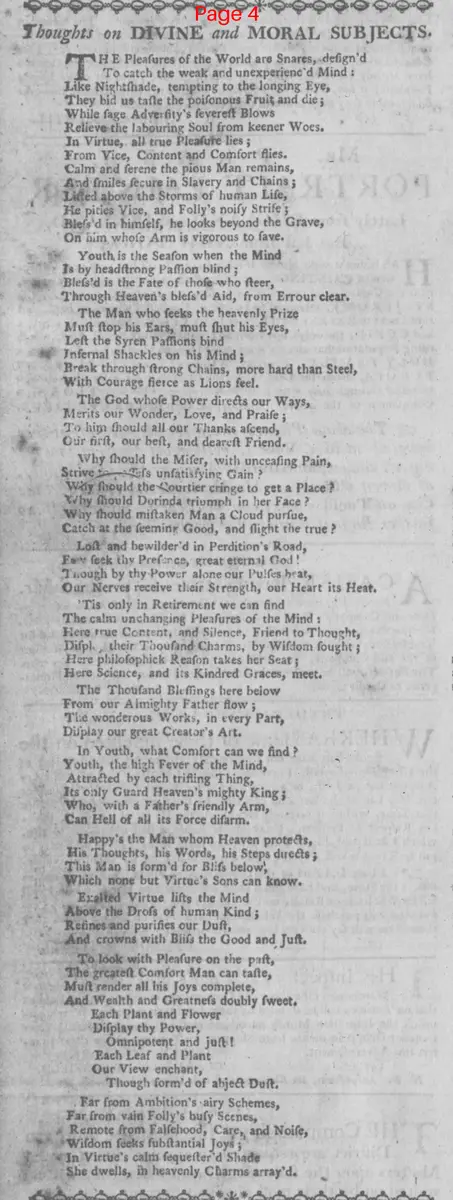
Thoughts on DIVINE and MORAL SUBJECTS.
To catch the weak and unexperienc'd Mind:
Like Nightshade, tempting to the longing Eye,
They bid us taste the poisonous Fruit and die;
While sage Adversity's severest Blows
Relieve the labouring Soul from keener Woes.
In Virtue, all true Pleasure lies;
From Vice, Content and Comfort flies.
Calm and serene the pious Man remains,
And smiles secure in Slavery and Chains;
Lifted above the Storms of human Life,
He pities Vice, and Folly's noisy Strife;
Bless'd in himself, he looks beyond the Grave,
On him whose Arm is vigorous to save.
Youth is the Season when the Mind
Is by headstrong Passion blind;
Bless'd is the Fate of those who steer,
Through Heaven's bless'd Aid, from Error clear.
The Man who seeks the heavenly Prize
Must stop his Ears, must shut his Eyes,
Lest the Syren Passions bind
Infernal Shackles on his Mind;
Break through strong Chains, more hard than Steel,
With Courage fierce as Lions feel.
The God whose Power directs our Ways,
Merits our Wonder, Love, and Praise;
To him should all our Thanks ascend,
Our first, our best, and dearest Friend.
Why should the Miser, with unceasing Pain,
Strive for unsatisfying Gain?
Why should the Courtier cringe to get a Place?
Why should Dorinda triumph in her Face?
Why should mistaken Man a Cloud pursue,
Catch at the seeming Good, and slight the true?
Lost and bewilder'd in Perdition's Road,
May seek thy Presence, great eternal God!
Though by thy Power alone our Pulses heat,
Our Nerves receive their Strength, our Heart its Heat.
'Tis only in Retirement we can find
The calm unchanging Pleasures of the Mind:
Here true Content, and Silence, Friend to Thought,
Display their Thousand Charms, by Wisdom sought;
Here philosophic Reason takes her Seat;
Here Science, and its Kindred Graces, meet.
The Thousand Blessings here below
From our Almighty Father flow;
The wondrous Works, in every Part,
Display our great Creator's Art.
In Youth, what Comfort can we find?
Youth, the high Fever of the Mind,
Attracted by each trifling Thing,
Its only Guard Heaven's mighty King;
Who, with a Father's friendly Arm,
Can Hell of all its Force disarm.
Happy's the Man whom Heaven protects,
His Thoughts, his Words, his Steps directs;
This Man is form'd for Bliss below,
Which none but Virtue's Sons can know.
Exalted Virtue lifts the Mind
Above the Dross of human Kind;
Refines and purifies our Dust,
And crowns with Bliss the Good and Just.
To look with Pleasure on the past,
The greatest Comfort Man can taste,
Must render all his Joys complete,
And Wealth and Greatness doubly sweet.
Each Plant and Flower
Display thy Power,
Omnipotent and just!
Each Leaf and Plant
Our View enchant,
Though form'd of abject Dust.
Far from Ambition's airy Schemes,
Far from vain Folly's busy Scenes,
Remote from Falsehood, Care, and Noise,
Wisdom seeks substantial Joys;
In Virtue's calm sequester'd Shade
She dwells, in heavenly Charms array'd.
What sub-type of article is it?
Didactic
Hymn
What themes does it touch?
Moral Virtue
Religious Faith
What keywords are associated?
Divine Subjects
Moral Virtue
Religious Reflection
Poem Details
Title
Thoughts On Divine And Moral Subjects.
Subject
A Collection Of Moral And Religious Reflections
Form / Style
Varied Stanzas
Key Lines
In Virtue, All True Pleasure Lies;