Thanks for visiting SNEWPapers!
Sign up free today to connect your AI tools to the Library of Congress' newspaper collection.
Daily Richmond Times Commercial November 26, 1849
Richmond, Virginia
What is this article about?
A deputy collector's letter from San Francisco describes a disorganized custom house, revenue estimates of $1.5–2.5 million, and the urgent need for government warehouses; about 240 vessels and 85,000–100,000 tons of shipping are in the harbor.
Quality green show the numbers
Measured from the scan
— how cleanly the OCR engine read the characters
- Mean ink quality
- 99.0% The length-weighted average confidence across the OCR lines — the mean of exactly the per-line scores whose tails the two figures below report. Typical is 99%.
- Illegible ink
- 0.0% Text sitting in OCR-detected lines that scored below 80% confidence — very shaky reads. Weighted by line length, so one long bad line counts for more than a short one.
- Uncertain ink
- 1.6% Text in lines that scored 80–90% — somewhat shaky reads.
- Matches source
- 99.53% How closely the served text matches the raw OCR of the same boxes, letter by letter, after collapsing spacing and case. This measures agreement, not correctness: the OCR is often wrong and the extractor corrects it, so 100% does not mean perfect, and a low figure usually means poor scan text was rewritten rather than that text was lost (length vs source shows loss).
- Length vs source
- 99.69% Below 100% means text was dropped from the OCR; above means text was added to make it read.
Assembled by the extraction model
— whether the stitched-together text holds up; catches layout and segmentation errors, which the scores above cannot see
- Transcription confidence
- 94.0% (typical 96%) How cleanly the extractor could assemble what it was given. Low here with clean ink scores points at layout analysis — the characters were read correctly but grouped or ordered wrongly.
- Comprehension
- 90.0% Whether the piece reads coherently start to finish. Can stay high while transcription confidence drops, when only part of the component is affected.
Clipping
Full Text
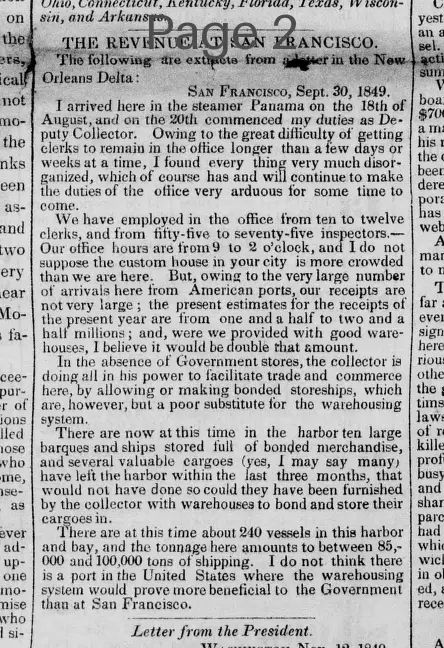
THE REVENUE AT SAN FRANCISCO
The following are extracts from a letter in the New Orleans Delta:
SAN FRANCISCO, Sept. 30, 1849.
I arrived here in the steamer Panama on the 18th of August, and on the 20th commenced my duties as Deputy Collector. Owing to the great difficulty of getting clerks to remain in the office longer than a few days or weeks at a time, I found every thing very much disorganized, which of course has and will continue to make the duties of the office very arduous for some time to come.
We have employed in the office from ten to twelve clerks, and from fifty-five to seventy-five inspectors. Our office hours are from 9 to 2 o'clock, and I do not suppose the custom house in your city is more crowded than we are here. But, owing to the very large number of arrivals here from American ports, our receipts are not very large; the present estimates for the receipts of the present year are from one and a half to two and a half millions; and, were we provided with good warehouses, I believe it would be double that amount.
In the absence of Government stores, the collector is doing all in his power to facilitate trade and commerce here, by allowing or making bonded storeships, which are, however, but a poor substitute for the warehousing system.
There are now at this time in the harbor ten large barques and ships stored full of bonded merchandise, and several valuable cargoes (yes, I may say many) have left the harbor within the last three months, that would not have done so could they have been furnished by the collector with warehouses to bond and store their cargoes in.
There are at this time about 240 vessels in this harbor and bay, and the tonnage here amounts to between 85,000 and 100,000 tons of shipping. I do not think there is a port in the United States where the warehousing system would prove more beneficial to the Government than at San Francisco.
What sub-type of article is it?
Policy
Warehousing
Shipping
What keywords are associated?
San Francisco Revenue
Custom House
Warehousing
Bonded Merchandise
Shipping Tonnage
What entities or persons were involved?
Deputy Collector
Steamer Panama
Collector Of San Francisco
Where did it happen?
San Francisco
Commercial Details
Location
San Francisco
Event Date
1849 09 30
Commodities
Bonded Merchandise
Cargoes
Key Figures
Deputy Collector
Steamer Panama
Collector Of San Francisco
Notable Details
- Writer arrived on steamer Panama Aug. 18 and began duties as Deputy Collector Sept. 20
- Office disorganized due to clerk turnover; 10–12 clerks and 55–75 inspectors employed
- Receipts estimated at $1.5–2.5 million for the year; could double with good warehouses
- Collector using bonded storeships in absence of government stores
- About 240 vessels in harbor; tonnage 85,000–100,000
- Argues warehousing system would greatly benefit the government at San Francisco