Thanks for visiting SNEWPapers!
Sign up free today to connect your AI tools to the Library of Congress' newspaper collection.
The New Hampshire Gazette And Historical Chronicle Poem June 4, 1773
Portsmouth, Rockingham, New Hampshire
What is this article about?
A moral satire on universal human discontent: people of every rank complain of each other, though all are part of one ordered plan; the remedy is to suppress pride and envy and trust fate.
Quality yellow Our extraction tools indicate this piece is a little shaky on the transcription; compare it to the source before quoting. show the numbers
Measured from the scan
— how cleanly the OCR engine read the characters
- Mean ink quality
- 98.0% The length-weighted average confidence across the OCR lines — the mean of exactly the per-line scores whose tails the two figures below report. Typical is 99%.
- Illegible ink
- 0.7% Text sitting in OCR-detected lines that scored below 80% confidence — very shaky reads. Weighted by line length, so one long bad line counts for more than a short one.
- Uncertain ink
- 0.3% Text in lines that scored 80–90% — somewhat shaky reads.
- Matches source
- 95.14% How closely the served text matches the raw OCR of the same boxes, letter by letter, after collapsing spacing and case. This measures agreement, not correctness: the OCR is often wrong and the extractor corrects it, so 100% does not mean perfect, and a low figure usually means poor scan text was rewritten rather than that text was lost (length vs source shows loss).
- Length vs source
- 99.63% Below 100% means text was dropped from the OCR; above means text was added to make it read.
Assembled by the extraction model
— whether the stitched-together text holds up; catches layout and segmentation errors, which the scores above cannot see
- Transcription confidence
- 85.0% (typical 96%) How cleanly the extractor could assemble what it was given. Low here with clean ink scores points at layout analysis — the characters were read correctly but grouped or ordered wrongly.
- Comprehension
- 95.0% Whether the piece reads coherently start to finish. Can stay high while transcription confidence drops, when only part of the component is affected.
Clipping
Full Text
OPALOATOACOHCOACOTL
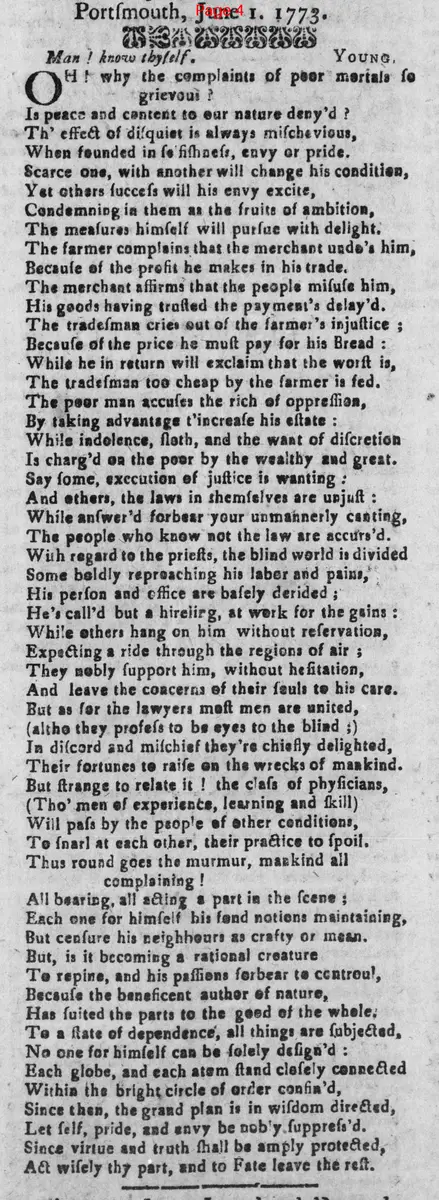
Man! know thyself. YOUNG
H! why the complaints of poor mortals so grievous?
Is peace and content to our nature deny'd?
Th' effect of disquiet is always mischievous,
When founded in selfishness, envy or pride.
Scarce one, with another will change his condition,
Yet others' success will his envy excite,
Condemning in them as the fruits of ambition,
The measures himself will pursue with delight.
The farmer complains that the merchant undoes him,
Because of the profit he makes in his trade.
The merchant affirms that the people misuse him,
His goods having trusted the payment's delay'd.
The tradesman cries out of the farmer's injustice;
Because of the price he must pay for his Bread:
While he in return will exclaim that the worst is,
The tradesman too cheap by the farmer is fed.
The poor man accuses the rich of oppression,
By taking advantage t'increase his estate:
While indolence, sloth, and the want of discretion
Is charg'd on the poor by the wealthy and great.
Say some, execution of justice is wanting:
And others, the laws in themselves are unjust:
While answer'd, forbear your unmannerly canting,
The people who know not the law are accurs'd.
With regard to the priests, the blind world is divided
Some boldly reproaching his labor and pains,
His person and office are basely derided;
He's call'd but a hireling, at work for the gains:
While others hang on him without reservation,
Expecting a ride through the regions of air;
They nobly support him, without hesitation,
And leave the concerns of their souls to his care.
But as for the lawyers most men are united,
(altho' they profess to be eyes to the blind;)
In discord and mischief they're chiefly delighted,
Their fortunes to raise on the wrecks of mankind.
But strange to relate it! the class of physicians,
(Tho' men of experience, learning and skill)
Will pass by the people of other conditions,
To snarl at each other, their practice to spoil.
Thus round goes the murmur, mankind all complaining!
All bearing, all acting a part in the scene;
Each one for himself his fond notions maintaining,
But censure his neighbours as crafty or mean.
But, is it becoming a rational creature
To repine, and his passions forbear to control,
Because the beneficent author of nature,
Has suited the parts to the need of the whole,
To a state of dependence, all things are subjected,
No one for himself can be solely design'd:
Each globe, and each atom stand closely connected
Within the bright circle of order confin'd,
Since then, the grand plan is in wisdom directed,
Let self, pride, and envy be nobly suppress'd.
Since virtue and truth shall be amply protected,
Act wisely thy part, and to Fate leave the rest.
What sub-type of article is it?
Satire
Didactic
What themes does it touch?
Satire Society
Moral Virtue
What keywords are associated?
Human Discontent
Social Satire
Mutual Complaints
Virtue And Fate
Poem Details
Title
Opaloatoacohcoacotl
Subject
Reflections On The Folly Of Mutual Complaints Among All Ranks Of Men
Form / Style
Quatrains With Alternating Rhyme
Key Lines
Thus Round Goes The Murmur, Mankind All Complaining!
Act Wisely Thy Part, And To Fate Leave The Rest.