Thank you for visiting SNEWPapers!
Sign up free
Alexandria Gazette, Commercial And Political
Alexandria, Virginia
What is this article about?
In January 1800, a young Austrian regiment drummer in Piedmont claimed to be the Dauphin of France, son of Louis XVI, recounting his escape from Simon's custody and journey to Turin. Recognized by features and scar, he was examined, then punished by running the gauntlet once before disappearing.
Merged-components note: Merged continuation of the story about the Pretended Dauphin of France.
Clippings
1 of 2
OCR Quality
Full Text
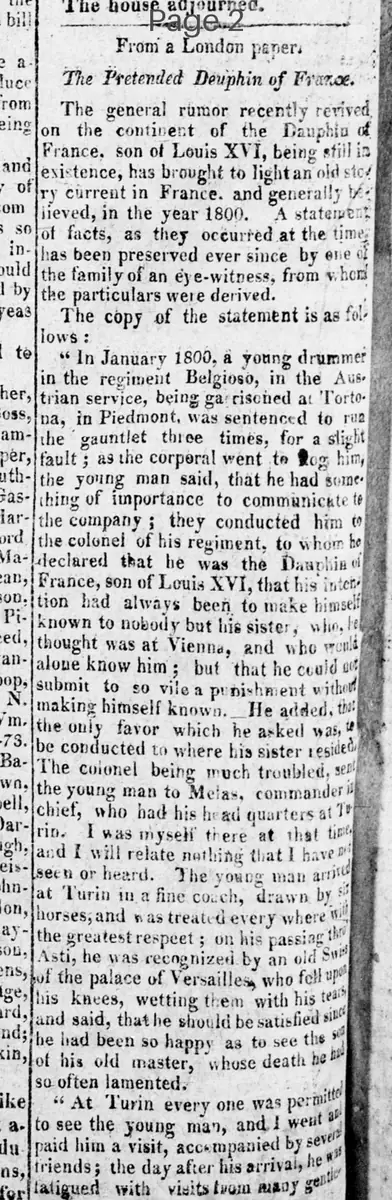
The Pretended Dauphin of France.
The general rumor recently revived on the continent of the Dauphin of France, son of Louis XVI. being still in existence, has brought to light an old story current in France, and generally believed, in the year 1800. A statement of facts, as they occurred at the time, has been preserved ever since by one of the family of an eye-witness, from whom the particulars were derived.
The copy of the statement is as follows:
In January 1800, a young drummer in the regiment Belgioso, in the Austrian service, being garrisoned at Tortona, in Piedmont, was sentenced to run the gauntlet three times, for a slight fault; as the corporal went to flog him, the young man said, that he had something of importance to communicate to the company; they conducted him to the colonel of his regiment, to whom he declared that he was the Dauphin of France, son of Louis XVI. that his intention had always been to make himself known to nobody but his sister, who, he thought was at Vienna, and who would alone know him: but that he could not submit to so vile a punishment without making himself known. He added, that the only favor which he asked was, to be conducted to where his sister resided
The colonel being much troubled, sent the young man to Melas, commander in chief, who had his head quarters at Turin. I was myself there at that time, and I will relate nothing that I have not seen or heard. The young man arrived at Turin in a fine coach, drawn by six horses, and was treated every where with the greatest respect; on his passing through Asti he was recognized by an old Swiss of the palace of Versailles, who fell upon his knees, wetting them with his tears and said, that he should be satisfied since he had been so happy as to see the son of his old master, whose death he had so often lamented.
At Turin every one was permitted to see the young man and paid him a visit, accompanied by several of my friends the day after his arrival men of Piedmont; he told us that he was much pleased at seeing some French-men, that our country was a very unfortunate one, but that he hoped to return one day to Versailles. I recognized his features in the face of the young man; I had seen the Dauphin in 1791, and almost all those who had known him formerly, found it so. We compared it, and found the resemblance perfect, to a picture which had been taken in the year 1791. Somebody having his picture in profile: that he asked it of us, and we gave it him. I desired him to relate to us by what succession of circumstances he was now at Turin, and this is what he told us--I examined him very closely. He said he in several private conversations, in which I will add all that I learned from him. He had been intrusted to the care of Simon, a shoemaker. That man, under apparent bad treatment, concealed an unlimited devotion to him, and indemnified him in private for all the cruelties he seemed to exercise over him publicly. Simon having received orders from Robespierre to poison the Dauphin, took that opportunity to keep him from his tormenters. He substituted a child of the same size and age, who had just died, and whose features were altered, attributing the effects of it to the poison. Simon placed the Dauphin in his house for several days; and intrusted him afterwards to the care of one of his friends, to conduct him to Bordeaux. He gave him a sum of money, & charged the Dauphin above all things to make himself known to no one but his sister, and to take patience till a time should arrive when he could see her again; an event, said he, which must one day or other take place. Having arrived at Bordeaux, they embarked and sailed to Corsica. At that place his attendant died; and being in distress, he was compelled to engage as a servant in a coffee house at Bastia. He remained there for a little time, and having heard that his sister resided at Vienna, he used all his efforts to gather money, to see her again; he afterwards embarked and sailed to Venice; having there obtained passports for Vienna, he attempted to travel thither on foot: but the commencement of hostilities in 1799, having filled Italy with Austrian recruits and camp followers, &c. the young man had the misfortune of being surrounded by one of their bands; upon his refusal to engage they cruelly treated him: and their conduct terminated in taking away his papers and money; so being without resources he was compelled to engage in the regiment before mentioned, in which he could only be received as a drummer on account of his age, 14 or 15. This is what the young man told us with the voice of truth, and at the same time with so much apparent indifference, as if he cared not a sous whether his hearers believed him or not. The kind of little court which had formed around him never omitted to address him by the title of Monsieur le Dauphin or Monseigneur. All the respectable ladies in Turin went to see him, and every one offered to provide him with clothes, linen, &c. Several offered him money, which he refused. The greater number among those who saw and spoke to him really remained in the persuasion, that he was the son of Louis the 16th; as to myself, who saw him without prepossession, I declare that I was much embarrassed what opinion to form of him. The whole exterior of the young man corresponded with what he said. The resemblance of his face was perfect: and a person who had formerly been attached to the French court having observed that he ought to have a scar on the skin on account of a fall which he had in the great stairs of Versailles, we really found a light scar on the place in question; he had besides the gait common to all the Bourbons, a majestic air, his skin exceedingly fair, and upon the whole possessing rare personal qualities. General Melas has dispatched a courier to Vienna, to the Emperor, in order to know what conduct he ought to pursue. He received orders to have the young man examined by a court martial: They told him at first, that if he confessed the truth he would be forgiven, but if they proved he had told a falsehood, he would be shot. He persisted in saying he was the Dauphin of France son of Louis XVI. and asked nothing else but to be conducted where his sister resided. From that time the public no longer had liberty to visit him, and a few days after a rumor was circulated that he had confessed that he was the son of a watch maker at Versailles. However, he told a friend of mine, who took the opportunity to speak to him while they were conducting him to prison, that it was false and that he had confessed nothing contradictory to what he had at first said. Nevertheless he was sentenced by the court martial, composed of Austrian Officers, to run the gauntlet three times on St. Charles' square. The ladies of the town, who had interested themselves in his happiness, went and asked general Melas for his pardon, who consented he should only pass once; he was accordingly conducted to St. Charles' square, to suffer his punishment; and a person worthy of faith, who approached very near him at that moment, told me that when the corporal took off his shirt, he exclaimed, What an indignity for a Bourbon! From that time the young man disappeared, and nobody knew what had become of him."
[London Paper]
What sub-type of article is it?
What keywords are associated?
What entities or persons were involved?
Where did it happen?
Foreign News Details
Primary Location
Turin
Event Date
January 1800
Key Persons
Outcome
sentenced to run the gauntlet three times but pardoned to once; subsequently disappeared.
Event Details
A young drummer in the Austrian regiment Belgioso at Tortona claimed to be the Dauphin, son of Louis XVI, escaped from Simon's custody via substitution and journeyed through Bordeaux, Corsica, Bastia, Venice to Italy. Recognized in Turin by resemblance, scar, and Bourbon traits; examined by court martial, persisted in claim, punished once on St. Charles' square, then vanished.