Thank you for visiting SNEWPapers!
Sign up free
Editorial
January 30, 1840
Staunton Spectator, And General Advertiser
Staunton, Virginia
What is this article about?
Editor Kenton Harper of the Staunton Spectator addresses a personal controversy between C.C. Baldwin and D.A. Stofer over an alleged forged letter authorizing suspension of the Lexington Gazette. Harper verifies the letter's genuineness via handwriting but notes date/location inconsistencies, expressing perplexity and declining further involvement.
Clipping
OCR Quality
98%
Excellent
Full Text
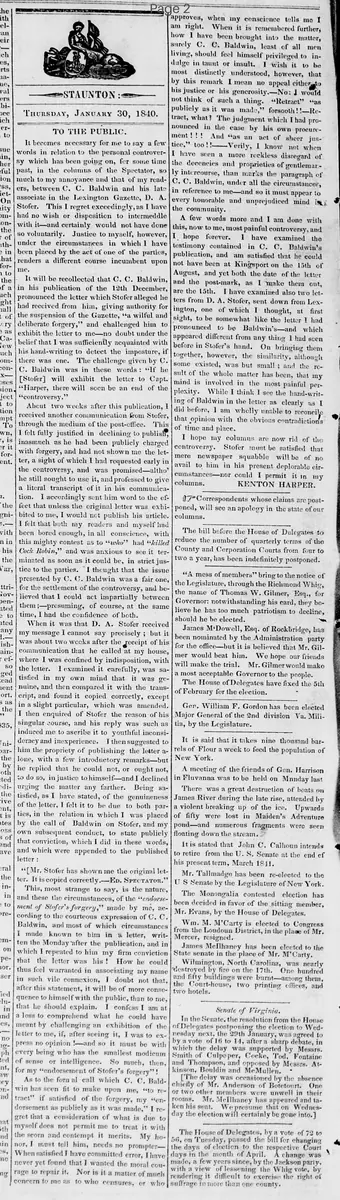
STAUNTON:
THURSDAY, JANUARY 30, 1840.
TO THE PUBLIC.
It becomes necessary for me to say a few words in relation to the personal controversy which has been going on, for some time past, in the columns of the Spectator, so much to my annoyance and that of my readers, between C. C. Baldwin and his late associate in the Lexington Gazette, D. A. Stofer. This I regret exceedingly, as I have had no wish or disposition to intermeddle with it and certainly would not have done so voluntarily. Justice to myself, however, under the circumstances in which I have been placed by the act of one of the parties, renders a different course incumbent upon me.
It will be recollected that C. C. Baldwin, in his publication of the 12th December, pronounced the letter which Stofer alleged he had received from him, giving authority for the suspension of the Gazette, "a wilful and deliberate forgery," and challenged him to exhibit the letter to me--no doubt under the belief that I was sufficiently acquainted with his hand-writing to detect the imposture, if there was one. The challenge given by C. C. Baldwin was in these words: "If he [Stofer] will exhibit the letter to Capt. Harper, there will soon be an end of the controversy."
About two weeks after this publication, I received another communication from Stofer, through the medium of the post-office. This I felt fully justified in declining to publish, inasmuch as he had been publicly charged with forgery, and had not shown me the letter, a sight of which I had requested early in the controversy, and was promised--altho' he still sought to use it, and professed to give a literal transcript of it in his communication. I accordingly sent him word to the effect that unless the original letter was exhibited to me, I would not publish his article. I felt that both my readers and myself had been bored enough, in all conscience, with this mighty contest as to "who had killed Cock Robin," and was anxious to see it terminated as soon as it could be, in strict justice to the parties. I thought that the issue presented by C. C. Baldwin was a fair one, for the settlement of the controversy, and believed that I could act impartially between them;--presuming, of course, at the same time, I had the confidence of both.
When it was that D. A. Stofer received my message I cannot say precisely; but it was about two weeks after the receipt of his communication that he called at my house, where I was confined by indisposition, with the letter. I examined it carefully, was satisfied in my own mind that it was genuine, and then compared it with the transcript, and found it copied correctly, except in a slight particular, which was amended. I then enquired of Stofer the reason of his singular course, and his reply was such as induced me to ascribe it to youthful inconsideracy and inexperience. I then suggested to him the propriety of publishing the letter alone, with a few introductory remarks--but he replied that he could not, or ought not, to do so, in justice to himself and I declined urging the matter any farther. Being satisfied, as I have stated, of the genuineness of the letter, I felt it to be due to both parties, in the relation in which I was placed by the call of Baldwin on Stofer, and my own subsequent conduct, to state publicly that conviction, which I did in these words, and which were appended to the published letter:
"[Mr. Stofer has shown me the original letter. It is copied correctly.--Ed. Spectator.]"
This, most strange to say, is the nature, and these the circumstances, of the "endorsement of Stofer's forgery," made by me, according to the courteous expression of C. C. Baldwin, and most of which circumstances I made known to him in a letter, written the Monday after the publication, and in which I repeated to him my firm conviction that the letter was his! How he could thus feel warranted in associating my name in such vile connexion, I doubt not that, after this statement, it will be of more consequence to himself with the public, than to me, that he should explain. I confess I am at a loss to comprehend what he could have meant by challenging an exhibition of the letter to me, if, after seeing it, I was to express no opinion!--and so it must be with every being who has the smallest modicum of sense or intelligence. So much, then, for my "endorsement of Stofer's forgery"!
As to the formal call which C. C. Baldwin has seen fit to make upon me, "to retract" if satisfied of the forgery, my "endorsement as publicly as it was made," I regret that a consideration of what is due to myself does not permit me to treat it with the scorn and contempt it merits. My honor, I must tell him, needs no prompter--When satisfied I have committed error, I have never yet found that I wanted the moral courage to repair it. Nor is it a matter of much concern to me as to who censures, or who approves, when my conscience tells me I am right. When it is remembered further, how I have been brought into the matter, surely C. C. Baldwin, least of all men living, should feel himself privileged to indulge in taunt or insult. I wish it to be most distinctly understood, however, that by this remark I mean no appeal either to his justice or his generosity.--No: I would not think of such a thing. "Retract" "as publicly as it was made," forsooth!!--Retract, what? The judgment which I had pronounced in the case by his own procurement!!! And "as an act of sheer justice," too!!!--Verily, I know not when I have seen a more reckless disregard of the decencies and proprieties of gentlemanly intercourse, than marks the paragraph of C. C. Baldwin, under all the circumstances, in reference to me and so it must appear to every honorable and unprejudiced mind in the community.
A few words more and I am done with this, now to me, most painful controversy, and I hope forever. I have examined the testimony contained in C. C. Baldwin's publication, and am satisfied that he could not have been at Kingsport on the 15th of August, and yet both the date of the letter and the post-mark, as I make them out, are the 15th. I have examined also two letters from D. A. Stofer, sent down from Lexington, one of which I thought, at first sight, to be somewhat like the letter I had pronounced to be Baldwin's--and which appeared different from any thing I had seen before in Stofer's hand. On bringing them together, however, the similarity, although some existed, was but small; and the result of the whole matter has been, that my mind is involved in the most painful perplexity. While I think I see the hand-writing of Baldwin in the letter as clearly as I did before, I am wholly unable to reconcile that opinion with the obvious contradictions of time and place.
I hope my columns are now rid of the controversy. Stofer must be satisfied that mere newspaper squabble will be of no avail to him in his present deplorable circumstances--nor could I permit it in my columns.
KENTON HARPER.
THURSDAY, JANUARY 30, 1840.
TO THE PUBLIC.
It becomes necessary for me to say a few words in relation to the personal controversy which has been going on, for some time past, in the columns of the Spectator, so much to my annoyance and that of my readers, between C. C. Baldwin and his late associate in the Lexington Gazette, D. A. Stofer. This I regret exceedingly, as I have had no wish or disposition to intermeddle with it and certainly would not have done so voluntarily. Justice to myself, however, under the circumstances in which I have been placed by the act of one of the parties, renders a different course incumbent upon me.
It will be recollected that C. C. Baldwin, in his publication of the 12th December, pronounced the letter which Stofer alleged he had received from him, giving authority for the suspension of the Gazette, "a wilful and deliberate forgery," and challenged him to exhibit the letter to me--no doubt under the belief that I was sufficiently acquainted with his hand-writing to detect the imposture, if there was one. The challenge given by C. C. Baldwin was in these words: "If he [Stofer] will exhibit the letter to Capt. Harper, there will soon be an end of the controversy."
About two weeks after this publication, I received another communication from Stofer, through the medium of the post-office. This I felt fully justified in declining to publish, inasmuch as he had been publicly charged with forgery, and had not shown me the letter, a sight of which I had requested early in the controversy, and was promised--altho' he still sought to use it, and professed to give a literal transcript of it in his communication. I accordingly sent him word to the effect that unless the original letter was exhibited to me, I would not publish his article. I felt that both my readers and myself had been bored enough, in all conscience, with this mighty contest as to "who had killed Cock Robin," and was anxious to see it terminated as soon as it could be, in strict justice to the parties. I thought that the issue presented by C. C. Baldwin was a fair one, for the settlement of the controversy, and believed that I could act impartially between them;--presuming, of course, at the same time, I had the confidence of both.
When it was that D. A. Stofer received my message I cannot say precisely; but it was about two weeks after the receipt of his communication that he called at my house, where I was confined by indisposition, with the letter. I examined it carefully, was satisfied in my own mind that it was genuine, and then compared it with the transcript, and found it copied correctly, except in a slight particular, which was amended. I then enquired of Stofer the reason of his singular course, and his reply was such as induced me to ascribe it to youthful inconsideracy and inexperience. I then suggested to him the propriety of publishing the letter alone, with a few introductory remarks--but he replied that he could not, or ought not, to do so, in justice to himself and I declined urging the matter any farther. Being satisfied, as I have stated, of the genuineness of the letter, I felt it to be due to both parties, in the relation in which I was placed by the call of Baldwin on Stofer, and my own subsequent conduct, to state publicly that conviction, which I did in these words, and which were appended to the published letter:
"[Mr. Stofer has shown me the original letter. It is copied correctly.--Ed. Spectator.]"
This, most strange to say, is the nature, and these the circumstances, of the "endorsement of Stofer's forgery," made by me, according to the courteous expression of C. C. Baldwin, and most of which circumstances I made known to him in a letter, written the Monday after the publication, and in which I repeated to him my firm conviction that the letter was his! How he could thus feel warranted in associating my name in such vile connexion, I doubt not that, after this statement, it will be of more consequence to himself with the public, than to me, that he should explain. I confess I am at a loss to comprehend what he could have meant by challenging an exhibition of the letter to me, if, after seeing it, I was to express no opinion!--and so it must be with every being who has the smallest modicum of sense or intelligence. So much, then, for my "endorsement of Stofer's forgery"!
As to the formal call which C. C. Baldwin has seen fit to make upon me, "to retract" if satisfied of the forgery, my "endorsement as publicly as it was made," I regret that a consideration of what is due to myself does not permit me to treat it with the scorn and contempt it merits. My honor, I must tell him, needs no prompter--When satisfied I have committed error, I have never yet found that I wanted the moral courage to repair it. Nor is it a matter of much concern to me as to who censures, or who approves, when my conscience tells me I am right. When it is remembered further, how I have been brought into the matter, surely C. C. Baldwin, least of all men living, should feel himself privileged to indulge in taunt or insult. I wish it to be most distinctly understood, however, that by this remark I mean no appeal either to his justice or his generosity.--No: I would not think of such a thing. "Retract" "as publicly as it was made," forsooth!!--Retract, what? The judgment which I had pronounced in the case by his own procurement!!! And "as an act of sheer justice," too!!!--Verily, I know not when I have seen a more reckless disregard of the decencies and proprieties of gentlemanly intercourse, than marks the paragraph of C. C. Baldwin, under all the circumstances, in reference to me and so it must appear to every honorable and unprejudiced mind in the community.
A few words more and I am done with this, now to me, most painful controversy, and I hope forever. I have examined the testimony contained in C. C. Baldwin's publication, and am satisfied that he could not have been at Kingsport on the 15th of August, and yet both the date of the letter and the post-mark, as I make them out, are the 15th. I have examined also two letters from D. A. Stofer, sent down from Lexington, one of which I thought, at first sight, to be somewhat like the letter I had pronounced to be Baldwin's--and which appeared different from any thing I had seen before in Stofer's hand. On bringing them together, however, the similarity, although some existed, was but small; and the result of the whole matter has been, that my mind is involved in the most painful perplexity. While I think I see the hand-writing of Baldwin in the letter as clearly as I did before, I am wholly unable to reconcile that opinion with the obvious contradictions of time and place.
I hope my columns are now rid of the controversy. Stofer must be satisfied that mere newspaper squabble will be of no avail to him in his present deplorable circumstances--nor could I permit it in my columns.
KENTON HARPER.
What sub-type of article is it?
Press Freedom
Crime Or Punishment
What keywords are associated?
Newspaper Controversy
Forgery Allegation
Letter Authenticity
Handwriting Verification
Editorial Impartiality
Personal Dispute
Publication Ethics
What entities or persons were involved?
C. C. Baldwin
D. A. Stofer
Kenton Harper
Lexington Gazette
Spectator
Editorial Details
Primary Topic
Controversy Over Alleged Forged Letter In Newspaper Dispute
Stance / Tone
Defensive Explanation With Expressed Perplexity
Key Figures
C. C. Baldwin
D. A. Stofer
Kenton Harper
Lexington Gazette
Spectator
Key Arguments
The Letter's Handwriting Matches Baldwin's, Indicating Genuineness
Baldwin Challenged Stofer To Show The Letter To Harper For Verification
Harper Acted Impartially As Requested By Baldwin
Inconsistencies In Date And Location Create Doubt
Refusal To Fully Retract Endorsement Due To Initial Verification
Criticism Of Baldwin's Demand For Public Retraction As Improper