Thank you for visiting SNEWPapers!
Sign up free
Story
March 1, 1891
The Anaconda Standard
Anaconda, Deer Lodge County, Montana
What is this article about?
An educational article on astronomy detailing the increased visibility of 80 million stars via telescopes, their immense distances, rapid movements, extreme heat, gaseous composition akin to Earth's elements, and a theory of formation from particle collisions in nebulae to cooling stars, explaining colors and light variations.
Clipping
OCR Quality
98%
Excellent
Full Text
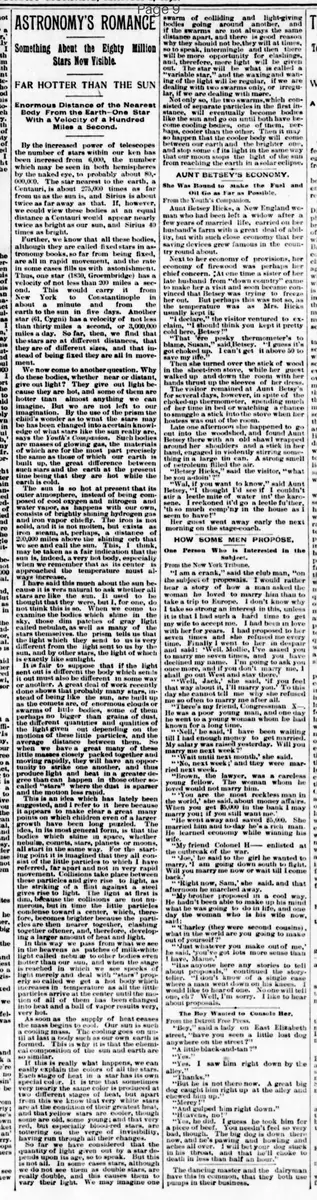
ASTRONOMY'S ROMANCE
Something About the Eighty Million Stars Now Visible
FAR HOTTER THAN THE SUN
Enormous Distance of the Nearest Body From the Earth—One Star With a Velocity of a Hundred Miles a Second.
By the increased power of telescopes the number of stars within our ken has been increased from 6,000, the number which may be seen in both hemispheres by the naked eye, to probably about 80,000,000. The star nearest to the earth, a Centauri, is about 275,000 times as far from us as the sun is, and Sirius is about twice as far away as that. If, however, we could view these bodies at an equal distance a Centauri would appear nearly twice as bright as our sun, and Sirius 40 times as bright.
Further, we know that all these bodies, although they are called fixed stars in astronomy books, so far from being fixed, are all in rapid movement, and the rate in some cases fills us with astonishment. Thus, one star (1830, Groombridge) has a velocity of not less than 200 miles a second. This would carry it from New York to Constantinople in about a minute and from the earth to the sun in five days. Another star (61, Cygni) has a velocity of not less than thirty miles a second, or 3,000,000 miles a day. So far, then, we find that the stars are at different distances, that they are of different sizes, and that instead of being fixed they are all in movement.
We now come to another question. Why do these bodies, whether near or distant, give out light? They give out light because they are hot, and some of them are hotter than almost anything we can imagine. But we are not left to our imagination. By the use of the prism the child's wonder as to what the stars may be has been changed into a certain knowledge of what stars like the sun really are, says the Youth's Companion. Such bodies are masses of glowing gas, the materials of which are for the most part precisely the same as those of which our earth is built up, the great difference between such stars and the earth at the present time being that they are hot while the earth is cold.
The sun is so hot at present that its outer atmosphere, instead of being composed of cool oxygen and nitrogen and water vapor, as happens with our own, consists of brightly shining hydrogen gas and iron vapor chiefly. The iron is not solid, and it is not molten, but exists as iron steam, at, perhaps, a distance of 200,000 miles above the shining orb that we see and call the sun. This, I think, may be taken as a fair indication that the sun is, indeed, a very hot body, especially when we remember that as its center is approached the temperature must always increase.
I have said this much about the sun because it is very natural to ask whether all stars are like the sun. It used to be thought that they were, but I, for one, do not think this is so. When we come to examine the bodies which shine in the sky, those dim patches of gray light called nebulae, as well as many of the stars themselves, the prism tells us that the light which they send to us is very different from the light sent to us by the sun, and by other stars, the light of which is exactly like sunlight.
It is fair to suppose that if the light sent out is different the body which sends it out must also be different in some way or another. A great deal of work recently done shows that probably many stars, instead of being like the sun, are built up as the comets are, of enormous clouds or swarms of little bodies, some of them perhaps no bigger than grains of dust, the different quantities and qualities of the light given out depending on the motions of these little particles and the average distance between them. So when we have a great many of these little masses closely packed together and moving rapidly, they will have an opportunity to strike one another, and thus produce light and heat in a greater degree than can happen in those other so-called 'stars' where the dust is sparser and the motion less rapid.
This is an idea which has lately been suggested, and I refer to it here because it appears to make clear a great many points on which children even of a larger growth have been long puzzled. The idea, in its most general form, is that the bodies which shine in space, whether nebulae, comets, stars, planets or moons, all start in the same way. For the starting point it is imagined that they all consist of the little particles to which I have referred, far apart and not in very rapid movement. Collisions take place between these particles and give rise to light, as the striking of a flint against a steel gives rise to light. The light at first is dim, because the collisions are not numerous, but in time the little particles condense toward a center, which, therefore, becomes brighter because the particles are then nearer together, clashing together oftener, and, therefore, developing a larger amount of heat and light.
In this way we pass from what we see in the heavens as patches of milk-white light called nebulae to other bodies even hotter than our sun, and when the stage is reached in which we see specks of light merely and deal with 'stars' properly so called we get a hot body which increases in temperature as all the little particles arrive at the center until the motion of all of them has been changed into heat and a ball of vapor results very, very hot.
As soon as the supply of heat ceases the mass begins to cool. Our sun is such a cooling mass. The cooling goes on until at last a body such as our own earth is formed. This is why it is that the chemical composition of the sun and earth are so similar.
If this is really what happens, we can easily explain the colors of all the stars. Each stage of heat in a star has its own special color. It is true that sometimes very nearly the same color is produced at two different stages of heat, but apart from this we know that very white stars are at the condition of their greatest heat, and that yellow stars are cooler, though some are old, some young; and that very red, but especially blood-red stars, are tottering on the verge of invisibility, having run through all their changes.
So far we have considered that the quantity of light given out by a star depends upon its age, so to speak. But this is not all. In some cases stars, although we do not see them as double stars, are really double, and this causes them to vary their light. We may imagine one swarm of colliding and light-giving bodies going around another, and if the swarms are not always the same distance apart, and there is good reason why they should not be, they will at times, so to speak, intermingle and then there will be more opportunity for clashings, and, therefore, more light will be given out. The star will be what is called a 'variable star,' and the waxing and waning of the light will be regular, if we are dealing with two swarms only, or irregular, if we are dealing with more.
Not only so, the two swarms, which consisted of separate particles in the first instance, will eventually become bodies like the sun and go on until both have become cooling bodies, one of them, perhaps, cooler than the other. Then it may so happen that the cooler body will come between our earth and the brighter one, and stop some of its light in the same way that our moon stops the light of the sun from reaching the earth in a solar eclipse.
Something About the Eighty Million Stars Now Visible
FAR HOTTER THAN THE SUN
Enormous Distance of the Nearest Body From the Earth—One Star With a Velocity of a Hundred Miles a Second.
By the increased power of telescopes the number of stars within our ken has been increased from 6,000, the number which may be seen in both hemispheres by the naked eye, to probably about 80,000,000. The star nearest to the earth, a Centauri, is about 275,000 times as far from us as the sun is, and Sirius is about twice as far away as that. If, however, we could view these bodies at an equal distance a Centauri would appear nearly twice as bright as our sun, and Sirius 40 times as bright.
Further, we know that all these bodies, although they are called fixed stars in astronomy books, so far from being fixed, are all in rapid movement, and the rate in some cases fills us with astonishment. Thus, one star (1830, Groombridge) has a velocity of not less than 200 miles a second. This would carry it from New York to Constantinople in about a minute and from the earth to the sun in five days. Another star (61, Cygni) has a velocity of not less than thirty miles a second, or 3,000,000 miles a day. So far, then, we find that the stars are at different distances, that they are of different sizes, and that instead of being fixed they are all in movement.
We now come to another question. Why do these bodies, whether near or distant, give out light? They give out light because they are hot, and some of them are hotter than almost anything we can imagine. But we are not left to our imagination. By the use of the prism the child's wonder as to what the stars may be has been changed into a certain knowledge of what stars like the sun really are, says the Youth's Companion. Such bodies are masses of glowing gas, the materials of which are for the most part precisely the same as those of which our earth is built up, the great difference between such stars and the earth at the present time being that they are hot while the earth is cold.
The sun is so hot at present that its outer atmosphere, instead of being composed of cool oxygen and nitrogen and water vapor, as happens with our own, consists of brightly shining hydrogen gas and iron vapor chiefly. The iron is not solid, and it is not molten, but exists as iron steam, at, perhaps, a distance of 200,000 miles above the shining orb that we see and call the sun. This, I think, may be taken as a fair indication that the sun is, indeed, a very hot body, especially when we remember that as its center is approached the temperature must always increase.
I have said this much about the sun because it is very natural to ask whether all stars are like the sun. It used to be thought that they were, but I, for one, do not think this is so. When we come to examine the bodies which shine in the sky, those dim patches of gray light called nebulae, as well as many of the stars themselves, the prism tells us that the light which they send to us is very different from the light sent to us by the sun, and by other stars, the light of which is exactly like sunlight.
It is fair to suppose that if the light sent out is different the body which sends it out must also be different in some way or another. A great deal of work recently done shows that probably many stars, instead of being like the sun, are built up as the comets are, of enormous clouds or swarms of little bodies, some of them perhaps no bigger than grains of dust, the different quantities and qualities of the light given out depending on the motions of these little particles and the average distance between them. So when we have a great many of these little masses closely packed together and moving rapidly, they will have an opportunity to strike one another, and thus produce light and heat in a greater degree than can happen in those other so-called 'stars' where the dust is sparser and the motion less rapid.
This is an idea which has lately been suggested, and I refer to it here because it appears to make clear a great many points on which children even of a larger growth have been long puzzled. The idea, in its most general form, is that the bodies which shine in space, whether nebulae, comets, stars, planets or moons, all start in the same way. For the starting point it is imagined that they all consist of the little particles to which I have referred, far apart and not in very rapid movement. Collisions take place between these particles and give rise to light, as the striking of a flint against a steel gives rise to light. The light at first is dim, because the collisions are not numerous, but in time the little particles condense toward a center, which, therefore, becomes brighter because the particles are then nearer together, clashing together oftener, and, therefore, developing a larger amount of heat and light.
In this way we pass from what we see in the heavens as patches of milk-white light called nebulae to other bodies even hotter than our sun, and when the stage is reached in which we see specks of light merely and deal with 'stars' properly so called we get a hot body which increases in temperature as all the little particles arrive at the center until the motion of all of them has been changed into heat and a ball of vapor results very, very hot.
As soon as the supply of heat ceases the mass begins to cool. Our sun is such a cooling mass. The cooling goes on until at last a body such as our own earth is formed. This is why it is that the chemical composition of the sun and earth are so similar.
If this is really what happens, we can easily explain the colors of all the stars. Each stage of heat in a star has its own special color. It is true that sometimes very nearly the same color is produced at two different stages of heat, but apart from this we know that very white stars are at the condition of their greatest heat, and that yellow stars are cooler, though some are old, some young; and that very red, but especially blood-red stars, are tottering on the verge of invisibility, having run through all their changes.
So far we have considered that the quantity of light given out by a star depends upon its age, so to speak. But this is not all. In some cases stars, although we do not see them as double stars, are really double, and this causes them to vary their light. We may imagine one swarm of colliding and light-giving bodies going around another, and if the swarms are not always the same distance apart, and there is good reason why they should not be, they will at times, so to speak, intermingle and then there will be more opportunity for clashings, and, therefore, more light will be given out. The star will be what is called a 'variable star,' and the waxing and waning of the light will be regular, if we are dealing with two swarms only, or irregular, if we are dealing with more.
Not only so, the two swarms, which consisted of separate particles in the first instance, will eventually become bodies like the sun and go on until both have become cooling bodies, one of them, perhaps, cooler than the other. Then it may so happen that the cooler body will come between our earth and the brighter one, and stop some of its light in the same way that our moon stops the light of the sun from reaching the earth in a solar eclipse.
What sub-type of article is it?
Curiosity
What themes does it cover?
Nature
Exploration
What keywords are associated?
Stars
Astronomy
Stellar Evolution
Nebulae
Celestial Bodies
Where did it happen?
The Heavens, Space
Story Details
Location
The Heavens, Space
Story Details
The article explains the vast number of visible stars, their distances, movements, heat, composition similar to Earth's, and a theory of stellar evolution from nebulae through collisions of particles to cooling bodies like the sun and earth, accounting for colors and variability.