Thank you for visiting SNEWPapers!
Sign up free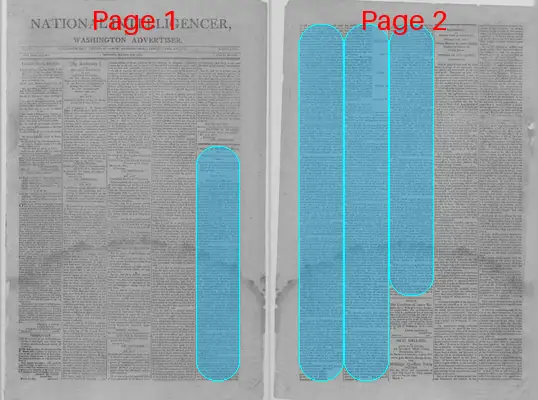
The National Intelligencer And Washington Advertiser
Washington, District Of Columbia
What is this article about?
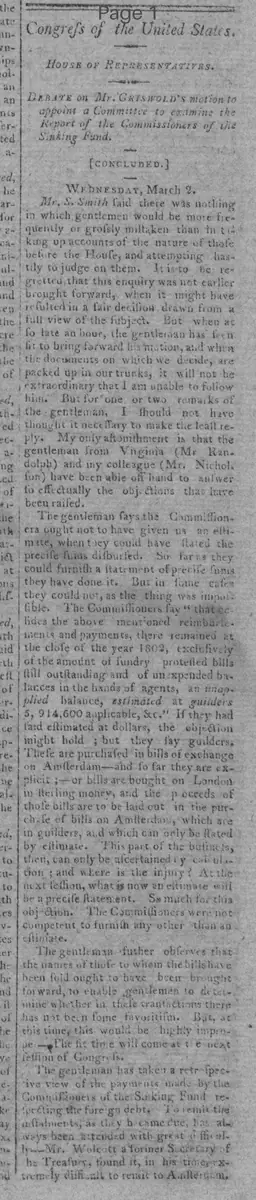
In the U.S. House of Representatives on March 2, 1803, debate concluded on Mr. Griswold's motion to appoint a committee to examine the Commissioners of the Sinking Fund's report on public debt payments. Speakers including S. Smith, Griswold, Randolph, and Nicholson discussed remittances to Holland, estimates in guilders, bank stock sales, and legal obligations. The resolution passed unanimously.
Merged-components note: Continuation of congressional debate on the report of the Commissioners of the Sinking Fund from page 1 to page 2; relabeled from 'story' to 'domestic_news' as it fits local/national non-story news.
Clippings
1 of 2
OCR Quality
Full Text
HOUSE OF REPRESENTATIVES.
DEBATE on Mr. Griswold's motion to appoint a Committee to examine the Report of the Commissioners of the Sinking Fund.
[CONCLUDED.]
Wednesday, March 2.
Mr. S. Smith said there was nothing in which gentlemen would be more frequently or grossly mistaken than in taking up accounts of the nature of those before the House, and attempting hastily to judge on them. It is to be regretted that this enquiry was not earlier brought forward, when it might have resulted in a fair decision drawn from a full view of the subject. But when at so late an hour, the gentleman has seen fit to bring forward his motion, and when the documents on which we decide, are packed up in our trunks, it will not be extraordinary that I am unable to follow him. But for one or two remarks of the gentleman, I should not have thought it necessary to make the least reply. My only astonishment is that the gentleman from Virginia (Mr. Randolph) and my colleague (Mr. Nicholson) have been able off hand to answer so effectually the objections that have been raised.
The gentleman says the Commissioners ought not to have given us an estimate, when they could have stated the precise sums disbursed. So far as they could furnish a statement of precise sums they have done it. But in some cases they could not, as the thing was impossible. The Commissioners say "that besides the above mentioned reimbursements and payments, there remained at the close of the year 1802, exclusively of the amount of sundry protested bills still outstanding and of unexpended balances in the hands of agents, an unapplied balance, estimated at guilders 5,914,600 applicable, &c." If they had said estimated at dollars, the objection might hold; but they say guilders. These are purchased in bills of exchange on Amsterdam-and so far they are explicit; or bills are bought on London in sterling money, and the proceeds of those bills are to be laid out in the purchase of bills on Amsterdam, which are in guilders, and which can only be stated by estimate. This part of the business is, then, can only be ascertained by calculation; and where is the injury? At the next session, what is now an estimate will be a precise statement. So much for this objection. The Commissioners were not competent to furnish any other than an estimate.
The gentleman further observes that the names of those to whom the bills have been sold ought to have been brought forward, to enable gentlemen to determine whether in these transactions there has not been some favoritism. But, at this time, this would be highly improper- the time will come at the next session of Congress.
The gentleman has taken a retrospective view of the payments made by the Commissioners of the Sinking Fund respecting the foreign debt. To remit three instalments, as they became due, has always been attended with great difficulty-Mr. Wolcott a former Secretary of the Treasury, found it, in his time, "extremely difficult to remit to Amsterdam."
He did me the honor to converse with me on the subject. I pointed out a mode, which he adopted. He was able to buy bills on London, but not on Amsterdam; but to have done this would have been a losing game. The merchants brought to him a cargo which, it was estimated, would in Amsterdam, produce a certain sum. He agreed to advance two thirds of this sum on the merchants consigning the property to our agent at Amsterdam; and to pay the remaining third on receiving advice that the amount of debt, contracted to be paid, was discharged. Could the Secretary have spent the amount of this money in Amsterdam? Nobody ever doubted of the transaction being a proper one. There was then a confidence in the government; and there must still be a confidence in the government.
Subsequent to that period, the trade to Amsterdam has increased in consequence of the war, by which our merchants, who have debts there to pay, are enabled to buy bills. But on the cessation of hostilities this facility in a great measure ceases. Another mode, therefore, was to be pursued, to make the necessary remittance for the payment of the public debt. In the year 1802 the Secretary found it difficult to remit; he was asked 42 cents per guilder; for the merchants, and my house among the rest, held out: they thought they had the Secretary in their power, knowing that he must at all events remit to a large amount; and they would have got the best of him, but for his judicious sale of the Bank Shares. He thereby compelled us to give out, and saved to the United States $58,000 dollars; and compelled the merchants to sell for 41 cents the guilder. If he had not done so, I should have got 42 cents a guilder for my bills—for that was the proportion that bills on Amsterdam then bore to bills on London. But by taking the demand from the market, he reduced their value.
Since the beginning of the year 1803, one million nine hundred thousand dollars have been required to be remitted to Holland. The Secretary again found difficulty from the high exchange required. I understand that he has made a judicious contract, and with gentlemen too who are not favorites of Congress, a contract which I should not have been willing to make; by which means he has been enabled to obtain exchange at 41 cents the guilder. It is true, the merchant gets the money now, and makes the payment in September. He appears, at first view, to gain the interest for the intervening period, but this is not the fact, as he sells the bills proportionally lower; and government loses nothing, as the money, if remitted, would lie useless in Holland. In all this there is no favoritism. For the Secretary places his terms in the banks, and every merchant of credit may buy; all, who have the means, may participate; it is a matter of public notoriety.
Mr. Smith concluded by observing, that though this subject had never before come to his view, he had thought it best to throw out those few remarks in answer to the gentleman from Connecticut.
Mr. Griswold. It would not have been necessary to answer the remarks made by gentlemen, but for the imputation cast upon the time at which this resolution has been offered. I did think the gentleman from Virginia (Mr. Randolph) would have done me the justice to state to the house my conduct on this occasion. What gentleman will not deny that on the day the report of the Commissioners of the Sinking Fund was received, I spoke to him, and that on the day after, I gave him my objections in writing, that he might converse with the Secretary of the Treasury. Some days after I showed him this resolution, and at his instance struck out one word.
Mr. Randolph asked what word.
Mr. Griswold replied the words "in fact." I am therefore not liable to the charge of attempting to surprise gentlemen. I have tried, without success, to offer the resolution for several days past. Yesterday I attempted it, but the gentleman from Maryland objected, and the house went to other business.
Since I am up, I will call the attention of the house to some of the remarks offered by gentlemen on the observations which I had the honor to submit.
In reply to my first objection that the Commissioners have not applied in the year the sum of 7,300,000 dollars, they ground themselves on two principles. They consider the Commissioners as having a right to consider the proceeds of the Bank Shares as forming a part; and they contend, in the next place, that a part of the remittances made to Holland are intended to meet installments becoming due in the year 1803. These two points I shall consider distinctly.
And first with respect to the Bank Stock, I want nothing but the report of the Commissioners to show there can be no pretensions to the first argument gentlemen use.
The Commissioners say they have received certain sums: And how? "From the funds appropriated by the direction of the act for the redemption of the whole of the public debt" viz:
"From the fund arising from interest on the domestic debt transferred to the Commissioners of the Sinking Fund, as per statement herewith for 1802, 326,419 92
From the fund arising from payments into the treasury of debts which originated under the late government, 888 79
From the fund arising from dividends on the Capital Stock, which belonged to the U. States in the Bank of said states from 1 July 1801, to 31 Dec. following, 88,960
From the fund arising from the sales of public lands, being the amount of monies paid into the Treasury in the year 1802, 179,575 52
From the proceeds of duties on goods, wares, and merchandise imported, and on the tonnage of ships or vessels, 6,759,125 77
Making in the whole the annual appropriation by law for the year 1802, under the act aforementioned, 7,300,000"
What do they say to the proceeds of Bank Shares? Do they pretend that they have a right to it?
They further observe that these have been applied to the re-imbursement of temporary loans obtained of the Bank of the United States."—From what fund? From the 7,300,000 dollars? No. From the proceeds of 2,220 shares of Bank Stock."
This, I think, is a sufficient answer to this part of the remarks of gentlemen.
In the second place, gentlemen say, the Commissioners had a right to remit money in 1802, to meet the installments of 1803. I admit, if to take the money entitles them to it, they had the right, and that if they had a right to avail themselves of the remittances for 1803, they have laid out the seven millions three hundred thousand dollars.
But how do they make this right out? What says the law? By it they as well as we are bound. If words can be plain, the words of that law are plain. The first section of the act of the last session provides for the annual appropriation of seven millions three hundred thousand dollars to the payment of the debt.
The second section directs the Secretary of the Treasury to pay, in each year, to the commissioners the sum of 7,300,000 dollars.
The third section provides how this sum shall be applied; and says "it shall be the duty of the said Commissioners to cause to be applied and paid out of the said fund, yearly and every year, at the treasury of this United States, the several and respective sums following." &c.
They are here directed to apply these sums yearly and every year. I ask, have they done it? Is making a remittance to meet installments becoming due the next year, or six years hence, applying this fund to this year? If that is deemed paying the debt, I can only say there is nothing like it in the law—it only enables the Commissioners to draw the seven millions three hundred thousand dollars out of the treasury, and not to keep it in their own hands, and say we mean to apply it six years hence. I contend, therefore, that this is no answer; and that under this view of the subject, the Commissioners may have received the annual appropriation without having applied it. I have no idea of criminating the Commissioners. A new report may explain all these difficulties. But I do contend, that according to this report, they have not applied in the year 1802 the whole seven millions three hundred thousand dollars appropriated.
But gentlemen say, it is impossible for them, and they are not obliged to account for the application of the whole amount; that from the nature of the debt due in Holland, part of the money must be remitted in the year preceding that in which it is due; and that if the whole were paid in one year, there would not remain enough for the succeeding year.
Mr. Nicholson said he had observed no such thing; he had said the Commissioners had power to draw for the ensuing year, but that it rested with the Secretary of the Treasury, according to the state of the treasury, to admit their drafts.
Mr. Griswold—Gentlemen then contend that the Commissioners had only a right in the first instance to draw 7,300,000 dollars; but that the proviso directs the Secretary to make the necessary advances. Will it then be pretended that there was not money enough in the treasury to pay the 7,300,000 dollars, and to provide for the necessary remittances? What says the report? Why, that our millions and a half lie dead in the treasury. In these circumstances would the Secretary dare, under this proviso, to refuse to allow drafts for the necessary remittances? There was money enough; and the Commissioners might have drawn much larger sum than they actually have drawn.
The argument therefore falls.
But gentlemen say, that by the law of the last session, the Commissioners are not obliged to apply 7,300,000 dollars in the year 1802; but that they have a right to compute the year from April 1802. I desire here, again, nothing but the report to show the fallacy of this argument. The report itself says they have received the whole appropriations for 1802. Why? Because the expression of the law requiring the payment either every year, clearly means the year for which the accounts are made up.
To account for the deficiency of 114,000 dollars, the gentleman from Maryland (Mr. Nicholson) has stated certain items, which, if admitted, will reduce the sum unaccounted for. I did not contend that the Commissioners could not account for this balance; but only that they had not accounted for it.
The gentleman, however, is mistaken in his calculations. The first item to which he alludes, is that of 7,994 dollars on account of debts due to foreign officers, and 14,596 on account of certain parts of the domestic debt. But I beg leave to inform the gentleman that no part of these two sums appear to have been paid. They are not stated on account of payments made; but only as disbursements from the treasury.
The gentleman considers the Commissioners in stating the guilders remitted right in making an estimate. Now, if on examining their report, it will appear that this transaction had nothing to do with the bankers in Amsterdam, the observation of the gentleman falls.
The report says "that besides the above mentioned re-imbursements and payments, there remained at the close of the year 1802, exclusively of the amount of sundry protested bills still outstanding and of unexpended balances in the hands of agents, an unapplied balance estimated at 5,914,606 guilders," &c.—Of monies in the hands of bankers? No. Of "remittances purchased and paid for."—
Have not the Commissioners an account of this?
Mr. Randolph here said it was extremely disagreeable to him to interrupt the gentleman. But he must be permitted to observe that the date of the report was the 5th of February 1803. Was it then reasonable to suppose that the treasury department had received from its agents, who were scattered from Savannah to Portland, an account of every bill purchased antecedent to the 1st of January, and that the books of those agents should be then fully settled and balanced? Could it be expected that any more than an estimate should be exhibited?
Mr. Griswold begged the gentleman from Virginia to refer to the report, by which it would appear that the sum of 5,914,606 guilders was exclusively of money in the hands of agents, and that it consisted of money remitted. Of this sum the Commissioners could and ought to have rendered a particular account.
The gentleman from Maryland (Mr. S. Smith) has mentioned the sale of the Bank Stock. I did not expect this circumstance would have been mentioned, as it has nothing to do with the subject now before us. I did hope that respecting that transaction an enquiry would have been made. I did believe the sale to be unwarranted by law, and to have involved a large sacrifice of public property. But this transaction has nothing to do with the resolution before us, and I have only made these observations in reply to the gentleman from Maryland to show that I neither subscribe to the prudence, legality or goodness of the sale.
With regard to any application of my remarks to individuals, I can only say I know nothing. I am not in the secrets of the treasury; but I do know, that if there should be a disposition to accommodate friends, it may be done in the disbursement of so large a sum as ten millions of dollars.
The question was then taken by yeas and nays, on agreeing to Mr. Griswold's resolution, and carried unanimously in the affirmative.
What sub-type of article is it?
What keywords are associated?
What entities or persons were involved?
Where did it happen?
Domestic News Details
Primary Location
United States
Event Date
Wednesday, March 2
Key Persons
Outcome
the resolution to appoint a committee passed unanimously by yeas and nays.
Event Details
Debate on Mr. Griswold's motion to examine the Sinking Fund Commissioners' report, focusing on whether the full $7,300,000 appropriation for 1802 was applied, remittances to Holland in guilders, estimates versus precise sums, bank stock sales, and legal requirements for annual application of funds.