Thank you for visiting SNEWPapers!
Sign up free
The L'anse Sentinel
L'anse, Baraga County, Michigan
What is this article about?
A Upper Peninsula resident advocates for a state normal school in the region, refuting opposition from lower Michigan figures like Hon. William Harry on costs and benefits. Proposes L'Anse as ideal central location with historical significance to pioneers, urges local commissioners, and lists prominent names for governor's consideration.
Clipping
OCR Quality
Full Text
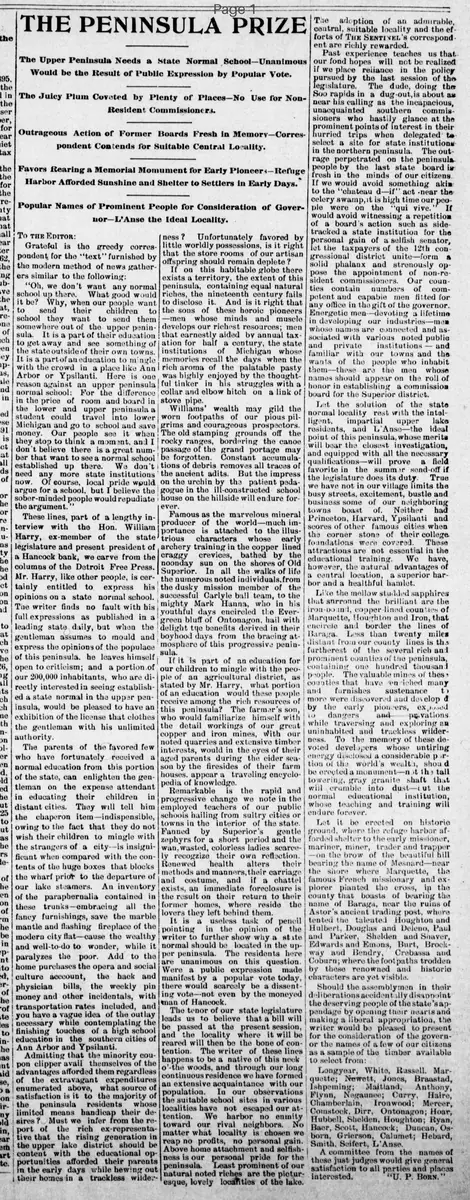
The Upper Peninsula Needs a State Normal School—Unanimous Would be the Result of Public Expression by Popular Vote.
The Juicy Plum Coveted by Plenty of Places—No Use for Non-Resident Commissioners.
Outrageous Action of Former Boards Fresh in Memory—Correspondent Contends for Suitable Central Locality.
Favors Rearing a Memorial Monument for Early Pioneers—Refuge Harbor Afforded Sunshine and Shelter to Settlers in Early Days.
Popular Names of Prominent People for Consideration of Governor—L'Anse the Ideal Locality.
To The Editor:
Grateful is the greedy correspondent for the text furnished by the modern method of news gatherers similar to the following:
"Oh, we don't want any normal school up there. What good would it be? Why, when our people want to send their children to school they want to send them somewhere out of the upper peninsula. It is a part of their education to get away and see something of the state outside of their own towns. It is a part of an education to mingle with the crowd in a place like Ann Arbor or Ypsilanti." Here is one reason against an upper peninsula normal school: For the difference in the price of room and board in the lower and upper peninsula a student could travel into lower Michigan and go to school and save money. Our people see it when they stop to think a moment, and I don't believe there is a great number that want to see a normal school established up there. We don't need any more state institutions now. Of course, local pride would argue for a school, but I believe the sober-minded people would repudiate the argument.
These lines, part of a lengthy interview with the Hon. William Harry, ex-member of the state legislature and present president of a Hancock bank, we carve from the columns of the Detroit Free Press. Mr. Harry, like other people, is certainly entitled to express his opinions on a state normal school. The writer finds no fault with his full expressions as published in a leading state daily, but when the gentleman assumes to mould and express the opinions of the populace of this peninsula, he leaves himself open to criticism; and a portion of our 200,000 inhabitants, who are directly interested in seeing established a state normal in the upper peninsula, would be pleased to have an exhibition of the license that clothes the gentleman with his unlimited authority.
The parents of the favored few who have fortunately received a normal education from this portion of the state, can enlighten the gentleman on the expense attendant in educating their children in distant cities. They will tell him the chaperon item—indispensable, owing to the fact that they do not wish their children to mingle with the strangers of a city—is insignificant when compared with the contents of the huge boxes that blocks the wharf prior to the departure of our lake steamers. An inventory of the paraphernalia contained in these trunks—embracing all the fancy furnishings, save the marble mantle and flashing fireplace of the modern city flat—cause the wealthy and well-to-do to wonder, while it paralyzes the poor. Add to the home purchases the opera and social culture account, the hack and physician bills, the weekly pin money and other incidentals, with transportation rates included, and you have a vague idea of the outlay necessary while contemplating the finishing touches of a high school education in the southern cities of Ann Arbor and Ypsilanti.
Admitting that the minority coupon clipper avail themselves of the advantages afforded them regardless of the extravagant expenditures enumerated above, what source of satisfaction is it to the majority of the peninsula residents whose limited means handicap their desires? Must we infer from the report of the rich ex-representative that the rising generation in the upper lake district should be content with the educational opportunities afforded their parents in the early days while hewing out their homes in a trackless wilderness?
Unfortunately favored by little worldly possessions, is it right that the store rooms of our artisan offspring should remain deplete? If on this habitable globe there exists a territory, the extent of this peninsula, containing equal natural riches, the nineteenth century fails to disclose it. And is it right that the sons of these heroic pioneers—men whose minds and muscle develops our richest resources; men that earnestly aided by annual taxation for half a century, the state institutions of Michigan whose memories recall the days when the rich aroma of the palatable pasty was highly enjoyed by the thoughtful tinker in his struggles with a collar and elbow hitch on a link of stove pipe.
Williams' wealth may gild the worn footpaths of our pious pilgrims and courageous prospectors. The old stamping grounds off the rocky ranges, bordering the canoe passage of the grand portage may be forgotten. Constant accumulations of debris removes all traces of the ancient adits. But the impress on the urchin by the patient pedagogue in the ill-constructed school house on the hillside will endure forever.
Famous as the marvelous mineral producer of the world—much importance is attached to the illustrious characters whose early archery training in the copper lined craggy crevices, bathed by the noonday sun on the shores of Old Superior. In all the walks of life the numerous noted individuals, from the dusky mission member of the successful Carlyle ball team, to the mighty Mark Hanna, who in his youthful days encircled the Evergreen bluff of Ontonagon, hail with delight the benefits derived in their boyhood days from the bracing atmosphere of this progressive peninsula.
If it is part of an education for our children to mingle with the people of an agricultural district, as stated by Mr. Harry, what portion of an education would these people receive among the rich resources of this peninsula? The farmer's son, who would familiarize himself with the detail workings of our great copper and iron mines, with our noted quarries and extensive timber interests, would in the eyes of their aged parents during the cider season by the firesides of their farm houses, appear a traveling encyclopedia of knowledge.
Remarkable is the rapid and progressive change we note in the employed teachers of our public schools hailing from sultry cities or towns in the interior of the state. Fanned by Superior's gentle zephyrs for a short period and the wan, wasted, colorless ladies scarcely recognize their own reflection. Renewed health alters their methods and manners, their carriage and costume, and if a chattel exists, an immediate foreclosure is the result on their return to their former homes, where reside the lovers they left behind them.
It is a useless task of pencil pointing in the opinion of the writer to further show why a state normal should be located in the upper peninsula. The residents here are unanimous on this question. Were a public expression made manifest by a popular vote today, there would scarcely be a dissenting vote—not even by the moneyed man of Hancock.
The tenor of our state legislature leads us to believe that a bill will be passed at the present session, and the locality where it will be reared will then be the bone of contention. The writer of these lines happens to be a native of this neck o'-the-woods, and through our long continuous residence we have formed an extensive acquaintance with our population. In our observations the suitable school sites in various localities have not escaped our attention. We harbor no enmity toward our rival neighbors. No matter what locality is chosen we reap no profits, no personal gain. Above home attachment and selfishness is our personal pride for the peninsula. Least prominent of our natural noted riches are the picturesque, lovely localities of the lake.
The adoption of an admirable, central, suitable locality and the efforts of The Sentinel's correspondent are richly rewarded. Past experience teaches us that our fond hopes will not be realized if we place reliance in the policy pursued by the last session of the Legislature. The dude, doing the Soo rapids in a dug-out, is about as near his calling as the incapacious, unacquainted southern commissioners who hastily glance at the prominent points of interest in their hurried trips when delegated to select a site for state institutions in the northern peninsula. The outrage perpetrated on the peninsula people by the last state board is fresh in the minds of our citizens.
If we would avoid something akin to the "chateau d-if" act near the celery swamp, it is high time our people were on the qui vive. If we would avoid witnessing a repetition of a board's action such as side-tracked a state institution for the personal gain of a selfish senator, let the taxpayers of the 12th congressional district unite—form a solid phalanx and strenuously oppose the appointment of non-resident commissioners. Our counties contain numbers of competent and capable men fitted for any office in the gift of the governor. Energetic men—devoting a lifetime in developing our industries—men whose names are connected and associated with various noted public and private institutions—and familiar with our towns and the wants of the people who inhabit them—these are the men whose names should appear on the roll of honor in establishing a commission board for the Superior district.
Let the solution of the state normal locality rest with the intelligent, impartial upper lake residents, and L'Anse—the ideal point of this peninsula, whose merits will bear the closest investigation and equipped with all the necessary qualifications—will prove a field favorite in the summer send-off if the legislature does its duty. True we have not in our village limits the busy streets, excitement, bustle and business some of our neighboring towns boast of. Neither had Princeton, Harvard, Ypsilanti and scores of other famous cities when the corner stone of their college foundations were covered. These attractions are not essential in the educational training. We have, however, the natural advantages of a central location, a superior harbor and a healthful hamlet.
Like the mellow studded sapphires that surround the brilliant are the iron-bound, copper-lined counties of Marquette, Houghton and Iron, that encircle and border the lines of Baraga. Less than twenty miles distant from our county lines is the furthest of the several rich and prominent counties of the peninsula, containing one hundred thousand people. The valuable mines of these counties that have enriched many and furnishes sustenance to more were discovered and developed by the early pioneers, exposed to dangers and privations while traversing and exploring an uninhabited and trackless wilderness. To the memory of these devoted developers whose untiring energy disclosed a considerable portion of the world's wealth, should be erected a monument—not the tall towering, gray granite shaft that will crumble into dust—but the normal educational institution, whose teaching and training will endure forever.
Let it be erected on historic ground, where the refuge harbor afforded shelter to the early missioner, mariner, miner, trader and trapper—on the brow of the beautiful hill bearing the name of Mesnard near the shore where Marquette, the famous French missionary and explorer planted the cross, in the county that boasts of bearing the name of Baraga, near the ruins of Astor's ancient trading post, where tented the talented Houghton and Hulbert, Douglas and Delano, Paul and Parker, Shelden and Shaver, Edwards and Emmons, Burt, Brockway and Bendry, Crebassa and Coburn; where the footpaths trodden by these renowned and historic characters are yet visible.
Should the assemblymen in their deliberations accidentally disappoint the deserving people of the state's appendage by opening their hearts and making a liberal appropriation, the writer would be pleased to present for the consideration of the governor the names of a few of our citizens as a sample of the timber available to select from: Longyear, White, Russell, Marquette; Newett, Jones, Braastad, Ishpeming; Maitland, Anthony, Flynn, Negaunee; Curry, Haire, Chamberlain, Ironwood; Mercer, Comstock, Dirr, Ontonagon; Hoar, Hubbell, Shelden, Houghton; Ryan, Baer, Scott, Hancock; Duncan, Osborn, Grierson, Calumet; Hebard, Smith, Seifert, L'Anse.
A committee from the names of these just judges would give general satisfaction to all parties and places interested.
"U. P. BORN."
What sub-type of article is it?
What themes does it cover?
What keywords are associated?
What entities or persons were involved?
Letter to Editor Details
Author
U. P. Born.
Recipient
To The Editor
Main Argument
the upper peninsula unanimously needs a state normal school to provide affordable local education, countering high costs of southern institutions; l'anse is proposed as the ideal central, historic location, with local residents urged for commissioner roles over non-residents.
Notable Details