Thank you for visiting SNEWPapers!
Sign up free
Editorial
April 21, 1841
Alexandria Gazette
Alexandria, Alexandria County, District Of Columbia
What is this article about?
An editorial from Alexandria, D.C., on April 21, 1841, defends Secretary of State Daniel Webster against attacks in Thomas Ritchie's address for the Virginia Opposition party. It criticizes Ritchie's charges of nepotism, assumed superiority in the cabinet, and proscription, accusing him of hypocrisy given past Democratic actions under Jackson.
Clipping
OCR Quality
82%
Good
Full Text
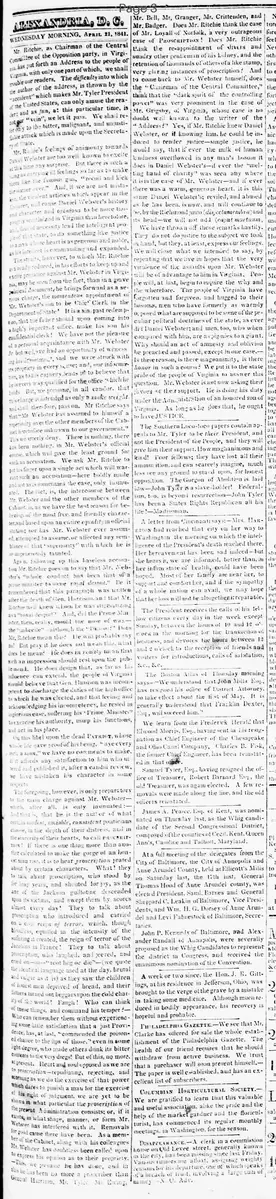
ALEXANDRIA, D. C.
WEDNESDAY MORNING, APRIL 21, 1841.
Committee of the Opposition party, in Virginia, Mr. Ritchie, as Chairman of the Central Committee, has put forth an Address to the people of Virginia, with only one part of which, we shall trouble our readers. The difficulty into which the author of the address, is thrown by the 'accident' which makes Mr. Tyler President of the United States, can only amuse the reader; and as humor at this particular time, is not our 'vein', we let it pass. We shall refer only to the bitter, malignant, and unjustifiable attack which is made upon the Secretary of State.
Daniel Webster are too well known to excite our feelings of animosity towards Mr. Webster's acting as carrying ill feelings so far as to make at this time only surprise. But there is such a thing as carrying ill feelings so far as to make them like the famous gun, 'recoil and kick the owner over.' And, if we are not mistaken, the virulent articles which appear in the Enquirer, will cause Daniel Webster's history and character and opinions to be more thoroughly scrutinized in Virginia than heretofore, and, thus of necessity lead the intelligent people of that state, to do something like justice to a man whose intellect is commanding and expanded, as his heart is as generous and noble.
The slurs, however, to which Mr. Ritchie has stooped, in his efforts to keep up and excite prejudice against Mr. Webster in Virginia, may be seen from the fact, that in a grave and momentous charge, the political document he brings forward as a section, that the father should upon coming into office, make his son his confidential clerk! We have not the pleasure of a personal acquaintance with Mr. Webster Jr but we have had an opportunity of witnessing his deportment as Chief Clerk in the Department of State! It is a sin, past redemption, that Mr. Webster's son to be Chief Clerk in the Department of State! It is a sin, past redemption, ably important office, make his son his Jr but we have had an opportunity of witness of a personal acquaintance with Mr. Webster coafidential clerk! We have not the pleasure ag his deportment, and we were struck with ats propriety in every sense; and, our information, as to his capacity, leads us to believe that Lolds Bur, we presume, in all candor, that Le is every way qualified for the office which he and shall therefore, pass on. Mr. Ritchie says mischarge intended as only a make weight smperiority over the other members of the Cabinet that 'Mr Webster has assumed to himself a met heretofore unknown to our government.' This we utterly deny. There is nothing, there has been nothing, in Mr. Webster's official course, which will give the least ground for such an accusation. We ask Mr. Ritchie to put his finger upon a single act which will warrant such an accusation-here boldly made and not, as sometimes the case, only insinuated. The fact is, the intercourse between Mr. Webster and the other members of the Cabinet, is, as we have the best reason for believing, of the most free, and friendly character, and based upon an entire equality official station; for has Mr. Webster ever assumed, attempted to assume, or affected any semblance of that'superiority' with which he is so ungenerously taunted.
Again, following up this baseless accusation Mr. Ritchie goes on to say that Mr. Webster's 'whole conduct has been that of a poyne minister to some royal despot,' Be it remembered that this paragraph was written after the death of Gen. Harrison, and that Mr. Ritchie well knew whom he was stigmatizing asa 'royal despot' And, did the President, then, really, mould the nose of wax- the 'imbecile' -although the 'person?' Does Mr. Ritchie mean this: He will probably say no But pray if he does not mean this, what does he mean? He does in reality mean that such an impression should rest upon the public mind. He does design that, as far as his influence can extend, the people of Virginia should believe that Gen. Harrison was incompetent to discharge the duties of the high office to which he was elected, and that feeling and acknowledging his incompetency, he rested with inglorious ease, suffering his 'Prime Minister' to exercise his authority, usurp his functions, and act in his place.
On this libel upon the dead Patriot, whose whole life gave proof of his being, 'ave every iet, a man,' we have no comments to make. If it affords any satisfaction to him who uttered and unblushed it, after a candid review, we have mistaken his character in some its aspects.
The foregoing, however, is only preparatory to the main charge against Mr. Webster- which, after all, is only insinuated:- And that is, that he is the author of what certain scdest, amiable, consistent politicians choose, in the depth of their distress, and in the sincerity of their hearts, to call proscription! If there is one thing more than another calculated to make the gorge of an honest man rise, it is to hear proscription prated about by certain characters. What! they to talk about proscription, who stood by for long years, and shouted for joy, as the axe of the Jackson guillotine descended upon its victims, and swept them by scores almost every day! They to talk about proscription who introduced and carried on a career of terror, which, though bloodless, equalled in the intensity of the suffering it created, the reign of terror of the Jacobins in France: They to talk about proscription, who laughed, and jeered, and cried on--'root hog or die'-(we quote the identical language used at the day, brutal and vulgar as it is) as they saw the children of honest men deprived of bread, and their fathers turned out beggars upon the cold charity of the world! Faugh! Who can think of these things, and command his temper ?- Who can remember them without experiencing some little satisfaction that a just Providence, has, at last, 'commended the poisoned chalice to the lips of those,' even in some light degree, who made others drink its bitter contents to the very dregs! But of this, no more, at present. Heart and soul opposed as we are to proscription-repudiating, rejecting, and scorning as we do the exercise of that power which dares to punish a man for the exercise of his right of judgment, we are yet to be shown in what particular the proscription of the present Administration consists; or, if it exists, in what shape, manner, or form Mr. Webster has interfered with it. Removals for good cause there have been. As a member of the Cabinet, along with his colleagues Mr. Webster has doubtless been called upon to express his opinion as to their propriety. —This, he presume he has done, and in this he has been no more a proscriber than General Harrison, Mr. Tyler, Mr. Ewing, Mr. Bell, Mr. Granger, Mr. Crittenden, and Mr. Badger. Does Mr. Ritchie think the case of Mr. Lovell of Norfolk, a very outrageous case of Proscription! Does Mr. Ritchie think the re-appointment of divers and sundry other gentlemen of his kidney, and the retention of thousands of others of a like stamp, very glaring instances of proscription? And to come back to Mr. Webster himself, does the 'Chairman of the Central Committee,' think that the 'dark spirit of the controlling power' was very prominent in the case of Mr. Grigsby, of Virginia, whose case is no doubt well known to the writer of the 'Address?' Yes, if Mr. Ritchie knew Daniel Webster, or if knowing him, he could be induced to render justice-simple justice, he would say, that if ever the milk of human kindness overflowed in any man's bosom it does in Daniel Webster's-if ever the 'melting hand of charity' was seen anywhere it is in the case of Mr. Webster-and if ever there was a warm, generous heart, it is this same Daniel Webster's: reviled, and abused as he has been, is now, and will continue to be, by the Richmond junto (dissectamembra) and its head-we will not add (caput mortuum).
We have thrown off these remarks hastily. They do not do justice to the subject we took in hand, but they, at least, express our feelings. We will close what we intended to say, by repeating that we live in hopes that the very virulence of the assaults upon Mr. Webster will be of advantage to him in Virginia. People will, at last, begin to inquire the why and the wherefore. The people of Virginia have forgotten and forgiven, and hugged to their bosoms, men who have formerly as warmly opposed what are supposed to be some of the peculiar political doctrines of the state, as ever did Daniel Webster; and men, too, who when compared with him, are as pigmies to a giant. Why should an act of amnesty and oblivion be preached and passed, except in one case.- Is there reason, is there magnanimity, is there honor in such a course? We put it to the state pride of the people of Virginia to answer this question. Mr. Webster is not now asking their favors or their support. He is doing his duty under the administration of an honored son of Virginia. As long as he does that, he ought to have JUSTICE.
WEDNESDAY MORNING, APRIL 21, 1841.
Committee of the Opposition party, in Virginia, Mr. Ritchie, as Chairman of the Central Committee, has put forth an Address to the people of Virginia, with only one part of which, we shall trouble our readers. The difficulty into which the author of the address, is thrown by the 'accident' which makes Mr. Tyler President of the United States, can only amuse the reader; and as humor at this particular time, is not our 'vein', we let it pass. We shall refer only to the bitter, malignant, and unjustifiable attack which is made upon the Secretary of State.
Daniel Webster are too well known to excite our feelings of animosity towards Mr. Webster's acting as carrying ill feelings so far as to make at this time only surprise. But there is such a thing as carrying ill feelings so far as to make them like the famous gun, 'recoil and kick the owner over.' And, if we are not mistaken, the virulent articles which appear in the Enquirer, will cause Daniel Webster's history and character and opinions to be more thoroughly scrutinized in Virginia than heretofore, and, thus of necessity lead the intelligent people of that state, to do something like justice to a man whose intellect is commanding and expanded, as his heart is as generous and noble.
The slurs, however, to which Mr. Ritchie has stooped, in his efforts to keep up and excite prejudice against Mr. Webster in Virginia, may be seen from the fact, that in a grave and momentous charge, the political document he brings forward as a section, that the father should upon coming into office, make his son his confidential clerk! We have not the pleasure of a personal acquaintance with Mr. Webster Jr but we have had an opportunity of witnessing his deportment as Chief Clerk in the Department of State! It is a sin, past redemption, that Mr. Webster's son to be Chief Clerk in the Department of State! It is a sin, past redemption, ably important office, make his son his Jr but we have had an opportunity of witness of a personal acquaintance with Mr. Webster coafidential clerk! We have not the pleasure ag his deportment, and we were struck with ats propriety in every sense; and, our information, as to his capacity, leads us to believe that Lolds Bur, we presume, in all candor, that Le is every way qualified for the office which he and shall therefore, pass on. Mr. Ritchie says mischarge intended as only a make weight smperiority over the other members of the Cabinet that 'Mr Webster has assumed to himself a met heretofore unknown to our government.' This we utterly deny. There is nothing, there has been nothing, in Mr. Webster's official course, which will give the least ground for such an accusation. We ask Mr. Ritchie to put his finger upon a single act which will warrant such an accusation-here boldly made and not, as sometimes the case, only insinuated. The fact is, the intercourse between Mr. Webster and the other members of the Cabinet, is, as we have the best reason for believing, of the most free, and friendly character, and based upon an entire equality official station; for has Mr. Webster ever assumed, attempted to assume, or affected any semblance of that'superiority' with which he is so ungenerously taunted.
Again, following up this baseless accusation Mr. Ritchie goes on to say that Mr. Webster's 'whole conduct has been that of a poyne minister to some royal despot,' Be it remembered that this paragraph was written after the death of Gen. Harrison, and that Mr. Ritchie well knew whom he was stigmatizing asa 'royal despot' And, did the President, then, really, mould the nose of wax- the 'imbecile' -although the 'person?' Does Mr. Ritchie mean this: He will probably say no But pray if he does not mean this, what does he mean? He does in reality mean that such an impression should rest upon the public mind. He does design that, as far as his influence can extend, the people of Virginia should believe that Gen. Harrison was incompetent to discharge the duties of the high office to which he was elected, and that feeling and acknowledging his incompetency, he rested with inglorious ease, suffering his 'Prime Minister' to exercise his authority, usurp his functions, and act in his place.
On this libel upon the dead Patriot, whose whole life gave proof of his being, 'ave every iet, a man,' we have no comments to make. If it affords any satisfaction to him who uttered and unblushed it, after a candid review, we have mistaken his character in some its aspects.
The foregoing, however, is only preparatory to the main charge against Mr. Webster- which, after all, is only insinuated:- And that is, that he is the author of what certain scdest, amiable, consistent politicians choose, in the depth of their distress, and in the sincerity of their hearts, to call proscription! If there is one thing more than another calculated to make the gorge of an honest man rise, it is to hear proscription prated about by certain characters. What! they to talk about proscription, who stood by for long years, and shouted for joy, as the axe of the Jackson guillotine descended upon its victims, and swept them by scores almost every day! They to talk about proscription who introduced and carried on a career of terror, which, though bloodless, equalled in the intensity of the suffering it created, the reign of terror of the Jacobins in France: They to talk about proscription, who laughed, and jeered, and cried on--'root hog or die'-(we quote the identical language used at the day, brutal and vulgar as it is) as they saw the children of honest men deprived of bread, and their fathers turned out beggars upon the cold charity of the world! Faugh! Who can think of these things, and command his temper ?- Who can remember them without experiencing some little satisfaction that a just Providence, has, at last, 'commended the poisoned chalice to the lips of those,' even in some light degree, who made others drink its bitter contents to the very dregs! But of this, no more, at present. Heart and soul opposed as we are to proscription-repudiating, rejecting, and scorning as we do the exercise of that power which dares to punish a man for the exercise of his right of judgment, we are yet to be shown in what particular the proscription of the present Administration consists; or, if it exists, in what shape, manner, or form Mr. Webster has interfered with it. Removals for good cause there have been. As a member of the Cabinet, along with his colleagues Mr. Webster has doubtless been called upon to express his opinion as to their propriety. —This, he presume he has done, and in this he has been no more a proscriber than General Harrison, Mr. Tyler, Mr. Ewing, Mr. Bell, Mr. Granger, Mr. Crittenden, and Mr. Badger. Does Mr. Ritchie think the case of Mr. Lovell of Norfolk, a very outrageous case of Proscription! Does Mr. Ritchie think the re-appointment of divers and sundry other gentlemen of his kidney, and the retention of thousands of others of a like stamp, very glaring instances of proscription? And to come back to Mr. Webster himself, does the 'Chairman of the Central Committee,' think that the 'dark spirit of the controlling power' was very prominent in the case of Mr. Grigsby, of Virginia, whose case is no doubt well known to the writer of the 'Address?' Yes, if Mr. Ritchie knew Daniel Webster, or if knowing him, he could be induced to render justice-simple justice, he would say, that if ever the milk of human kindness overflowed in any man's bosom it does in Daniel Webster's-if ever the 'melting hand of charity' was seen anywhere it is in the case of Mr. Webster-and if ever there was a warm, generous heart, it is this same Daniel Webster's: reviled, and abused as he has been, is now, and will continue to be, by the Richmond junto (dissectamembra) and its head-we will not add (caput mortuum).
We have thrown off these remarks hastily. They do not do justice to the subject we took in hand, but they, at least, express our feelings. We will close what we intended to say, by repeating that we live in hopes that the very virulence of the assaults upon Mr. Webster will be of advantage to him in Virginia. People will, at last, begin to inquire the why and the wherefore. The people of Virginia have forgotten and forgiven, and hugged to their bosoms, men who have formerly as warmly opposed what are supposed to be some of the peculiar political doctrines of the state, as ever did Daniel Webster; and men, too, who when compared with him, are as pigmies to a giant. Why should an act of amnesty and oblivion be preached and passed, except in one case.- Is there reason, is there magnanimity, is there honor in such a course? We put it to the state pride of the people of Virginia to answer this question. Mr. Webster is not now asking their favors or their support. He is doing his duty under the administration of an honored son of Virginia. As long as he does that, he ought to have JUSTICE.
What sub-type of article is it?
Partisan Politics
What keywords are associated?
Daniel Webster
Thomas Ritchie
Virginia Opposition
Cabinet Defense
Political Proscription
Nepotism Charge
Harrison Libel
What entities or persons were involved?
Daniel Webster
Thomas Ritchie
John Tyler
William Henry Harrison
Webster Jr.
Mr. Lovell
Mr. Grigsby
Editorial Details
Primary Topic
Defense Of Daniel Webster Against Thomas Ritchie's Attacks
Stance / Tone
Strongly Pro Webster, Anti Ritchie And Virginia Democrats
Key Figures
Daniel Webster
Thomas Ritchie
John Tyler
William Henry Harrison
Webster Jr.
Mr. Lovell
Mr. Grigsby
Key Arguments
Ritchie's Attack On Webster's Appointment Of His Son As Clerk Is Unjust; Son Is Qualified.
Webster Has Not Assumed Superiority In The Cabinet; Relations Are Equal And Friendly.
Ritchie's 'Prime Minister' Accusation Libels Harrison As Incompetent.
Accusations Of Proscription By Democrats Are Hypocritical Given Jackson Era Purges.
Webster Is Merciful And Not Involved In Proscriptions; Calls For Justice In Virginia.