Thank you for visiting SNEWPapers!
Sign up free
Literary
May 19, 1837
The Hillsborough Recorder
Hillsboro, Orange County, North Carolina
What is this article about?
A young Virginian lawyer arrives penniless in an Arkansas village, entertains at a grog shop with fiddle playing, singing, and jumping to win clients, rises to prominence but dies from dissipation. Followed by a moral on combining education with moral principles to prevent intelligent villainy.
Merged-components note: These components continue the narrative tale 'An Arkansas Lawyer,' a work of fiction; the appended moral reflection is included as part of the literary piece, overriding the original editorial label.
Clipping
OCR Quality
95%
Excellent
Full Text
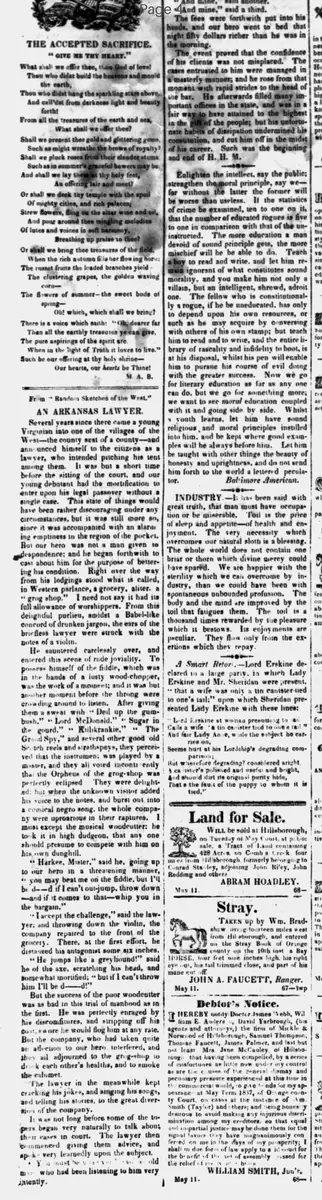
AN ARKANSAS LAWYER.
Several years since there came a young Virginian into one of the villages of the West-the county seat of a County-and announced himself to the citizens as a lawyer, who intended pitching his tent among them. It was but a short time before the sitting of the court. and our young debutant had the mortification to enter upon his legal passover without a single case. This state of things would have been rather discouraging under any circumstances, but it was still more so, since it was accompanied with an alarming emptiness in the region of the pocket.
But our hero was not a man given to despondence; and he began forthwith to cast about him for the purpose of bettering his condition. Right over the way from his lodgings stood what is called, in Western parlance, a grocery, alias a "grog shop." I need not say it had its full allowance of worshippers. From this delightful purlieu, amidst a Babel-like concord of drunken jargon, the ears of the briefless lawyer were struck with the notes of a violin.
He sauntered carelessly over, and entered this scene of rude joviality. To possess himself of the fiddle, which was in the hands of a lusty wood-chopper, was the work of a moment; and it was but another moment before the throng were crowding around to listen. After giving them a "swart wub" "Deil up the gum-bush," "Lord MacDonald," "Sugar in the gourd," "Kilikrankie," "The Gre'd Spy," and several other "good old Scotch reels and strathspeys, they perceived that the instrument was played by a master, and they all voted unanimously that the Orpheus of the grog-shop was perfectly eclipsed They were delighted; but when the unknown visitor added his voice to the notes. and burst out into a comical negro song, the whole company were uproarious in their raptures. I must except the musical woodcutter: he took it in high dudgeon, that any one should presume to compete with him on his own dunghill.
"Harkee, Mister," said he, going up to our hero in a threatening manner, "you may beat me on the fiddle, but I'll be d--d if I can't out-jump. throw down -and if it comes to that-whip you in the bargain."
"I accept the challenge," said the lawyer; and throwing down the violin, the company repaired to the front of the grocery. There. at the first effort. he distanced his antagonist some six inches.
"He jumps like a greyhound!" said he of the axe, scratching his head, and somewhat mortified; " but if I can't throw him I'll be d--d!"
But the success of the poor woodcutter was as bad in this trial of manhood as in the first. He was perfectly enraged by his discomfitures, and stripping off his coat, swore he would flog him at any rate. But the company, who had taken quite an affection to our hero interfered, and they all adjourned to the grog-shop to drink each other's healths, and to smoke the calumet.
The lawyer in the meanwhile kept cracking his jokes, and singing his songs, and telling his stories, in the great diversion of the company.
It was not long before some of the topers began very naturally to talk about their cases in court. The lawyer then commenced giving them advice, and spoke very learnedly upon the subject.
"You must be a lawyer," said an old man who had been listening to him very intently.
The fees were forthwith put into his hands, and our hero went to bed that night fifty dollars richer than he was in the morning.
The event proved that the confidence of his clients was not misplaced. The cases entrusted to him were managed in a masterly manner; and he rose from that moment with rapid strides to the head of the bar. He afterwards filled many important offices in the state, and was in a fair way to have attained to the highest in the gift of the people; but his unfortunate habits of dissipation undermined his constitution, and cut him off in the midst of his career. Such was the beginning and end of H. H. M.
Enlighten the intellect, say the public; strengthen the moral principle, say we- for without the latter the former will be worse than useless. If the statistics of crime be examined, ten to one on it, that the number of educated rogues is five to one in comparison with that of the un-instructed. The more education a man devoid of sound principle gets, the more mischief will he be able to do. Teach a boy to read and write, and let him remain ignorant of what constitutes sound morality, and you make him not only a villain, but an intelligent, shrewd, adroit one. The fellow who is constitutionally a rogue, if he be uneducated. has only to depend upon his own resources, or such as he may acquire by conversing with others of his own stamp; but teach him to read and to write, and the entire library of rascality and infidelity to boot, is at his disposal, whilst his pen will enable him to pursue his course of evil doing with the greater success. Now we go for literary education as far as any one can do. but we go for something more; we want to see moral education coupled with it and going side by side. Whilst youth learns, let him have sound religious, and moral principles instilled into him. and be kept where good examples will be always before him. Let him be taught with other things the beauty of honesty and uprightness, and do not send him forth to the world a lettered peculator.
Several years since there came a young Virginian into one of the villages of the West-the county seat of a County-and announced himself to the citizens as a lawyer, who intended pitching his tent among them. It was but a short time before the sitting of the court. and our young debutant had the mortification to enter upon his legal passover without a single case. This state of things would have been rather discouraging under any circumstances, but it was still more so, since it was accompanied with an alarming emptiness in the region of the pocket.
But our hero was not a man given to despondence; and he began forthwith to cast about him for the purpose of bettering his condition. Right over the way from his lodgings stood what is called, in Western parlance, a grocery, alias a "grog shop." I need not say it had its full allowance of worshippers. From this delightful purlieu, amidst a Babel-like concord of drunken jargon, the ears of the briefless lawyer were struck with the notes of a violin.
He sauntered carelessly over, and entered this scene of rude joviality. To possess himself of the fiddle, which was in the hands of a lusty wood-chopper, was the work of a moment; and it was but another moment before the throng were crowding around to listen. After giving them a "swart wub" "Deil up the gum-bush," "Lord MacDonald," "Sugar in the gourd," "Kilikrankie," "The Gre'd Spy," and several other "good old Scotch reels and strathspeys, they perceived that the instrument was played by a master, and they all voted unanimously that the Orpheus of the grog-shop was perfectly eclipsed They were delighted; but when the unknown visitor added his voice to the notes. and burst out into a comical negro song, the whole company were uproarious in their raptures. I must except the musical woodcutter: he took it in high dudgeon, that any one should presume to compete with him on his own dunghill.
"Harkee, Mister," said he, going up to our hero in a threatening manner, "you may beat me on the fiddle, but I'll be d--d if I can't out-jump. throw down -and if it comes to that-whip you in the bargain."
"I accept the challenge," said the lawyer; and throwing down the violin, the company repaired to the front of the grocery. There. at the first effort. he distanced his antagonist some six inches.
"He jumps like a greyhound!" said he of the axe, scratching his head, and somewhat mortified; " but if I can't throw him I'll be d--d!"
But the success of the poor woodcutter was as bad in this trial of manhood as in the first. He was perfectly enraged by his discomfitures, and stripping off his coat, swore he would flog him at any rate. But the company, who had taken quite an affection to our hero interfered, and they all adjourned to the grog-shop to drink each other's healths, and to smoke the calumet.
The lawyer in the meanwhile kept cracking his jokes, and singing his songs, and telling his stories, in the great diversion of the company.
It was not long before some of the topers began very naturally to talk about their cases in court. The lawyer then commenced giving them advice, and spoke very learnedly upon the subject.
"You must be a lawyer," said an old man who had been listening to him very intently.
The fees were forthwith put into his hands, and our hero went to bed that night fifty dollars richer than he was in the morning.
The event proved that the confidence of his clients was not misplaced. The cases entrusted to him were managed in a masterly manner; and he rose from that moment with rapid strides to the head of the bar. He afterwards filled many important offices in the state, and was in a fair way to have attained to the highest in the gift of the people; but his unfortunate habits of dissipation undermined his constitution, and cut him off in the midst of his career. Such was the beginning and end of H. H. M.
Enlighten the intellect, say the public; strengthen the moral principle, say we- for without the latter the former will be worse than useless. If the statistics of crime be examined, ten to one on it, that the number of educated rogues is five to one in comparison with that of the un-instructed. The more education a man devoid of sound principle gets, the more mischief will he be able to do. Teach a boy to read and write, and let him remain ignorant of what constitutes sound morality, and you make him not only a villain, but an intelligent, shrewd, adroit one. The fellow who is constitutionally a rogue, if he be uneducated. has only to depend upon his own resources, or such as he may acquire by conversing with others of his own stamp; but teach him to read and to write, and the entire library of rascality and infidelity to boot, is at his disposal, whilst his pen will enable him to pursue his course of evil doing with the greater success. Now we go for literary education as far as any one can do. but we go for something more; we want to see moral education coupled with it and going side by side. Whilst youth learns, let him have sound religious, and moral principles instilled into him. and be kept where good examples will be always before him. Let him be taught with other things the beauty of honesty and uprightness, and do not send him forth to the world a lettered peculator.
What sub-type of article is it?
Prose Fiction
Essay
What themes does it cover?
Moral Virtue
What keywords are associated?
Arkansas Lawyer
Grog Shop
Fiddle Playing
Moral Education
Dissipation
Educated Rogues
Literary Details
Title
An Arkansas Lawyer.
Key Lines
"Harkee, Mister," Said He, Going Up To Our Hero In A Threatening Manner, "You May Beat Me On The Fiddle, But I'll Be D D If I Can't Out Jump. Throw Down And If It Comes To That Whip You In The Bargain."
"You Must Be A Lawyer," Said An Old Man Who Had Been Listening To Him Very Intently.
Such Was The Beginning And End Of H. H. M.
Enlighten The Intellect, Say The Public; Strengthen The Moral Principle, Say We For Without The Latter The Former Will Be Worse Than Useless.