Thank you for visiting SNEWPapers!
Sign up free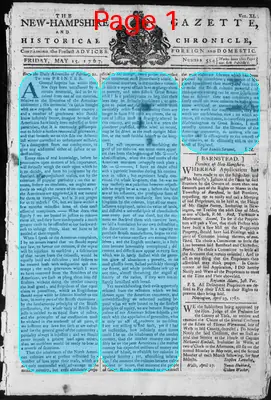
Letter to Editor
May 15, 1767
The New Hampshire Gazette And Historical Chronicle
Portsmouth, Greenland, Rockingham County, New Hampshire
What is this article about?
A letter from February 21 argues for liberating American commerce by repealing restrictive trade laws that harm both colonies and Britain, emphasizing constitutional justice, equal protection, and mutual economic benefits, critiquing past policies under Mr. G--.
Clipping
OCR Quality
98%
Excellent
Full Text
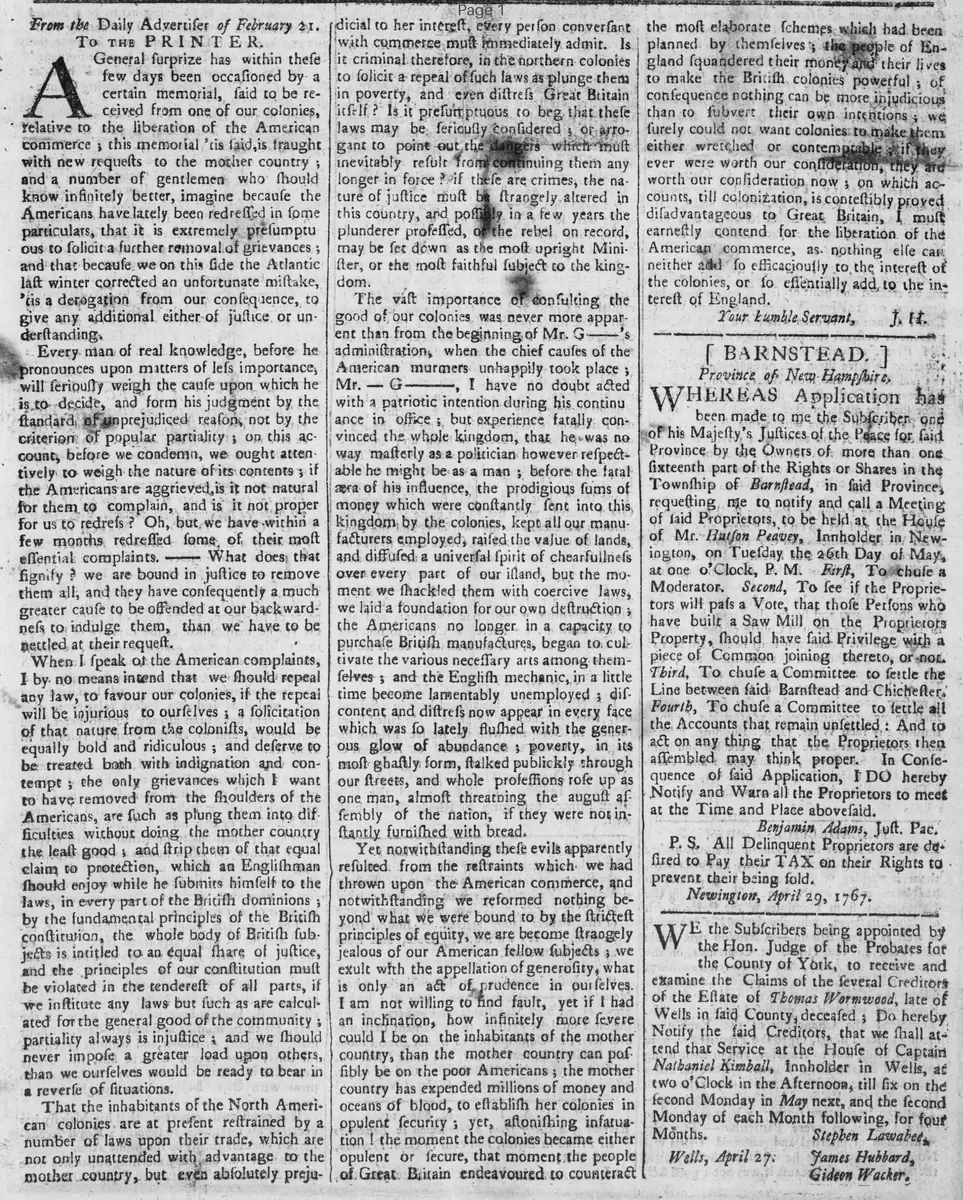
From the Daily Advertiser of February 21.
TO THE PRINTER.
General surprise has within these few days been occasioned by a certain memorial, said to be received from one of our colonies, relative to the liberation of the American commerce; this memorial 'tis said, is fraught with new requests to the mother country; and a number of gentlemen who should know infinitely better, imagine because the Americans have lately been redressed in some particulars, that it is extremely presumptuous to solicit further removal of grievances; and that because we on this side the Atlantic last winter corrected an unfortunate mistake, 'tis a derogation from our consequence, to give any additional either of justice or understanding.
Every man of real knowledge, before he pronounces upon matters of less importance, will seriously weigh the cause upon which he is to decide, and form his judgment by the standard of unprejudiced reason, not by the criterion of popular partiality; on this account, before we condemn, we ought attentively to weigh the nature of its contents; if the Americans are aggrieved, is it not natural for them to complain, and is it not proper for us to redress? Oh, but we have within a few months redressed some of their most essential complaints. So what does that signify? we are bound in justice to remove them all, and they have consequently a much greater cause to be offended at our backwardness to indulge them, than we have to be nettled at their request.
When I speak of the American complaints, I by no means intend that we should repeal any law, to favour our colonies, if the repeal will be injurious to ourselves; a solicitation of that nature from the colonists, would be equally bold and ridiculous; and deserve to be treated both with indignation and contempt; the only grievances which I want to have removed from the shoulders of the Americans, are such as plunge them into difficulties without doing the mother country the least good; and strip them of that equal claim to protection, which an Englishman should enjoy while he submits himself to the laws, in every part of the British dominions: by the fundamental principles of the British constitution, the whole body of British subjects is entitled to an equal share of justice, and the principles of our constitution must be violated in the tenderest of all parts, if we institute any laws but such as are calculated for the general good of the community; partiality always is injustice; and we should never impose a greater load upon others, than we ourselves would be ready to bear in a reverse of situations.
That the inhabitants of the North American colonies are at present restrained by a number of laws upon their trade, which are not only unattended with advantage to the mother country, but even absolutely prejudicial to her interest, every person conversant with commerce must immediately admit. Is it criminal therefore, in the northern colonies to solicit a repeal of such laws as plunge them in poverty, and even distress Great Britain itself? Is it presumptuous to beg that these laws may be seriously considered; or arrogant to point out the dangers which must inevitably result from continuing them any longer in force? if these are crimes, the nature of justice must be strangely altered in this country, and possibly in a few years the plunderer professed, or the rebel on record, may be set down as the most upright Minister, or the most faithful subject to the kingdom.
The vast importance of consulting the good of our colonies was never more apparent than from the beginning of Mr. G--'s administration, when the chief causes of the American murmurs unhappily took place; Mr. G-, I have no doubt acted with a patriotic intention during his continuance in office; but experience fatally convinced the whole kingdom, that he was no way masterly as a politician however respectable he might be as a man; before the fatal era of his influence, the prodigious sums of money which were constantly sent into this kingdom by the colonies, kept all our manufacturers employed, raised the value of lands, and diffused a universal spirit of cheerfulness over every part of our island, but the moment we shackled them with coercive laws, we laid a foundation for our own destruction; the Americans no longer in a capacity to purchase British manufactures, began to cultivate the various necessary arts among themselves; and the English mechanic in a little time became lamentably unemployed; discontent and distress now appear in every face which was so lately flushed with the generous glow of abundance; poverty, in its most ghastly form, stalked publicly through our streets, and whole professions rose up as one man, almost threatening the august assembly of the nation, if they were not instantly furnished with bread.
Yet notwithstanding these evils apparently resulted from the restraints which we had thrown upon the American commerce, and notwithstanding we reformed nothing beyond what we were bound to by the strictest principles of equity, we are become strangely jealous of our American fellow subjects; we exult with the appellation of generosity, what is only an act of prudence in ourselves. I am not willing to find fault, yet if I had an inclination, how infinitely more severe could I be on the inhabitants of the mother country, than the mother country can possibly be on the poor Americans; the mother country has expended millions of money and oceans of blood, to establish her colonies in opulent security; yet, astonishing infatuation! the moment the colonies became either opulent or secure, that moment the people of Great Britain endeavoured to counteract the most elaborate schemes which had been planned by themselves; the people of England squandered their money and their lives to make the British colonies powerful; of consequence nothing can be more injudicious than to subvert their own intentions; we surely could not want colonies to make them either wretched or contemptible: if they ever were worth our consideration, they are worth our consideration now; on which accounts, till colonization is incontestibly proved disadvantageous to Great Britain, I must earnestly contend for the liberation of the American commerce, as nothing else can neither add so efficaciously to the interest of the colonies, or so essentially add to the interest of England.
Your humble Servant,
J. TT.
TO THE PRINTER.
General surprise has within these few days been occasioned by a certain memorial, said to be received from one of our colonies, relative to the liberation of the American commerce; this memorial 'tis said, is fraught with new requests to the mother country; and a number of gentlemen who should know infinitely better, imagine because the Americans have lately been redressed in some particulars, that it is extremely presumptuous to solicit further removal of grievances; and that because we on this side the Atlantic last winter corrected an unfortunate mistake, 'tis a derogation from our consequence, to give any additional either of justice or understanding.
Every man of real knowledge, before he pronounces upon matters of less importance, will seriously weigh the cause upon which he is to decide, and form his judgment by the standard of unprejudiced reason, not by the criterion of popular partiality; on this account, before we condemn, we ought attentively to weigh the nature of its contents; if the Americans are aggrieved, is it not natural for them to complain, and is it not proper for us to redress? Oh, but we have within a few months redressed some of their most essential complaints. So what does that signify? we are bound in justice to remove them all, and they have consequently a much greater cause to be offended at our backwardness to indulge them, than we have to be nettled at their request.
When I speak of the American complaints, I by no means intend that we should repeal any law, to favour our colonies, if the repeal will be injurious to ourselves; a solicitation of that nature from the colonists, would be equally bold and ridiculous; and deserve to be treated both with indignation and contempt; the only grievances which I want to have removed from the shoulders of the Americans, are such as plunge them into difficulties without doing the mother country the least good; and strip them of that equal claim to protection, which an Englishman should enjoy while he submits himself to the laws, in every part of the British dominions: by the fundamental principles of the British constitution, the whole body of British subjects is entitled to an equal share of justice, and the principles of our constitution must be violated in the tenderest of all parts, if we institute any laws but such as are calculated for the general good of the community; partiality always is injustice; and we should never impose a greater load upon others, than we ourselves would be ready to bear in a reverse of situations.
That the inhabitants of the North American colonies are at present restrained by a number of laws upon their trade, which are not only unattended with advantage to the mother country, but even absolutely prejudicial to her interest, every person conversant with commerce must immediately admit. Is it criminal therefore, in the northern colonies to solicit a repeal of such laws as plunge them in poverty, and even distress Great Britain itself? Is it presumptuous to beg that these laws may be seriously considered; or arrogant to point out the dangers which must inevitably result from continuing them any longer in force? if these are crimes, the nature of justice must be strangely altered in this country, and possibly in a few years the plunderer professed, or the rebel on record, may be set down as the most upright Minister, or the most faithful subject to the kingdom.
The vast importance of consulting the good of our colonies was never more apparent than from the beginning of Mr. G--'s administration, when the chief causes of the American murmurs unhappily took place; Mr. G-, I have no doubt acted with a patriotic intention during his continuance in office; but experience fatally convinced the whole kingdom, that he was no way masterly as a politician however respectable he might be as a man; before the fatal era of his influence, the prodigious sums of money which were constantly sent into this kingdom by the colonies, kept all our manufacturers employed, raised the value of lands, and diffused a universal spirit of cheerfulness over every part of our island, but the moment we shackled them with coercive laws, we laid a foundation for our own destruction; the Americans no longer in a capacity to purchase British manufactures, began to cultivate the various necessary arts among themselves; and the English mechanic in a little time became lamentably unemployed; discontent and distress now appear in every face which was so lately flushed with the generous glow of abundance; poverty, in its most ghastly form, stalked publicly through our streets, and whole professions rose up as one man, almost threatening the august assembly of the nation, if they were not instantly furnished with bread.
Yet notwithstanding these evils apparently resulted from the restraints which we had thrown upon the American commerce, and notwithstanding we reformed nothing beyond what we were bound to by the strictest principles of equity, we are become strangely jealous of our American fellow subjects; we exult with the appellation of generosity, what is only an act of prudence in ourselves. I am not willing to find fault, yet if I had an inclination, how infinitely more severe could I be on the inhabitants of the mother country, than the mother country can possibly be on the poor Americans; the mother country has expended millions of money and oceans of blood, to establish her colonies in opulent security; yet, astonishing infatuation! the moment the colonies became either opulent or secure, that moment the people of Great Britain endeavoured to counteract the most elaborate schemes which had been planned by themselves; the people of England squandered their money and their lives to make the British colonies powerful; of consequence nothing can be more injudicious than to subvert their own intentions; we surely could not want colonies to make them either wretched or contemptible: if they ever were worth our consideration, they are worth our consideration now; on which accounts, till colonization is incontestibly proved disadvantageous to Great Britain, I must earnestly contend for the liberation of the American commerce, as nothing else can neither add so efficaciously to the interest of the colonies, or so essentially add to the interest of England.
Your humble Servant,
J. TT.
What sub-type of article is it?
Persuasive
Political
Ethical Moral
What themes does it cover?
Commerce Trade
Economic Policy
Constitutional Rights
What keywords are associated?
American Commerce
Trade Restrictions
British Colonies
Constitutional Justice
Economic Grievances
George Grenville
Colonial Policy
What entities or persons were involved?
J. Tt.
The Printer
Letter to Editor Details
Author
J. Tt.
Recipient
The Printer
Main Argument
britain should repeal trade laws restricting american colonies that harm both parties, as they violate constitutional principles of equal justice and protection, and only benefit neither side.
Notable Details
References Mr. G 'S Administration
Impact On British Manufacturers And Economy
British Constitution And Equal Protection
Historical Context Of Colonial Trade Restrictions