Thank you for visiting SNEWPapers!
Sign up free
Editorial
March 12, 1834
Rhode Island Constitutionalist
Providence, Providence County, Rhode Island
What is this article about?
Editorial advocating for comprehensive mental education beyond basic literacy to alleviate poverty, reduce crime and drunkenness, and strengthen republican government, drawing on English and French examples.
Clipping
OCR Quality
98%
Excellent
Full Text
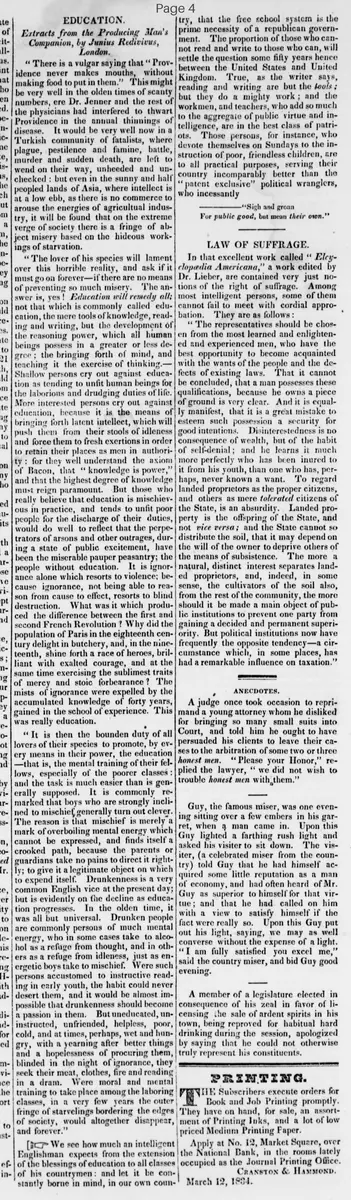
EDUCATION.
Extracts from the Producing Man's Companion, by Junius Redivivus, London.
"There is a vulgar saying that "Providence never makes mouths, without making food to put in them." This might be very well in the olden times of scanty numbers, ere Dr. Jenner and the rest of the physicians had interfered to thwart Providence in the annual thinnings of disease. It would be very well now in a Turkish community of fatalists, where plague, pestilence and famine, battle, murder and sudden death, are left to wend on their way, unheeded and unchecked: but even in the sunny and half peopled lands of Asia, where intellect is at a low ebb, as there is no commerce to arouse the energies of agricultural industry, it will be found that on the extreme verge of society there is a fringe of abject misery based on the hideous workings of starvation.
The lover of his species will lament over this horrible reality, and ask if it must go on forever—if there are no means of preventing so much misery. The answer is, yes! Education will remedy all—not that which is commonly called education, the mere tools of knowledge, reading and writing, but the development of the reasoning power, which all human beings possess in a greater or less degree; the bringing forth of mind, and teaching it the exercise of thinking.
Shallow persons cry out against education as tending to unfit human beings for the laborious and drudging duties of life. More interested persons cry out against education, because it is the means of bringing forth latent intellect, which will push them from their stools of idleness and force them to fresh exertions in order to retain their places as men in authority: for they well understand the axiom of Bacon, that "knowledge is power." and that the highest degree of knowledge must reign paramount.
But those who really believe that education is mischievous in practice, and tends to unfit poor people for the discharge of their duties, would do well to reflect that the perpetrators of arsons and other outrages, during a state of public excitement, have been the miserable pauper peasantry; the people without education. It is ignorance alone which resorts to violence; because ignorance, not being able to reason from cause to effect, resorts to blind destruction.
What was it which produced the difference between the first and second French Revolution? Why did the population of Paris in the eighteenth century delight in butchery, and, in the nineteenth, shine forth a race of heroes, brilliant with exalted courage, and at the same time exercising the sublimest traits of mercy and stoic forbearance? The mists of ignorance were expelled by the accumulated knowledge of forty years, gained in the school of experience. This was really education.
It is then the bounden duty of all lovers of their species to promote, by every means in their power, the education—that is, the mental training of their fellows, especially of the poorer classes: and the task is much easier than is generally supposed. It is commonly remarked that boys who are strongly inclined to mischief generally turn out clever. The reason is that mischief is merely a mark of overboiling mental energy which cannot be expressed, and finds itself a crooked path, because the parents or guardians take no pains to direct it rightly; to give it a legitimate object on which to expend itself.
Drunkenness is a very common English vice at the present day: but is evidently on the decline as education progresses. In the olden time, it was all but universal. Drunken people are commonly persons of much mental energy, who in some cases take to alcohol as a refuge from thought, and in others as a refuge from idleness, just as energetic boys take to mischief. Were such persons accustomed to instructive reading in early youth, the habit could never desert them, and it would be almost impossible that drunkenness should become a passion in them.
But uneducated, uninstructed, unfriended, helpless, poor, cold, and at times, perhaps, wet and hungry, with a yearning after better things and a hopelessness of procuring them, blinded in the night of ignorance, they seek their meat, clothes, fire and reading in a dram.
Were moral and mental training to take place among the laboring classes, in a very few years the outer fringe of starvelings bordering the edges of society, would altogether disappear, and forever.
We see how much an intelligent Englishman expects from the extension of the blessings of education to all classes of his countrymen: and let it be constantly borne in mind, in our own country, that the free school system is the prime necessity of a republican government. The proportion of those who cannot read and write to those who can, will settle the question some fifty years hence between the United States and United Kingdom. True, as the writer says, reading and writing are but the tools; but they do a mighty work; and the workmen, and teachers, who add so much to the aggregate of public virtue and intelligence, are in the best class of patriots. Those persons, for instance, who devote themselves on Sundays to the instruction of poor, friendless children, are to all practical purposes, serving their country incomparably better than the "patent exclusive" political wranglers, who incessantly
"Sigh and groan
For public good, but mean their own."
Extracts from the Producing Man's Companion, by Junius Redivivus, London.
"There is a vulgar saying that "Providence never makes mouths, without making food to put in them." This might be very well in the olden times of scanty numbers, ere Dr. Jenner and the rest of the physicians had interfered to thwart Providence in the annual thinnings of disease. It would be very well now in a Turkish community of fatalists, where plague, pestilence and famine, battle, murder and sudden death, are left to wend on their way, unheeded and unchecked: but even in the sunny and half peopled lands of Asia, where intellect is at a low ebb, as there is no commerce to arouse the energies of agricultural industry, it will be found that on the extreme verge of society there is a fringe of abject misery based on the hideous workings of starvation.
The lover of his species will lament over this horrible reality, and ask if it must go on forever—if there are no means of preventing so much misery. The answer is, yes! Education will remedy all—not that which is commonly called education, the mere tools of knowledge, reading and writing, but the development of the reasoning power, which all human beings possess in a greater or less degree; the bringing forth of mind, and teaching it the exercise of thinking.
Shallow persons cry out against education as tending to unfit human beings for the laborious and drudging duties of life. More interested persons cry out against education, because it is the means of bringing forth latent intellect, which will push them from their stools of idleness and force them to fresh exertions in order to retain their places as men in authority: for they well understand the axiom of Bacon, that "knowledge is power." and that the highest degree of knowledge must reign paramount.
But those who really believe that education is mischievous in practice, and tends to unfit poor people for the discharge of their duties, would do well to reflect that the perpetrators of arsons and other outrages, during a state of public excitement, have been the miserable pauper peasantry; the people without education. It is ignorance alone which resorts to violence; because ignorance, not being able to reason from cause to effect, resorts to blind destruction.
What was it which produced the difference between the first and second French Revolution? Why did the population of Paris in the eighteenth century delight in butchery, and, in the nineteenth, shine forth a race of heroes, brilliant with exalted courage, and at the same time exercising the sublimest traits of mercy and stoic forbearance? The mists of ignorance were expelled by the accumulated knowledge of forty years, gained in the school of experience. This was really education.
It is then the bounden duty of all lovers of their species to promote, by every means in their power, the education—that is, the mental training of their fellows, especially of the poorer classes: and the task is much easier than is generally supposed. It is commonly remarked that boys who are strongly inclined to mischief generally turn out clever. The reason is that mischief is merely a mark of overboiling mental energy which cannot be expressed, and finds itself a crooked path, because the parents or guardians take no pains to direct it rightly; to give it a legitimate object on which to expend itself.
Drunkenness is a very common English vice at the present day: but is evidently on the decline as education progresses. In the olden time, it was all but universal. Drunken people are commonly persons of much mental energy, who in some cases take to alcohol as a refuge from thought, and in others as a refuge from idleness, just as energetic boys take to mischief. Were such persons accustomed to instructive reading in early youth, the habit could never desert them, and it would be almost impossible that drunkenness should become a passion in them.
But uneducated, uninstructed, unfriended, helpless, poor, cold, and at times, perhaps, wet and hungry, with a yearning after better things and a hopelessness of procuring them, blinded in the night of ignorance, they seek their meat, clothes, fire and reading in a dram.
Were moral and mental training to take place among the laboring classes, in a very few years the outer fringe of starvelings bordering the edges of society, would altogether disappear, and forever.
We see how much an intelligent Englishman expects from the extension of the blessings of education to all classes of his countrymen: and let it be constantly borne in mind, in our own country, that the free school system is the prime necessity of a republican government. The proportion of those who cannot read and write to those who can, will settle the question some fifty years hence between the United States and United Kingdom. True, as the writer says, reading and writing are but the tools; but they do a mighty work; and the workmen, and teachers, who add so much to the aggregate of public virtue and intelligence, are in the best class of patriots. Those persons, for instance, who devote themselves on Sundays to the instruction of poor, friendless children, are to all practical purposes, serving their country incomparably better than the "patent exclusive" political wranglers, who incessantly
"Sigh and groan
For public good, but mean their own."
What sub-type of article is it?
Education
Social Reform
Moral Or Religious
What keywords are associated?
Education Reform
Mental Training
Social Improvement
Ignorance Dangers
Drunkenness Decline
Republican Government
Free Schools
What entities or persons were involved?
Junius Redivivus
Dr. Jenner
Bacon
French Revolution Participants
English Society
United States
United Kingdom
Editorial Details
Primary Topic
Advocacy For Mental Education To Prevent Social Ills
Stance / Tone
Strong Advocacy For Comprehensive Education
Key Figures
Junius Redivivus
Dr. Jenner
Bacon
French Revolution Participants
English Society
United States
United Kingdom
Key Arguments
Education Develops Reasoning To Prevent Misery And Starvation
Ignorance Leads To Violence And Crime
True Education Transformed The French Revolution From Butchery To Heroism
Mental Training Redirects Youthful Energy From Mischief To Productive Pursuits
Education Reduces Drunkenness By Providing Alternatives To Idleness
Free Schools Essential For Republican Government
Teachers Are True Patriots Compared To Self Interested Politicians