Thank you for visiting SNEWPapers!
Sign up free
Editorial
September 27, 1813
Portland Gazette, And Maine Advertiser
Portland, Cumberland County, Maine
What is this article about?
An editorial critiques the U.S. War of 1812 efforts, arguing that conquering Canada offers no value and resolving impressment would harm American seamen. It questions the administration's rejection of peace offers and suggests possible French (Napoleonic) influence on U.S. policy.
Clipping
OCR Quality
95%
Excellent
Full Text
Political Miscellany.
Seasonable Reflections.
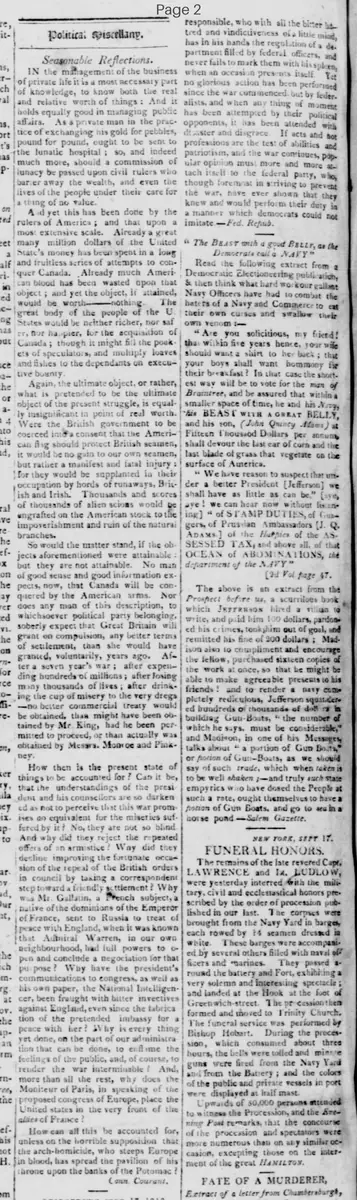
IN the management of the business of private life it is a most necessary part of knowledge, to know both the real and relative worth of things: And it holds equally good in managing public affairs. As a private man in the practice of exchanging his gold for pebbles, pound for pound, ought to be sent to the lunatic hospital; so, and indeed much more, should a commission of lunacy be passed upon civil rulers who barter away the wealth, and even the lives of the people under their care for a thing of no value.
And yet this has been done by the rulers of America: and that upon a most extensive scale. Already a great many million dollars of the United States' money has been spent in a long and fruitless Series of attempts to conquer Canada. Already much American blood has been wasted upon that object; and yet the object, if attained, would be worth nothing. The great body of the people of the U. States would be neither richer, nor safer, nor happier, for the acquisition of Canada: though it might fill the pockets of speculators, and multiply loaves and fishes to the dependants on executive bounty.
Again, the ultimate object, or rather, what is pretended to be the ultimate object of the present struggle, is equally insignificant in point of real worth. Were the British government to be coerced into a consent that the American flag should protect British seamen, it would be no gain to our own seamen, but rather a manifest and fatal injury: for they would be supplanted in their occupation by hordes of runaways, British and Irish. Thousands and scores of thousands of alien scions would be engrafted on the American stock to the impoverishment and ruin of the natural branches.
So would the matter stand, if the objects aforementioned were attainable: but they are not attainable. No man of good sense and good information expects, now, that Canada will be conquered by the American arms. Nor does any man of this description, to whichsoever political party belonging, soberly expect that Great Britain will grant on compulsion, any better terms of settlement, than she would have granted, voluntarily, years ago.
After a seven years' war; after expending hundreds of millions; after losing many thousands of lives; after drinking the cup of misery to the very dregs—no better commercial treaty would be obtained, than might have been obtained by Mr. King, had he been permitted to proceed, or than actually was obtained by Messrs. Monroe and Pinkney.
How then is the present state of things to be accounted for? Can it be, that the understandings of the president and his counsellors are so darkened as not to perceive that this war promises no equivalent for the miseries suffered by it? No, they are not so blind. And why did they reject the repeated offers of an armistice? Why did they decline improving the fortunate occasion of the repeal of the British orders in council by taking a correspondent step toward a friendly settlement? Why was Mr. Gallatin, a French subject, a native of the dominions of the Emperor of France, sent to Russia to treat of peace with England, when it was known that Admiral Warren, in our own neighbourhood, had full powers to open and conclude a negociation for that purpose? Why have the president's communications to congress, as well as his own paper, the National Intelligencer, been fraught with bitter invectives against England, even since the fabrication of the pretended embassy for a peace with her? Why is every thing yet done, on the part of our administration that can be done, to enflame the feelings of the public, and, of course, to render the war interminable? And, more than all the rest, why does the Moniteur of Paris, in speaking of the proposed congress of Europe, place the United States in the very front of the allies of France?
How can all this be accounted for, unless on the horrible supposition that the arch-homicide, who steeps Europe in blood, has spread the pavilion of his throne upon the banks of the Potomac?
Conn. Courant.
Seasonable Reflections.
IN the management of the business of private life it is a most necessary part of knowledge, to know both the real and relative worth of things: And it holds equally good in managing public affairs. As a private man in the practice of exchanging his gold for pebbles, pound for pound, ought to be sent to the lunatic hospital; so, and indeed much more, should a commission of lunacy be passed upon civil rulers who barter away the wealth, and even the lives of the people under their care for a thing of no value.
And yet this has been done by the rulers of America: and that upon a most extensive scale. Already a great many million dollars of the United States' money has been spent in a long and fruitless Series of attempts to conquer Canada. Already much American blood has been wasted upon that object; and yet the object, if attained, would be worth nothing. The great body of the people of the U. States would be neither richer, nor safer, nor happier, for the acquisition of Canada: though it might fill the pockets of speculators, and multiply loaves and fishes to the dependants on executive bounty.
Again, the ultimate object, or rather, what is pretended to be the ultimate object of the present struggle, is equally insignificant in point of real worth. Were the British government to be coerced into a consent that the American flag should protect British seamen, it would be no gain to our own seamen, but rather a manifest and fatal injury: for they would be supplanted in their occupation by hordes of runaways, British and Irish. Thousands and scores of thousands of alien scions would be engrafted on the American stock to the impoverishment and ruin of the natural branches.
So would the matter stand, if the objects aforementioned were attainable: but they are not attainable. No man of good sense and good information expects, now, that Canada will be conquered by the American arms. Nor does any man of this description, to whichsoever political party belonging, soberly expect that Great Britain will grant on compulsion, any better terms of settlement, than she would have granted, voluntarily, years ago.
After a seven years' war; after expending hundreds of millions; after losing many thousands of lives; after drinking the cup of misery to the very dregs—no better commercial treaty would be obtained, than might have been obtained by Mr. King, had he been permitted to proceed, or than actually was obtained by Messrs. Monroe and Pinkney.
How then is the present state of things to be accounted for? Can it be, that the understandings of the president and his counsellors are so darkened as not to perceive that this war promises no equivalent for the miseries suffered by it? No, they are not so blind. And why did they reject the repeated offers of an armistice? Why did they decline improving the fortunate occasion of the repeal of the British orders in council by taking a correspondent step toward a friendly settlement? Why was Mr. Gallatin, a French subject, a native of the dominions of the Emperor of France, sent to Russia to treat of peace with England, when it was known that Admiral Warren, in our own neighbourhood, had full powers to open and conclude a negociation for that purpose? Why have the president's communications to congress, as well as his own paper, the National Intelligencer, been fraught with bitter invectives against England, even since the fabrication of the pretended embassy for a peace with her? Why is every thing yet done, on the part of our administration that can be done, to enflame the feelings of the public, and, of course, to render the war interminable? And, more than all the rest, why does the Moniteur of Paris, in speaking of the proposed congress of Europe, place the United States in the very front of the allies of France?
How can all this be accounted for, unless on the horrible supposition that the arch-homicide, who steeps Europe in blood, has spread the pavilion of his throne upon the banks of the Potomac?
Conn. Courant.
What sub-type of article is it?
War Or Peace
Foreign Affairs
Partisan Politics
What keywords are associated?
War Of 1812
Canada Conquest
Impressment
Peace Negotiations
British Orders In Council
Napoleon Influence
U.S. Administration Critique
What entities or persons were involved?
President
Mr. Gallatin
Mr. King
Messrs. Monroe And Pinkney
Admiral Warren
British Government
Great Britain
Emperor Of France
France
United States
Canada
Editorial Details
Primary Topic
Critique Of War Of 1812 Objectives And Administration Policy
Stance / Tone
Strongly Anti War And Critical Of U.S. Administration
Key Figures
President
Mr. Gallatin
Mr. King
Messrs. Monroe And Pinkney
Admiral Warren
British Government
Great Britain
Emperor Of France
France
United States
Canada
Key Arguments
Conquering Canada Offers No Real Value To The American People
Resolving Impressment By Protecting British Seamen Would Harm American Seamen
War Objectives Are Unattainable
Better Terms Could Have Been Obtained Voluntarily Years Ago
Administration Rejected Peace Offers And Armistice
Sending Gallatin To Russia Instead Of Negotiating Locally Suggests Ulterior Motives
Continued Invectives Against England Despite Peace Efforts
Possible French Influence On U.S. Policy