Thank you for visiting SNEWPapers!
Sign up free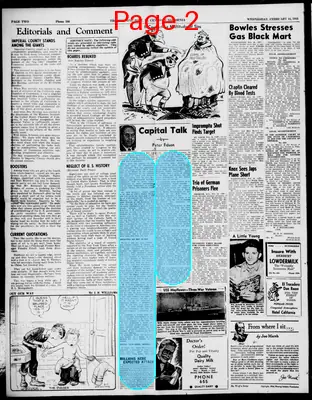
Imperial Valley Press
El Centro, Imperial County, California
What is this article about?
During WWII, U.S. Congressmen probe the Army Information Branch for unbiased political info to soldiers ahead of the 1944 election, fearing vote influence. Led by Col. Munson, it runs vast media ops including films by Capra, radio, and publications to keep troops informed fairly. (248 chars)
Clipping
OCR Quality
Full Text
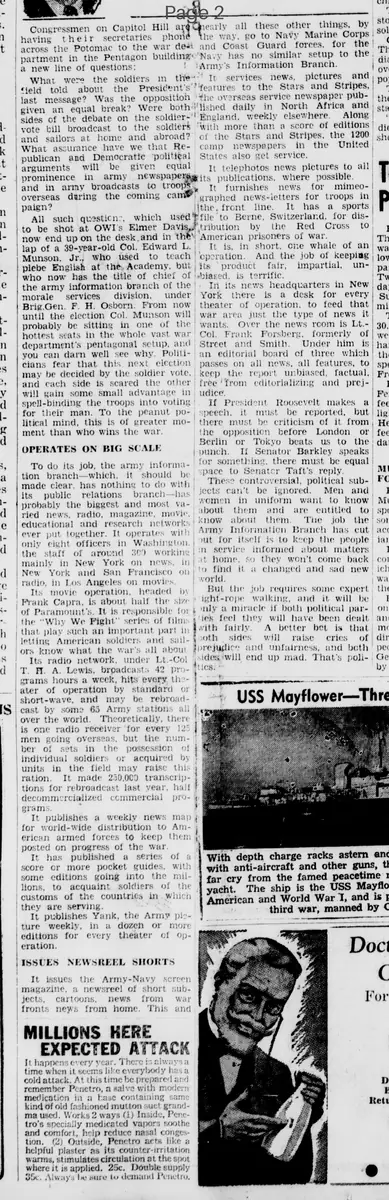
What were the soldiers in the field told about the President's last message? Was the opposition given an equal break? Were both sides of the debate on the soldier-vote bill broadcast to the soldiers and sailors at home and abroad?
What assurance have we that Republican and Democratic political arguments will be given equal prominence in army newspapers and in army broadcasts to troops overseas during the coming campaign?
All such questions, which used to be shot at OWI's Elmer Davis, now end up on the desk and in the lap of a 39-year-old Col. Edward L. Munson. Jr., who used to teach plebe English at the Academy, but who now has the title of chief of the army information branch of the morale services division, under Brig.Gen. F. H. Osborn. From now until the election Col. Munson will probably be sitting in one of the hottest seats in the whole vast war department's pentagonal setup, and you can darn well see why. Politicians fear that this next election may be decided by the soldier vote, and each side is scared the other will gain some small advantage in spell-binding the troops into voting for their man. To the peanut political mind, this is of greater moment than who wins the war.
OPERATES ON BIG SCALE
To do its job, the army information branch-which, it should be made clear, has nothing to do with its public relations branch-has probably the biggest and most varied news, radio, magazine, movie, educational and research networks ever put together. It operates with only eight officers in Washington the staff of around 300 working mainly in New York on news, in New York and San Francisco on radio, in Los Angeles on movies.
Its movie operation, headed by Frank Capra, is about half the size of Paramount's. It is responsible for the "Why We Fight" series of films that play such an important part in letting American soldiers and sailors know what the war's all about.
Its radio network, under Lt.-Col. T. H. A. Lewis, broadcasts 42 program hours a week, hits every theater of operation by standard or short-wave, and may be rebroadcast by some 65 Army stations all over the world. Theoretically, there is one radio receiver for every 125 men going overseas, but the number of sets in the possession of individual soldiers or acquired by units in the field may raise this ration. It made 250,000 transcriptions for rebroadcast last year, half decommercialized commercial programs.
It publishes a weekly news map for world-wide distribution to American armed forces to keep them posted on progress of the war.
It has published a series of a score or more pocket guides, with some editions going into the millions, to acquaint soldiers of the customs of the countries in which they are serving.
It publishes Yank, the Army picture weekly, in a dozen or more editions for every theater of operation.
ISSUES NEWSREEL SHORTS
It issues the Army-Navy screen magazine, a newsreel of short subjects, cartoons, news from war fronts news from home. This
MILLIONS HERE EXPECTED ATTACK
It happens every year. There is always a time when it seems like everybody has a cold attack. At this time be prepared and remember Penetro, a salve with modern medication in a base containing same kind of old fashioned mutton suet grandma used. Works 2 ways (1) Inside, Penetro's specially medicated vapors soothe and comfort, help reduce nasal congestion. (2) Outside, Penetro acts like a helpful plaster as its counter-irritation warms, stimulates circulation at the spot where it is applied. 25c. Double supply 35c. Always be sure to demand Penetro.
Nearly all these other things, by the way, go to Navy Marine Corps and Coast Guard forces, for the Navy has no similar setup to the Army's Information Branch.
It services news, pictures and features to the Stars and Stripes, the overseas service newspaper published daily in North Africa and England, weekly elsewhere. Along with more than a score of editions of the Stars and Stripes, the 1200 camp newspapers in the United States also get service.
It telephotos news pictures to all its publications, where possible. It furnishes news for mimeographed news-letters for troops in the front line. It has a sports file to Berne, Switzerland, for distribution by the Red Cross to American prisoners of war.
It is, in short, one whale of an operation. And the job of keeping its product fair, impartial, unbiased, is terrific.
In its news headquarters in New York there is a desk for every theater of operation, to feed that war area just the type of news it wants. Over the news room is Lt.-Col. Frank Forsberg, formerly of Street and Smith. Under him is an editorial board of three which passes on all news, all features, to keep the report unbiased, factual, free from editorializing and prejudice.
If President Roosevelt makes a speech, it must be reported, but there must be criticism of it from the opposition before London or Berlin or Tokyo beats us to the punch. If Senator Barkley speaks for something, there must be equal space to Senator Taft's reply.
These controversial, political subjects can't be ignored. Men and women in uniform want to know about them and are entitled to know about them.
The job the Army Information Branch has cut out for itself is to keep the people in service informed about matters it home, so they won't come back to find it a changed and sad new world.
But the job requires some tight-rope walking, and it will be only a miracle if both political parties feel they will have been dealt with fairly.
A better bet is that both sides will raise cries of prejudice and unfairness, and both sides will end up mad. That's politics.
What sub-type of article is it?
What themes does it cover?
What keywords are associated?
What entities or persons were involved?
Where did it happen?
Story Details
Key Persons
Location
Capitol Hill, Washington, D.C.; Pentagon; New York; San Francisco; Los Angeles; Theaters Of Operation Worldwide
Story Details
Congressmen question the Army Information Branch on fair dissemination of political information to soldiers regarding the soldier-vote bill and upcoming election. Led by Col. Edward L. Munson Jr. under Brig. Gen. F. H. Osborn, the branch operates extensive news, radio, movie, and publication networks to inform troops impartially, including Why We Fight films, radio broadcasts, Yank magazine, and Stars and Stripes, amid fears of political bias influencing the soldier vote.