Thank you for visiting SNEWPapers!
Sign up free
Editorial
February 27, 1835
The Hillsborough Recorder
Hillsboro, Orange County, North Carolina
What is this article about?
Editorial on retributive justice, using the death of Therese de Mericourt—deified as 'goddess of reason' in the French Revolution—as an example of divine punishment fitting the crime. Argues that sin inevitably leads to suitable retribution, often delayed but certain, and urges recognition of God's moral governance over human affairs.
Clipping
OCR Quality
85%
Good
Full Text
From the South.
RETRIBUTIVE JUSTICE.
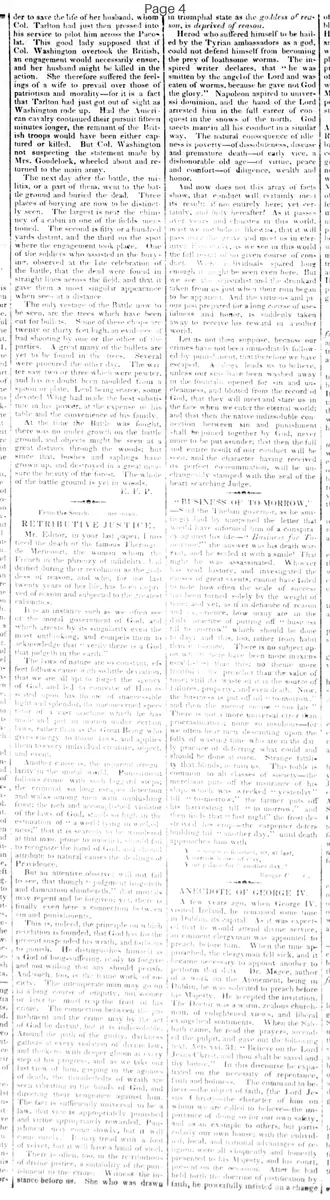
Mr. Editor, in your last paper, I noticed the death of the famous Therese de Mericourt, the woman whom the French in the phrenzy of infidelity, deified during their revolution as the goddess of reason, and who, for the last twenty years of her life, has been deprived of reason and subjected to the greatest calamities.
It is an instance such as we often see of the moral government of God, and which arrests by its singularity even the most unthinking, and compels them to acknowledge that "surely there is a God that judgeth in the earth."
The laws of nature are so constant, effect follows cause with so little deviation, that we are all apt to forget the agency of God, and led to conceive of Him as seated upon His throne of inaccessible light and splendour, the unconcerned spectator of a wide machine which He has made and put in motion under certain Laws, rather than as the Great Being who gives energy to those laws, and applies them to every individual creature, object, and event.
Another cause is, the contrary irregularity in the moral world. Punishment follows crime with such long and tardy steps, the criminal so long escapes detection and walks among men with blushing front: the rich and accomplished violator of the laws of God, stands so high in the estimation of a world-wise in wickedness:" that it is scarcely to be wondered at that man, prone to unbelief, should fail to recognize the hand of God, and should attribute to natural causes the dealings of Providence.
But an attentive observer will not fail to see, that though "judgment lingereth and damnation slumbereth," that morals may repent and be forgiven: yet, there is finally even here a connection between sin and punishments.
This is, indeed, the principle on which revelation is founded, that God has for the present suspended his wrath, and forbears to punish. He distinguishes himself as a God of long-suffering, ready to forgive and not willing that any should perish. And such, too, is the true work of society. The intemperate man may go on in a long course of iniquity, but sooner or later he must reap the fruit of his crime. The connection between the punishment and the crime may by the will of God be distant, but it is indissoluble.
Around the path of the guilty, darkness gathers at every violation of divine Law, and thickens with deeper gloom at every step of his progress, and as we take our last view of him, gasping in the agonies of death, the thunderbolts of wrath are seen vibrating in the hands of God, and directing their vengeance against him.
The fact is sufficiently universal to be a law, that vice is appropriately punished and virtue appropriately rewarded. Punishment may come slowly, but it will come surely. It may tread with a foot of velvet, but it will have a hand of steel.
There is often, too, in the retributions of divine justice, a suitability of the punishment to the crime. Witness the instance before us. She who was drawn in triumphal state as the goddess of reason, is deprived of reason.
Herod who suffered himself to be hailed by the Tyrian ambassadors as a god, could not defend himself from becoming the prey of loathsome worms. The inspired writer declares, that "he was smitten by the angel of the Lord and was eaten of worms, because he gave not God the glory." Napoleon aspired to universal dominion, and the hand of the Lord arrested him in the full career of conquest in the snows of the north. God meets man in all his conduct in a similar way. The natural consequence of idleness is poverty—of dissoluteness, disease and premature death—of early vice, a dishonorable old age—of virtue, peace and comfort—of diligence, wealth and honor.
And now does not this array of facts show, that conduct will certainly meet its result: if not entirely here: yet certainly, and only hereafter? As it passes over years and dates in this world, must we not believe, that it will pass over, the grave and meet us in eternity, as we see in this world the full result of no given course of conduct. Were individuals spared long enough might be seen even here. But we see the sensualist and the drunkard taken from us just when their ruin began to be apparent. And the virtuous and pious just prepared for a long course of usefulness and honor, is suddenly taken away to receive his reward in another world.
Let us not then suppose, because our crimes have not been immediately followed by punishment, that therefore we have escaped. Analogy leads us to believe, unless our sins have been washed away in the fountain opened for sin and uncleanness, and blotted from the record of God, that they will meet and stare us in the face when we enter the eternal world: and that then the native indissoluble connection between sin and punishment shall be joined together by God, never more to be put asunder; that then the full and entire result of our conduct will be seen, and the character having received its perfect consummation, will be unchangeably stamped with the seal of the heart searching Judge.
RETRIBUTIVE JUSTICE.
Mr. Editor, in your last paper, I noticed the death of the famous Therese de Mericourt, the woman whom the French in the phrenzy of infidelity, deified during their revolution as the goddess of reason, and who, for the last twenty years of her life, has been deprived of reason and subjected to the greatest calamities.
It is an instance such as we often see of the moral government of God, and which arrests by its singularity even the most unthinking, and compels them to acknowledge that "surely there is a God that judgeth in the earth."
The laws of nature are so constant, effect follows cause with so little deviation, that we are all apt to forget the agency of God, and led to conceive of Him as seated upon His throne of inaccessible light and splendour, the unconcerned spectator of a wide machine which He has made and put in motion under certain Laws, rather than as the Great Being who gives energy to those laws, and applies them to every individual creature, object, and event.
Another cause is, the contrary irregularity in the moral world. Punishment follows crime with such long and tardy steps, the criminal so long escapes detection and walks among men with blushing front: the rich and accomplished violator of the laws of God, stands so high in the estimation of a world-wise in wickedness:" that it is scarcely to be wondered at that man, prone to unbelief, should fail to recognize the hand of God, and should attribute to natural causes the dealings of Providence.
But an attentive observer will not fail to see, that though "judgment lingereth and damnation slumbereth," that morals may repent and be forgiven: yet, there is finally even here a connection between sin and punishments.
This is, indeed, the principle on which revelation is founded, that God has for the present suspended his wrath, and forbears to punish. He distinguishes himself as a God of long-suffering, ready to forgive and not willing that any should perish. And such, too, is the true work of society. The intemperate man may go on in a long course of iniquity, but sooner or later he must reap the fruit of his crime. The connection between the punishment and the crime may by the will of God be distant, but it is indissoluble.
Around the path of the guilty, darkness gathers at every violation of divine Law, and thickens with deeper gloom at every step of his progress, and as we take our last view of him, gasping in the agonies of death, the thunderbolts of wrath are seen vibrating in the hands of God, and directing their vengeance against him.
The fact is sufficiently universal to be a law, that vice is appropriately punished and virtue appropriately rewarded. Punishment may come slowly, but it will come surely. It may tread with a foot of velvet, but it will have a hand of steel.
There is often, too, in the retributions of divine justice, a suitability of the punishment to the crime. Witness the instance before us. She who was drawn in triumphal state as the goddess of reason, is deprived of reason.
Herod who suffered himself to be hailed by the Tyrian ambassadors as a god, could not defend himself from becoming the prey of loathsome worms. The inspired writer declares, that "he was smitten by the angel of the Lord and was eaten of worms, because he gave not God the glory." Napoleon aspired to universal dominion, and the hand of the Lord arrested him in the full career of conquest in the snows of the north. God meets man in all his conduct in a similar way. The natural consequence of idleness is poverty—of dissoluteness, disease and premature death—of early vice, a dishonorable old age—of virtue, peace and comfort—of diligence, wealth and honor.
And now does not this array of facts show, that conduct will certainly meet its result: if not entirely here: yet certainly, and only hereafter? As it passes over years and dates in this world, must we not believe, that it will pass over, the grave and meet us in eternity, as we see in this world the full result of no given course of conduct. Were individuals spared long enough might be seen even here. But we see the sensualist and the drunkard taken from us just when their ruin began to be apparent. And the virtuous and pious just prepared for a long course of usefulness and honor, is suddenly taken away to receive his reward in another world.
Let us not then suppose, because our crimes have not been immediately followed by punishment, that therefore we have escaped. Analogy leads us to believe, unless our sins have been washed away in the fountain opened for sin and uncleanness, and blotted from the record of God, that they will meet and stare us in the face when we enter the eternal world: and that then the native indissoluble connection between sin and punishment shall be joined together by God, never more to be put asunder; that then the full and entire result of our conduct will be seen, and the character having received its perfect consummation, will be unchangeably stamped with the seal of the heart searching Judge.
What sub-type of article is it?
Moral Or Religious
What keywords are associated?
Retributive Justice
Divine Punishment
Moral Government
Goddess Of Reason
French Revolution
Sin And Punishment
Eternal Judgment
What entities or persons were involved?
Therese De Mericourt
Herod
Napoleon
God
Editorial Details
Primary Topic
Retributive Justice And Divine Punishment
Stance / Tone
Moral Exhortation Affirming God's Justice
Key Figures
Therese De Mericourt
Herod
Napoleon
God
Key Arguments
Punishment Follows Crime With Long But Certain Steps
Divine Justice Often Suits Punishment To The Crime
Historical Examples Illustrate Retributive Justice
Sin Leads To Inevitable Retribution In This Life Or The Next
God Is Long Suffering But Ultimately Judges The Earth