Thank you for visiting SNEWPapers!
Sign up free
Daily National Intelligencer
Washington, District Of Columbia
What is this article about?
In this 1812 editorial, the author distinguishes between honest citizens attached to Britain and vociferous pro-British Federalists who oppose the US war effort. It criticizes the latter for rejoicing at British triumphs in Europe, which threaten American maritime rights, and warns of factional rhetoric fueling foreign misconceptions, like rumors of Massachusetts secession. Notes Potomac free of British ships.
Merged-components note: Continuation of the 'Desultory Thoughts' editorial across multiple components within the page, based on sequential reading order and text continuity.
Clipping
OCR Quality
Full Text
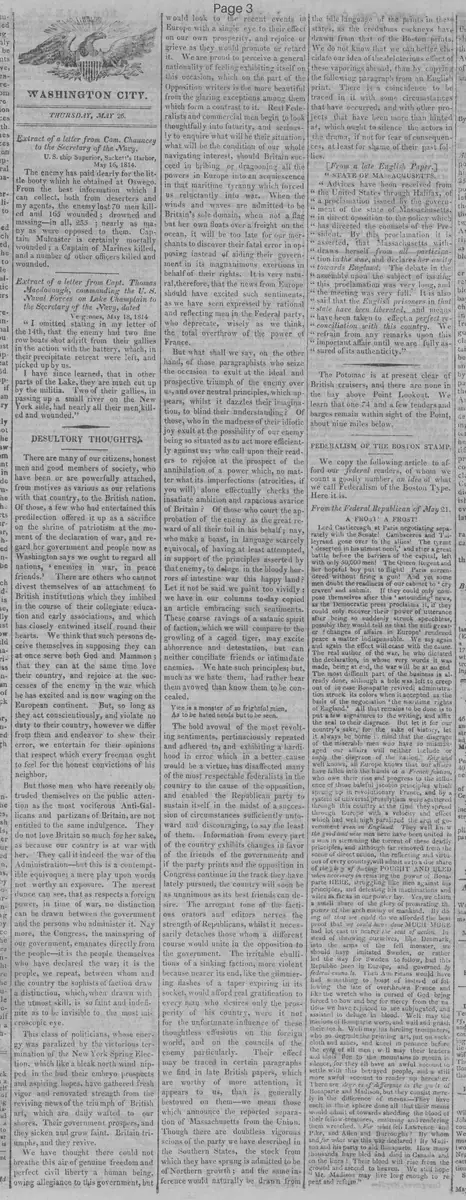
There are many of our citizens, honest men and good members of society, who have been or are powerfully attached, from motives as various as our relations with that country, to the British nation. Of those, a few who had entertained this predilection offered it up as a sacrifice on the shrine of patriotism at the moment of the declaration of war, and regard her government and people now as Washington says we ought to regard all nations, enemies in war, in peace friends.* There are others who cannot divest themselves of an attachment to British institutions which they imbibed in the course of their collegiate education and early associations, and which has closely entwined itself round their hearts. We think that such persons deceive themselves in supposing they can at once serve both God and Mammon; that they can at the same time love their country, and rejoice at the successes of the enemy in the war which he has excited and is now waging on the European continent. But, so long as they act conscientiously, and violate no duty to their country, however we differ from them and endeavor to shew their error, we entertain for their opinions that respect which every freeman ought to feel for the honest convictions of his neighbor.
But those men who have recently obtruded themselves on the public attention as the most vociferous Anti-Gallicans and partizans of Britain, are not entitled to the same indulgence. They do not love Britain so much for her sake, as because our country is at war with her. They call it indeed the war of the Administration—but this is a contemptible equivoque; a mere play upon words not worthy an exposure. The merest dunce can see, that as respects a foreign power, in time of war, no distinction can be drawn between the government and the persons who administer it. Nay more, the Congress, the mainspring of our government, emanates directly from the people—it is the people themselves who have declared the war; it is the people, we repeat, between whom and the country the sophists of faction draw a distinction, which, when drawn with the utmost skill, is so faint and indefinite as to be invisible to the most microscopic eye.
This class of politicians, whose energy was paralyzed by the victorious termination of the New York Spring Election, which like a bleak north wind nipped in the bud their embryo prospects and aspiring hopes, have gathered fresh vigor and renovated strength from the reviving news of the triumph of British arms, which are daily wafted to our shores. Their government prospers, and they sicken and grow faint. Britain triumphs, and they revive.
We have thought there could not breathe this air of genuine freedom and perfect civil liberty a human being, owing allegiance to this government, but would look to the recent events in Europe with a single eye to their effect on our own prosperity, and rejoice or grieve as they would promote or retard it. We are proud to perceive a general nationality of feeling exhibiting itself on this occasion, which on the part of the Opposition writers is the more beautiful from the glaring exceptions among them which form a contrast to it. Real Federalists and commercial men begin to look thoughtfully into futurity, and seriously to enquire what will be their situation, what will be the condition of our whole navigating interest, should Britain succeed in bribing or dragooning all the powers in Europe into an acquiescence in that maritime tyranny which forced us reluctantly into war. When the winds and waves are admitted to be Britain's sole domain, when not a flag but her own floats over a freight on the ocean, it will be too late for our merchants to discover their fatal error in opposing instead of aiding their government in its magnanimous exertions in behalf of their rights. It is very natural, therefore, that the news from Europe should have excited such sentiments as we have seen expressed by rational and reflecting men in the Federal party, who deprecate, wisely as we think, the total overthrow of the power of France.
But what shall we say, on the other hand, of those paragraphists who seize the occasion to exult at the ideal and prospective triumph of the enemy over us, and over neutral principles, which appears, whilst it dazzles their imagination, to blind their understanding? Of those, who in the madness of their idiotic joy exult at the possibility of our enemy being so situated as to act more efficiently against us; who call upon their readers to rejoice at the prospect of the annihilation of a power which, no matter what its imperfections (atrocities, if you will) alone effectually checks the insatiate ambition and rapacious avarice of Britain? Of those who court the approbation of the enemy as the great reward of all their toil in his behalf; nay, who make a boast, in language scarcely equivocal, of having at least attempted, in support of the principles asserted by that enemy, to deluge in the bloody horrors of intestine war this happy land? Let it not be said we paint too vividly; we have in our columns to-day copied an article embracing such sentiments. These coarse ravings of a satanic spirit of faction, which we will compare to the growling of a caged tiger, may excite abhorrence and detestation, but can neither conciliate friends or intimidate enemies. We hate such principles; but, much as we hate them, had rather hear them avowed than know them to be concealed.
Vice is a monster of so frightful mien,
As to be hated needs but to be seen.
The bold avowal of the most revolting sentiments, pertinaciously repeated and adhered to, and exhibiting a hardihood in error which in a better cause would be a virtue, has disaffected many of the most respectable federalists in the country to the cause of the opposition, and enabled the Republican party to sustain itself in the midst of a succession of circumstances sufficiently untoward and discouraging, to say the least of them. Information from every part of the country exhibits changes in favor of the friends of the government; and if the party prints and the opposition in Congress continue in the track they have lately pursued, the country will soon be as unanimous as its best friends can desire. The arrogant tone of the factious orators and editors nerves the strength of Republicans, whilst it necessarily detaches those whom a different course would unite in the opposition to the government. The irritable ebullitions of a sinking faction, more violent because nearer its end, like the glimmering flashes of a taper expiring in its socket, would afford real gratification to every man who desires only the prosperity of his country, were it not for the unfortunate influence of these thoughtless effusions on the foreign world, and on the councils of the enemy particularly. Their effect may be traced in certain paragraphs we find in late British papers, which are worthy of more attention, it appears to us, than is generally bestowed on them—we mean those which announce the reported separation of Massachusetts from the Union. Though there are doubtless vigorous scions of the party we have described in the Southern States, the stock from which they have sprung is admitted to be of Northern growth; and the same inference would naturally be drawn from the idle language of the prints in these states, as the credulous cockneys have drawn from that of the Boston prints. We do not know that we can better elucidate our idea of the deleterious effect of these vaporings abroad, than by copying the following paragraph from an English print. There is a coincidence to be traced in it with some circumstances that have occurred, and with other projects that have been more than hinted at, which ought to silence the actors in the drama, if not for fear of consequences, at least for shame of their past follies.
[From a late English Paper.]
"STATE OF MASSACHUSETTS.
"Advices have been received from
"the United States through Halifax, of
"a proclamation issued by the govern-
"ment of the state of Massachusetts.
"in direct opposition to the policy which
"has directed the counsels of the Pre-
"sident. By this proclamation it is
"asserted, that Massachusetts with-
"draws herself from all participa-
"tion in the war, and declares her amity
"towards England. The debate in the
"assembly upon the subject of issuing
"this proclamation was very long, and
"the meeting was very full." It is also
"said that the English prisoners in that
"state have been liberated, and means
"have been taken to effect a perfect re
"conciliation with this country. We
"refrain from any remarks upon this
"important affair until we are fully as
"sured of its authenticity."
The Potomac is at present clear of British cruisers, and there are none in the bay above Point Lookout. We learn that one 74 and a few tenders and barges remain within sight of the Point, about nine miles below.
What sub-type of article is it?
What keywords are associated?
What entities or persons were involved?
Editorial Details
Primary Topic
Criticism Of Pro British Opposition During The War Of 1812
Stance / Tone
Strongly Pro Government And Patriotic, Anti Factional
Key Figures
Key Arguments