Thank you for visiting SNEWPapers!
Sign up free
Letter to Editor
July 3, 1874
The Enquirer Southerner
Tarboro, Edgecombe County, North Carolina
What is this article about?
Correspondent inspects Louisville, Harrods Creek and West Port narrow-gauge railroad, details its engine, cars, costs, and construction. Advocates for similar roads in the South due to lower expenses and efficiency compared to broad-gauge lines.
Clipping
OCR Quality
95%
Excellent
Full Text
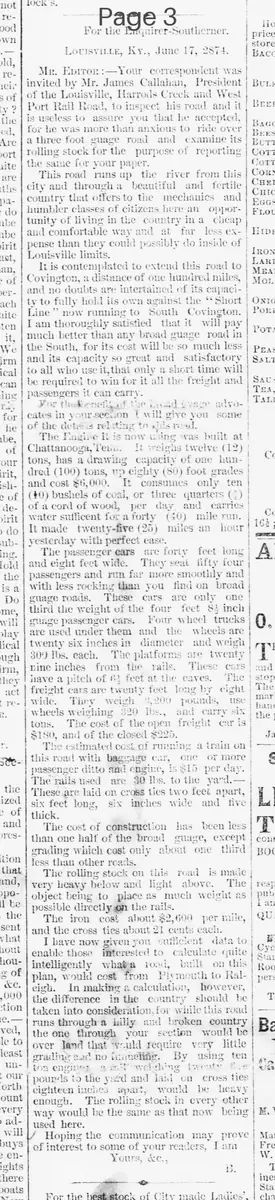
For the Enquirer-Southerner.
Louisville, Ky., June 17, 1874.
Mr. Editor:-
Your correspondent was invited by Mr. James Callahan, President of the Louisville, Harrods Creek and West Port Rail Road, to inspect his road and it is useless to assure you that he accepted. for he was more than anxious to ride over a three foot gauge road and examine its rolling stock for the purpose of reporting the same for your paper.
This road runs up the river from this city and through a beautiful and fertile country that offers to the mechanics and humbler classes of citizens here an opportunity of living in the country in a cheap and comfortable way and at far less expense than they could possibly do inside of Louisville limits.
It is contemplated to extend this road to Covington, a distance of one hundred miles, and no doubts are entertained of its capacity to fully hold its own against the " Short Line" now running to South Covington.
I am thoroughly satisfied that it will pay much better than any broad gauge road in the South, for its cost will be so much less and its capacity so great and satisfactory to all who use it,that only a short time will be required to win for it all the freight and passengers it can carry.
To those interested in narrow gauge roads in your section I will give you some of the details relating to his road.
The Engine it is now using was built at Chattanooga,Tenn. It weighs twelve (12) tons, has a drawing capacity of one hundred (100) tons, up eighty (80) foot grades and cost $6,000. It consumes only ten ($10) bushels of coal, or three quarters (3/4) of a cord of wood, per day and carries water sufficient for a forty (40) mile run. It made twenty-five (25) miles an hour yesterday with perfect ease.
The passenger cars are forty feet long and eight feet wide. They seat fifty four passengers and run far more smoothly and with less rocking than you find on broad gauge roads. These cars are only one third the weight of the four feet 8 inch gauge passenger cars. Four wheel trucks are used under them and the wheels are twenty six inches in diameter and weigh 300 lbs. each. The platforms are twenty nine inches from the rails. These cars have a pitch of 6 feet at the eaves. The freight cars are twenty feet long by eight wide. They weigh , 2000 pounds, use wheels weighing 320 lbs., and carry six tons. The cost of the open freight car is $180, and of the closed $225.
The estimated cost of running a train on this road with baggage car, one or more passenger ditto and engine, is $15 per day.
The rails used are 30 lbs. to the yard.- These are laid on cross ties two feet apart. six feet long, six inches wide and five thick.
The cost of construction has been less than one half of the broad gauge, except grading which cost only about one third less than other roads.
The rolling stock on this road is made very heavy below and light above, The object being to place as much weight as possible directly on the rails.
The iron cost about $2,600 per mile and the cross ties about 21 cents each.
I have now given you sufficient data to enable those interested to calculate quite intelligently what a road, built on this plan, would cost from Plymouth to Raleigh, In making a calculation, however, the difference in the country should be taken into consideration, for while this road runs through a hilly and broken country the one through your section would be over land that would require very little grading and no tunneling. By using ten ton engines a rail weighing twenty five pounds to the yard and laid on cross ties eighteen inches apart, would be heavy enough. The rolling stock in every other way would be the same as that now being used here.
Hoping the communication may prove of interest to some of your readers, I am
Yours, &c.,
B.
Louisville, Ky., June 17, 1874.
Mr. Editor:-
Your correspondent was invited by Mr. James Callahan, President of the Louisville, Harrods Creek and West Port Rail Road, to inspect his road and it is useless to assure you that he accepted. for he was more than anxious to ride over a three foot gauge road and examine its rolling stock for the purpose of reporting the same for your paper.
This road runs up the river from this city and through a beautiful and fertile country that offers to the mechanics and humbler classes of citizens here an opportunity of living in the country in a cheap and comfortable way and at far less expense than they could possibly do inside of Louisville limits.
It is contemplated to extend this road to Covington, a distance of one hundred miles, and no doubts are entertained of its capacity to fully hold its own against the " Short Line" now running to South Covington.
I am thoroughly satisfied that it will pay much better than any broad gauge road in the South, for its cost will be so much less and its capacity so great and satisfactory to all who use it,that only a short time will be required to win for it all the freight and passengers it can carry.
To those interested in narrow gauge roads in your section I will give you some of the details relating to his road.
The Engine it is now using was built at Chattanooga,Tenn. It weighs twelve (12) tons, has a drawing capacity of one hundred (100) tons, up eighty (80) foot grades and cost $6,000. It consumes only ten ($10) bushels of coal, or three quarters (3/4) of a cord of wood, per day and carries water sufficient for a forty (40) mile run. It made twenty-five (25) miles an hour yesterday with perfect ease.
The passenger cars are forty feet long and eight feet wide. They seat fifty four passengers and run far more smoothly and with less rocking than you find on broad gauge roads. These cars are only one third the weight of the four feet 8 inch gauge passenger cars. Four wheel trucks are used under them and the wheels are twenty six inches in diameter and weigh 300 lbs. each. The platforms are twenty nine inches from the rails. These cars have a pitch of 6 feet at the eaves. The freight cars are twenty feet long by eight wide. They weigh , 2000 pounds, use wheels weighing 320 lbs., and carry six tons. The cost of the open freight car is $180, and of the closed $225.
The estimated cost of running a train on this road with baggage car, one or more passenger ditto and engine, is $15 per day.
The rails used are 30 lbs. to the yard.- These are laid on cross ties two feet apart. six feet long, six inches wide and five thick.
The cost of construction has been less than one half of the broad gauge, except grading which cost only about one third less than other roads.
The rolling stock on this road is made very heavy below and light above, The object being to place as much weight as possible directly on the rails.
The iron cost about $2,600 per mile and the cross ties about 21 cents each.
I have now given you sufficient data to enable those interested to calculate quite intelligently what a road, built on this plan, would cost from Plymouth to Raleigh, In making a calculation, however, the difference in the country should be taken into consideration, for while this road runs through a hilly and broken country the one through your section would be over land that would require very little grading and no tunneling. By using ten ton engines a rail weighing twenty five pounds to the yard and laid on cross ties eighteen inches apart, would be heavy enough. The rolling stock in every other way would be the same as that now being used here.
Hoping the communication may prove of interest to some of your readers, I am
Yours, &c.,
B.
What sub-type of article is it?
Informative
Persuasive
What themes does it cover?
Infrastructure
Commerce Trade
What keywords are associated?
Narrow Gauge Railroad
Louisville Railroad
Construction Costs
Rolling Stock
Southern Routes
What entities or persons were involved?
B.
Mr. Editor
Letter to Editor Details
Author
B.
Recipient
Mr. Editor
Main Argument
the narrow-gauge louisville, harrods creek and west port railroad offers lower construction and operating costs than broad-gauge lines, with efficient rolling stock, making it a superior option for southern routes like plymouth to raleigh.
Notable Details
Engine: 12 Tons, Draws 100 Tons Up 80 Foot Grades, Costs $6,000, Built In Chattanooga
Passenger Cars: 40 Ft Long, Seat 54, One Third Weight Of Broad Gauge Cars
Freight Cars: 20 Ft Long, Carry 6 Tons, Cost $180 $225
Rails: 30 Lbs/Yard, Iron $2,600/Mile
Construction Cost Less Than Half Of Broad Gauge