Thank you for visiting SNEWPapers!
Sign up free
Gazette Of The United States And Daily Evening Advertiser
Philadelphia, Philadelphia County, Pennsylvania
What is this article about?
In this first letter, Germanicus defends President Washington's speech on the recent insurrection in western Pennsylvania, attributing its fomentation to self-created societies and combinations of men spreading suspicions against the government. He critiques the House of Representatives' response for downplaying the societies' role and outlines future letters to justify the President's comments.
Clipping
OCR Quality
Full Text
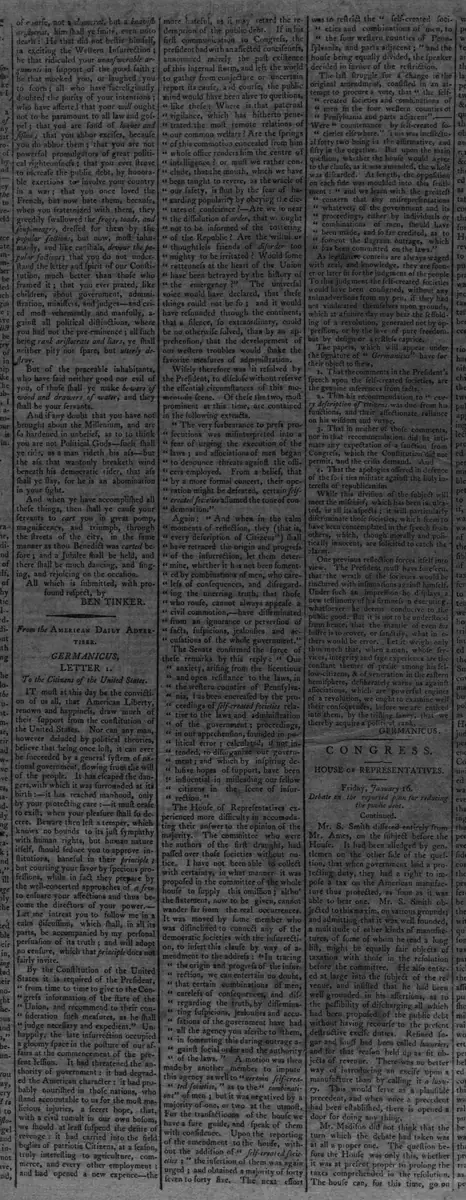
GERMANICUS,
LETTER I.
To the Citizens of the United States.
IT must at this day be the conviction of us all, that American Liberty, renown and happiness, draw much of their support from the constitution of the United States. Nor can any man, however deluded by political theories, believe that being once lost, it can ever be succeeded by a general system of national government, flowing from the will of the people. It has escaped the dangers, with which it was surrounded at its birth:--it has reached manhood, only by your protecting care: it must cease to exist, when your pleasure shall so decree. Beware then lest a temper, which knows no bounds to its just sympathy with human rights, but human nature itself, should seduce you to approve institutions, baneful in their principle; but courting your favor by specious professions, while in fact they prepare by the well-concerted approaches of a few to ensnare your affections and thus become the directors of your power.
Let me intreat you to follow me in a calm discussion, which shall, in all its parts, be accompanied by my personal persuasion of its truth; and will adopt no censure, which that principle does not fairly invite.
By the Constitution of the United States it is required of the President, "from time to time to give to the Congress information of the state of the Union, and recommend to their consideration such measures, as he shall judge necessary and expedient." Unfortunately, the late insurrection occupied a gloomy place in the posture of our affairs at the commencement of the present session. It had threatened the authority of government: it had degraded the American character: it had probably nourished in those nations, who stand accountable to us for the most malicious injuries, a secret hope, that, with a civil tumult in our own bosom, we should at least suspend the desire of revenge: it had carried into the field bodies of patriotic Citizens, at a season, truly interesting to agriculture, commerce, and every other employment: and had opened a new expence--the more hateful, as it may retard the redemption of the public debt. If in his first communication to Congress, the president had with affected conciseness, announced merely the past existence of this internal storm, and left the world to gather from conjecture or uncertain report its cause, and course, the public mind would have been alive to questions, like these: Where is that paternal vigilance, which has hitherto penetrated the most remote relations of our common welfare? Are the springs of this commotion concealed from him whose office renders him the centre of intelligence? or must we rather conclude, that the mouth, which we have been taught to revere, as the oracle of our safety, is shut by the fear of hazarding popularity by obeying the dictates of conscience? Are we so near the dissolution of order, that we ought not to be informed of the tottering of the Republic? Are the wilful or thoughtless friends of disorder too mighty to be irritated? Would some rottenness at the heart of the Union have been betrayed by the history of the emergency? The universal voice would have declared, that these things could not be so; and it would have resounded through the continent, that a silence, so extraordinary, could be no otherwise solved, than by an apprehension, that the developement of our western troubles would shake the favorite measures of administration.
Wisely therefore was it resolved by the President, to disclose without reserve the essential circumstances of this momentous scene. Of these the two, most prominent at this time, are contained in the following extracts.
"The very forbearance to press prosecutions was misinterpreted into a fear of urging the execution of the laws; and associations of men began to denounce threats against the officers employed. From a belief, that by a more formal concert, their operation might be defeated, certain self-created societies assumed the tone of condemnation."
Again: "And when in the calm moments of reflection, they (that is, every description of Citizens) shall have retraced the origin and progress of the insurrection, let them determine, whether it has not been fomented by combinations of men, who careless of consequences, and disregarding the unerring truth, that those who rouse, cannot always appease a civil commotion,--have disseminated from an ignorance or perversion of facts, suspicions, jealousies and accusations of the whole government."
The Senate confirmed the force of these remarks by this reply: "Our anxiety, arising from the licentious and open resistance to the laws, in the western counties of Pennsylvania, has been encreased by the proceedings of self-created societies relative to the laws and administration of the government; proceedings, in our apprehension, founded in political error; calculated, if not intended, to disorganize our government; and which by inspiring delusive hopes of support, have been far influential in misleading our fellow citizens in the scene of insurrection."
The House of Representatives experienced more difficulty in accommodating their answer to the opinion of the majority. The committee who were the authors of the first draught, had passed over those societies without notice. I have not been able to collect with certainty, in what manner it was proposed in the committee of the whole house to supply this omission; altho the statement, now to be given, cannot wander far from the real occurrences.
It was moved by some member who was disinclined to connect any of the democratic societies with the insurrection, to insert this clause by way of amendment to the address: "In tracing the origin and progress of the insurrection, we can entertain no doubt, that certain combinations of men, careless of consequences, and disregarding the truth, by disseminating suspicions, jealousies and accusations of the government have had all the agency you ascribe to them, in fomenting this daring outrage against social order and the authority of the laws." A motion was then made by another member to impute this agency as well to "certain self-created societies," as to the "combinations" of men; but it was negatived by a majority of one, or two at the utmost.
For the transactions of the house we have a sure guide, and speak of them with confidence. Upon the reporting of the amendment to the house, without the addition of "self-created societies;" the insertion of them was again urged; and obtained a majority of forty even to forty five. The next effort was to add to the societies and combinations of men, "to the four western counties of Pennsylvania, and parts adjacent;" and the house being equally divided, the speaker decided in favour of the restriction. The last struggle for a change in the original amendment, consisted in an attempt to procure a vote, that "the self-created societies and combinations of men in the four western counties of Pennsylvania and parts adjacent". Were countenanced by self-created societies elsewhere." This was ineffectual forty two being in the affirmative, and fifty in the negative. But upon the main question, whether the house would agree to the clause, as it was amended, the whole was discarded. At length, the opposition on each side was moulded into this sentiment: "and we learn with the greatest concern that any misrepresentations whatever, of the government and its proceedings, either by individuals or combinations of men, should have been made, and so far credited, as to foment the flagrant outrage, which has been committed on the laws."
As legislative contests are always waged with zeal, and knowledge, they are sooner or later fit for the judgment of the people. To this judgment the self-created societies would have been consigned, without any animadversions from my pen, if they had not vindicated themselves upon grounds, which at a future day may bear the scaffolding of a revolution, generated not by oppression, or by the love of pure freedom, but by design or a restless caprice.
The papers, which will appear under the signature of "Germanicus" have for their object to shew,
I. That the comments in the President's speech upon the self-created societies, are the genuine inferences from facts.
2. That his recommendation to "every description of citizens, was due from his functions, and their affectionate reliance on his wisdom and virtue."
3. That in neither of those comments, nor in that recommendation, did he intimate any expectation of a sanction from Congress, which the Constitution did not permit, and the crisis demand. And
4 That the apologies offered in defence of the societies militate against the holy interests of republicanism.
While this division of the subject will meet the mischief, which has been inculcated, in all its aspects; it will particularly discriminate those societies, which seem to have been contemplated in the speech from others, which, though morally and politically innocent, are solicited to catch the alarm.
One previous reflection forces itself into view. The President must have foreseen, that the wrath of the societies would be tinctured with insinuations against himself. Under such an impression he displays a new testimony of his firmness in executing, whatsoever he deems conducive to the public good. But it is not to be understood from hence, that the mantle of even his lustre is to cover, or sanctify, what in others would be error. Let it weigh only thus much that, when a man, whose services, integrity and age experience are the constant themes of praise among his fellow-citizens, & of veneration in the eastern hemisphere, deliberately warns us against associations, which are powerful engines of a revolution, we ought to examine well their consequences, before we are enticed into them, by the trifling fancy, that we thereby acquire a political rank.
GERMANICUS.
What sub-type of article is it?
What themes does it cover?
What keywords are associated?
What entities or persons were involved?
Letter to Editor Details
Author
Germanicus
Recipient
To The Citizens Of The United States
Main Argument
the president's comments on self-created societies fomenting the insurrection are justified, as evidenced by legislative responses; future letters will demonstrate that these societies threaten republicanism and that the president's warnings are constitutional and necessary.
Notable Details