Thank you for visiting SNEWPapers!
Sign up free
Wilmington Journal
Wilmington, New Hanover County, North Carolina
What is this article about?
The Mississippi flood has inundated five million acres and affected 178,000 people in Louisiana, destroying cotton and sugar crops. Relief committee in New Orleans distributes rations but needs more aid as suffering grows to over 50,000 in need.
Clipping
OCR Quality
Full Text
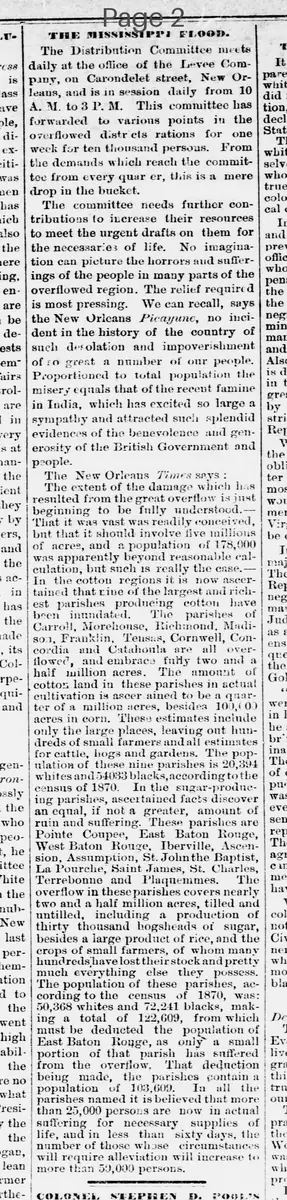
The Distribution Committee meets daily at the office of the Levee Company, on Carondelet street, New Orleans, and is in session daily from 10 A. M. to 3 P. M. This committee has forwarded to various points in the overflowed districts rations for one week for ten thousand persons. From the demands which reach the committee from every quarter, this is a mere drop in the bucket.
The committee needs further contributions to increase their resources to meet the urgent drafts on them for the necessaries of life. No imagination can picture the horrors and sufferings of the people in many parts of the overflowed region. The relief required is most pressing. We can recall, says the New Orleans Picayune, no incident in the history of the country of such desolation and impoverishment of so great a number of our people. Proportioned to total population the misery equals that of the recent famine in India, which has excited so large a sympathy and attracted such splendid evidences of the benevolence and generosity of the British Government and people.
The New Orleans Times says:
The extent of the damage which has resulted from the great overflow is just beginning to be fully understood. That it was vast was readily conceived, but that it should involve five millions of acres, and a population of 178,000 was apparently beyond reasonable calculation, but such is really the case. In the cotton regions it is now ascertained that nine of the largest and richest parishes producing cotton have been inundated.
The parishes of Carroll, Morehouse, Richmond, Madison, Franklin, Tensas, Cornwall, Concordia and Catahoula are all overflowed, and embrace fully two and a half million acres. The amount of cotton land in these parishes in actual cultivation is ascertained to be a quarter of a million acres, besides 100,000 acres in corn. These estimates include only the large places, leaving out hundreds of small farmers and all estimates for cattle, hogs and gardens. The population of these nine parishes is 20,394 whites and 54,033 blacks, according to the census of 1870. In the sugar-producing parishes, ascertained facts discover an equal, if not a greater, amount of ruin and suffering. These parishes are Pointe Coupee, East Baton Rouge, West Baton Rouge, Iberville, Ascension, Assumption, St. John the Baptist, La Fourche, Saint James, St. Charles, Terrebonne and Plaquemines.
The overflow in these parishes covers nearly two and a half million acres, tilled and untilled, including a production of thirty thousand hogsheads of sugar, besides a large product of rice, and the crops of small farmers, of whom many hundreds have lost their stock and pretty much everything else they possess.
The population of these parishes, according to the census of 1870, was: 50,368 whites and 72,241 blacks, making a total of 122,609, from which must be deducted the population of East Baton Rouge, as only a small portion of that parish has suffered from the overflow. That deduction being made, the parishes contain a population of 103,609. In all the parishes named it is believed that more than 25,000 persons are now in actual suffering for necessary supplies of life, and in less than sixty days, the number of those whose circumstances will require alleviation will increase to more than 50,000 persons.
What sub-type of article is it?
What themes does it cover?
What keywords are associated?
Where did it happen?
Story Details
Location
New Orleans, Overflowed Districts In Louisiana Parishes Including Carroll, Morehouse, Richmond, Madison, Franklin, Tensas, Cornwall, Concordia, Catahoula, Pointe Coupee, East Baton Rouge, West Baton Rouge, Iberville, Ascension, Assumption, St. John The Baptist, La Fourche, Saint James, St. Charles, Terrebonne, Plaquemines
Story Details
The Mississippi flood inundates five million acres and 178,000 people in Louisiana cotton and sugar parishes, destroying 250,000 acres of cotton, 100,000 acres of corn, 30,000 hogsheads of sugar, and livestock. Relief committee in New Orleans provides rations for 10,000 but needs more as 25,000 suffer now and 50,000 soon.