Thank you for visiting SNEWPapers!
Sign up free
The Daily Worker
Chicago, Cook County, Illinois
What is this article about?
Missionary Charles A. Leonard reports that the Nineteenth Route Army's heroic stand at Shanghai has inspired increased anti-Japanese sentiment among Manchurian peasants, boosting their confidence to resist invaders. He describes the Japanese-backed Manchoukuo government as powerless outside railway zones, with pitiable conditions worsened by Japanese military actions, and alleges Soviet arms to insurgents.
Clipping
OCR Quality
Full Text
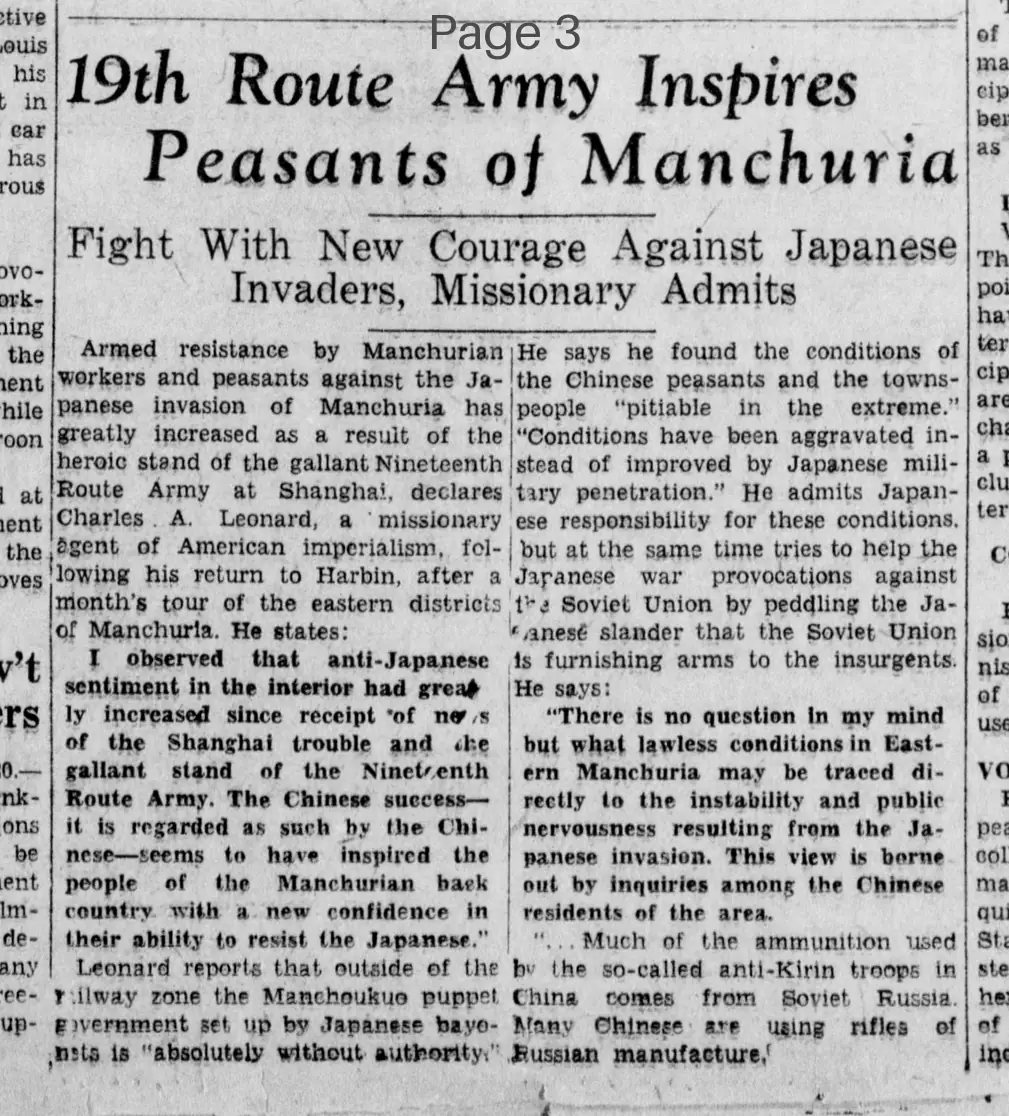
heroic stand of the gallant Nineteenth Route Army at Shanghai, declares Charles. A. Leonard, a missionary agent of American imperialism, following his return to Harbin, after a month's tour of the eastern districts of Manchuria. He states:
I observed that anti-Japanese sentiment in the interior had greatly increased since receipt of news of the Shanghai trouble and the gallant stand of the Nineteenth Route Army. The Chinese success- it is regarded as such by the Chinese-seems to have inspired the people of the Manchurian back country with a new confidence in their ability to resist the Japanese.
Leonard reports that outside of the railway zone the Manchoukuo puppet government set up by Japanese bayonets is "absolutely without authority."
He says he found the conditions of the Chinese peasants and the towns-people "pitiable in the extreme."
"Conditions have been aggravated instead of improved by Japanese military penetration." He admits Japanese responsibility for these conditions. but at the same time tries to help the Japanese war provocations against the Soviet Union by peddling the Japanese slander that the Soviet Union is furnishing arms to the insurgents:
He says:
"There is no question in my mind but what lawless conditions in Eastern Manchuria may be traced directly to the instability and public nervousness resulting from the Japanese invasion. This view is borne out by inquiries among the Chinese residents of the area.
". . Much of the ammunition used by the so-called anti-Kirin troops in China comes from Soviet Russia. Many Chinese are using rifles of Russian manufacture,"
What sub-type of article is it?
What keywords are associated?
What entities or persons were involved?
Where did it happen?
Foreign News Details
Primary Location
Manchuria
Key Persons
Outcome
increased anti-japanese sentiment and confidence among chinese peasants to resist; manchoukuo puppet government without authority outside railway zone; pitiable conditions for peasants and townspeople aggravated by japanese military penetration; allegations of soviet arms to insurgents
Event Details
Charles A. Leonard, after touring eastern districts of Manchuria, reports that news of the Nineteenth Route Army's gallant stand at Shanghai has greatly increased anti-Japanese sentiment in the interior, inspiring the people with new confidence to resist the Japanese. Outside the railway zone, the Japanese-set Manchoukuo puppet government has absolutely no authority. Conditions for Chinese peasants and townspeople are pitiable in the extreme, worsened by Japanese military penetration. Lawless conditions traced to Japanese invasion instability. Ammunition and rifles used by anti-Kirin troops come from Soviet Russia.