Thank you for visiting SNEWPapers!
Sign up free
Story
February 2, 1850
Weekly National Intelligencer
Washington, District Of Columbia
What is this article about?
1849 report from Fort Nisqually, Oregon Territory, on U.S. military arrival and detailed census of 12 local Indian tribes, their numbers, subsistence, and relations with settlers; predicts tribal extinction.
Clipping
OCR Quality
98%
Excellent
Full Text
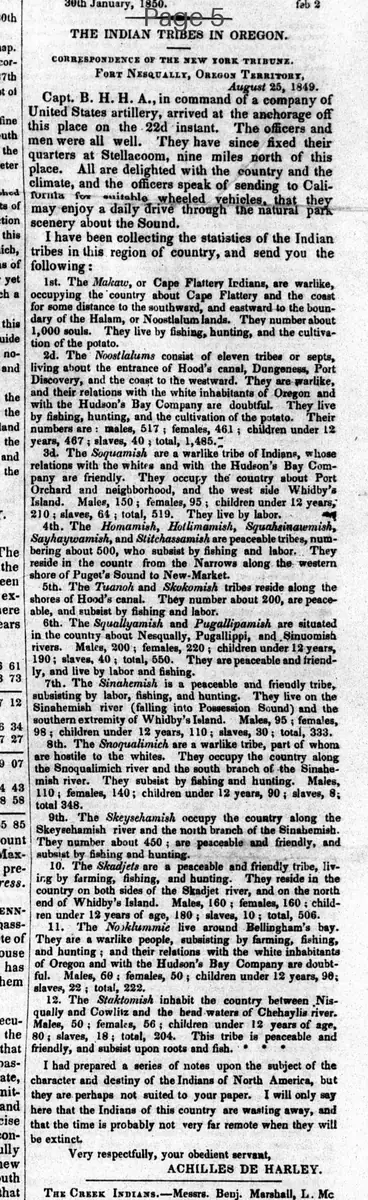
The Indian Tribes in Oregon.
CORRESPONDENCE OF THE NEW YORK TRIBUNE.
Fort Nisqually, Oregon Territory, August 25, 1849.
Capt. B. H. H. A., in command of a company of United States artillery, arrived at the anchorage off this place on the 22d instant. The officers and men were all well. They have since fixed their quarters at Stellacoom, nine miles north of this place. All are delighted with the country and the climate, and the officers speak of sending to California for suitable wheeled vehicles, that they may enjoy a daily drive through the natural park scenery about the Sound.
I have been collecting the statistics of the Indian tribes in this region of country, and send you the following:
1st. The Makaw, or Cape Flattery Indians, are warlike, occupying the country about Cape Flattery and the coast for some distance to the southward, and eastward to the boundary of the Halam, or Noostlalum lands. They number about 1,000 souls. They live by fishing, hunting, and the cultivation of the potato.
2d. The Noostlalums consist of eleven tribes or septs, living about the entrance of Hood's canal, Dungeness, Port Discovery, and the coast to the westward. They are warlike, and their relations with the white inhabitants of Oregon and with the Hudson's Bay Company are doubtful. They live by fishing, hunting, and the cultivation of the potato. Their numbers are: males, 517; females, 461; children under 12 years, 467; slaves, 40; total, 1,485.
3d. The Soquamish are a warlike tribe of Indians, whose relations with the whites and with the Hudson's Bay Company are friendly. They occupy the country about Port Orchard and neighborhood, and the west side Whidby's Island. Males, 150; females, 95; children under 12 years, 210; slaves, 64; total, 519. They live by labor.
4th. The Homamish, Hotlimamish, Squahsinawemish, Sayhaywamish, and Slitchassamish are peaceable tribes, numbering about 500, who subsist by fishing and labor. They reside in the country from the Narrows along the western shore of Puget's Sound to New-Market.
5th. The Tuanoh and Skokomish tribes reside along the shores of Hood's canal. They number about 200, are peaceable, and subsist by fishing and labor.
6th. The Squallyamish and Pugallipamish are situated in the country about Nisqually, Pugalluppi, and Sinuomish rivers. Males, 200; females, 220; children under 12 years, 190; slaves, 40; total, 550. They are peaceable and friendly, and live by labor and fishing.
7th. The Sinahemish is a peaceable and friendly tribe, subsisting by labor, fishing, and hunting. They live on the Sinahemish river (falling into Possession Sound) and the southern extremity of Whidby's Island. Males, 95; females, 98; children under 12 years, 110; slaves, 30; total, 333.
8th. The Snogualimich are a warlike tribe, part of whom are hostile to the whites. They occupy the country along the Snoqualimich river and the south branch of the Sinahemish river. They subsist by fishing and hunting. Males, 110; females, 140; children under 12 years, 90; slaves, 8; total 348.
9th. The Skeysehamish occupy the country along the Skeysehamish river and the north branch of the Sinahemish. They number about 450; are peaceable and friendly, and subsist by fishing and hunting.
10. The Skadjets are a peaceable and friendly tribe, living by farming, fishing, and hunting. They reside in the country on both sides of the Skadjet river, and on the north end of Whidby's Island. Males, 160; females, 160; children under 12 years of age, 180; slaves, 10; total, 506.
11. The Nooklummie live around Bellingham's bay. They are a warlike people, subsisting by farming, fishing, and hunting; and their relations with the white inhabitants of Oregon and with the Hudson's Bay Company are doubtful. Males, 60; females, 50; children under 12 years, 90; slaves, 22; total, 222.
12. The Staktomish inhabit the country between Nisqually and Cowlitz and the head waters of Chehalis river. Males, 50; females, 56; children under 12 years of age, 80; slaves, 18; total, 204. This tribe is peaceable and friendly, and subsist upon roots and fish.
I had prepared a series of notes upon the subject of the character and destiny of the Indians of North America, but they are perhaps not suited to your paper. I will only say here that the Indians of this country are wasting away, and that the time is probably not very far remote when they will be extinct,
Very respectfully, your obedient servant,
ACHILLES DE HARLEY.
CORRESPONDENCE OF THE NEW YORK TRIBUNE.
Fort Nisqually, Oregon Territory, August 25, 1849.
Capt. B. H. H. A., in command of a company of United States artillery, arrived at the anchorage off this place on the 22d instant. The officers and men were all well. They have since fixed their quarters at Stellacoom, nine miles north of this place. All are delighted with the country and the climate, and the officers speak of sending to California for suitable wheeled vehicles, that they may enjoy a daily drive through the natural park scenery about the Sound.
I have been collecting the statistics of the Indian tribes in this region of country, and send you the following:
1st. The Makaw, or Cape Flattery Indians, are warlike, occupying the country about Cape Flattery and the coast for some distance to the southward, and eastward to the boundary of the Halam, or Noostlalum lands. They number about 1,000 souls. They live by fishing, hunting, and the cultivation of the potato.
2d. The Noostlalums consist of eleven tribes or septs, living about the entrance of Hood's canal, Dungeness, Port Discovery, and the coast to the westward. They are warlike, and their relations with the white inhabitants of Oregon and with the Hudson's Bay Company are doubtful. They live by fishing, hunting, and the cultivation of the potato. Their numbers are: males, 517; females, 461; children under 12 years, 467; slaves, 40; total, 1,485.
3d. The Soquamish are a warlike tribe of Indians, whose relations with the whites and with the Hudson's Bay Company are friendly. They occupy the country about Port Orchard and neighborhood, and the west side Whidby's Island. Males, 150; females, 95; children under 12 years, 210; slaves, 64; total, 519. They live by labor.
4th. The Homamish, Hotlimamish, Squahsinawemish, Sayhaywamish, and Slitchassamish are peaceable tribes, numbering about 500, who subsist by fishing and labor. They reside in the country from the Narrows along the western shore of Puget's Sound to New-Market.
5th. The Tuanoh and Skokomish tribes reside along the shores of Hood's canal. They number about 200, are peaceable, and subsist by fishing and labor.
6th. The Squallyamish and Pugallipamish are situated in the country about Nisqually, Pugalluppi, and Sinuomish rivers. Males, 200; females, 220; children under 12 years, 190; slaves, 40; total, 550. They are peaceable and friendly, and live by labor and fishing.
7th. The Sinahemish is a peaceable and friendly tribe, subsisting by labor, fishing, and hunting. They live on the Sinahemish river (falling into Possession Sound) and the southern extremity of Whidby's Island. Males, 95; females, 98; children under 12 years, 110; slaves, 30; total, 333.
8th. The Snogualimich are a warlike tribe, part of whom are hostile to the whites. They occupy the country along the Snoqualimich river and the south branch of the Sinahemish river. They subsist by fishing and hunting. Males, 110; females, 140; children under 12 years, 90; slaves, 8; total 348.
9th. The Skeysehamish occupy the country along the Skeysehamish river and the north branch of the Sinahemish. They number about 450; are peaceable and friendly, and subsist by fishing and hunting.
10. The Skadjets are a peaceable and friendly tribe, living by farming, fishing, and hunting. They reside in the country on both sides of the Skadjet river, and on the north end of Whidby's Island. Males, 160; females, 160; children under 12 years of age, 180; slaves, 10; total, 506.
11. The Nooklummie live around Bellingham's bay. They are a warlike people, subsisting by farming, fishing, and hunting; and their relations with the white inhabitants of Oregon and with the Hudson's Bay Company are doubtful. Males, 60; females, 50; children under 12 years, 90; slaves, 22; total, 222.
12. The Staktomish inhabit the country between Nisqually and Cowlitz and the head waters of Chehalis river. Males, 50; females, 56; children under 12 years of age, 80; slaves, 18; total, 204. This tribe is peaceable and friendly, and subsist upon roots and fish.
I had prepared a series of notes upon the subject of the character and destiny of the Indians of North America, but they are perhaps not suited to your paper. I will only say here that the Indians of this country are wasting away, and that the time is probably not very far remote when they will be extinct,
Very respectfully, your obedient servant,
ACHILLES DE HARLEY.
What sub-type of article is it?
Historical Event
Curiosity
What themes does it cover?
Exploration
Misfortune
What keywords are associated?
Indian Tribes
Oregon Territory
Population Statistics
Hudson Bay Company
Extinction
What entities or persons were involved?
Achilles De Harley
Capt. B. H. H. A.
Where did it happen?
Oregon Territory, Fort Nisqually, Puget Sound
Story Details
Key Persons
Achilles De Harley
Capt. B. H. H. A.
Location
Oregon Territory, Fort Nisqually, Puget Sound
Event Date
August 25, 1849
Story Details
Correspondence detailing the arrival of U.S. artillery company at Fort Nisqually and providing statistics on 12 Indian tribes in the region, including their populations, lifestyles, relations with whites and Hudson's Bay Company, and noting the Indians' impending extinction.