Thank you for visiting SNEWPapers!
Sign up free
The Enquirer
Richmond, Henrico County, Virginia
What is this article about?
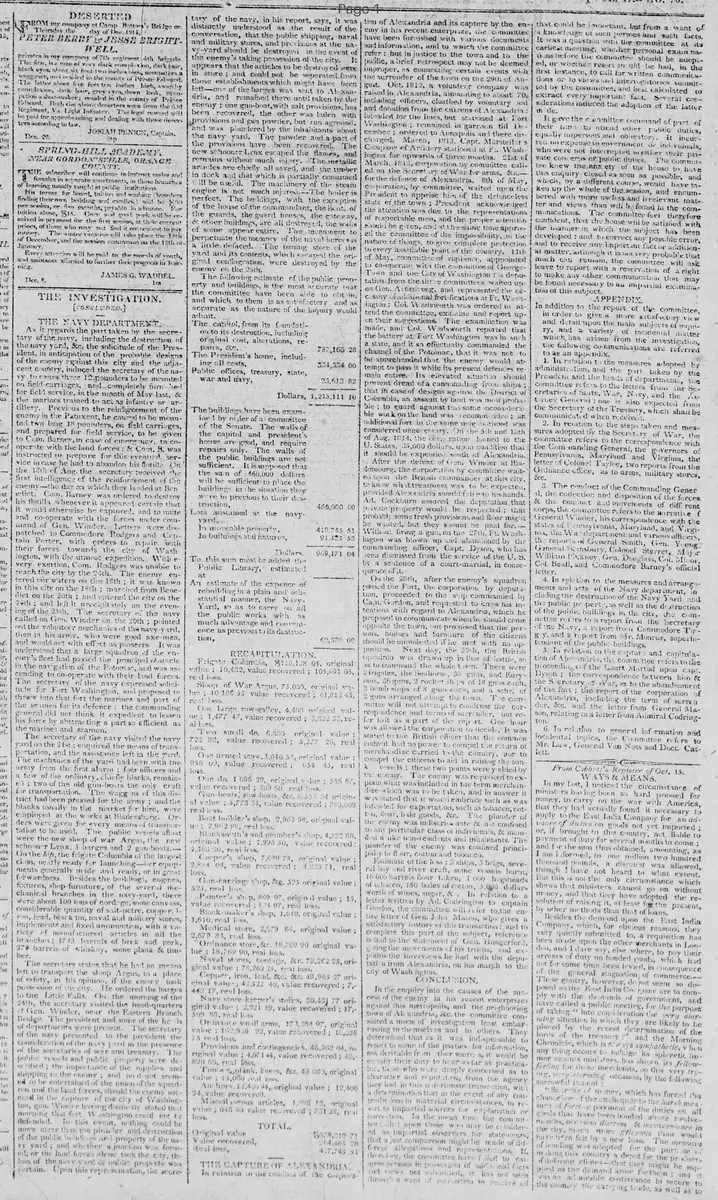
Congressional committee report on the 1814 British invasion of Washington, D.C., detailing Navy Department preparations, destruction of the Navy Yard to prevent capture, estimated losses, and the surrender and plunder of Alexandria.
Merged-components note: These components form a single coherent congressional investigative report on the events surrounding the British attack on Washington, including the navy yard destruction, capture of Alexandria, conclusion, and appendix, with tables as part of the loss estimates.
Clipping
OCR Quality
Full Text
[CONCLUDED.]
THE NAVY DEPARTMENT
As it regards the part taken by the secretary of the navy, including the destruction of the navy yard, &c. the solicitude of the President, in anticipation of the probable designs of the enemy against this city and the adjacent country, induced the secretary of the navy to cause three 12-pounders to be mounted on field-carriages, and completely furnished for field service, in the month of May last, & the marines trained to act as infantry or artillery. Previous to the reinforcement of the enemy in the Patuxent, he caused to be mounted two long 18 pounders, on field carriages, and prepared for field service, to be given to Com. Barney, in case of emergency, to co-operate with the land forces; & Com. B. was instructed to prepare for this event & service in case he had to abandon his flotilla. On the 18th of Aug. the secretary received the first intelligence of the reinforcement of the enemy—the day on which they landed at Benedict. Com. Barney was ordered to destroy his flotilla whenever it appeared certain that it would otherwise be captured, and to unite and co-operate with the forces under command of Gen. Winder. Letters were dispatched to Commodore Rodgers and Captain Porter, with orders to repair with their forces towards the city of Washington, with the utmost expedition. With every exertion, Com. Rodgers was unable to reach the city by the 24th. The enemy entered our waters on the 16th; it was known in this city on the 18th: marched from Benedict on the 20th; and entered the city on the 24th: and left it precipitately on the evening of the 25th. The secretary of the navy called on Gen. Winder on the 20th; pointed out the volunteer mechanics of the navy-yard, then in his army, who were good axe-men, and would act with effect as pioneers. It was understood that a large squadron of the enemy's fleet had passed the principal obstacle in the navigation of the Potomac, and was ascending to co-operate with their land forces. The secretary of the navy expressed solicitude for Fort Washington, and proposed to throw into that fort the marines and part of the seamen for its defence: the commanding general did not think it expedient to lessen his force by abstracting a part so efficient as the marines and seamen.
The secretary of the navy visited the navy yard on the 21st: enquired the means of transportation, and the assistance left in the yard. The mechanics of the yard had been with the army from the first alarm: four officers and a few of the ordinary, chiefly blacks, remained; two of the old gun-boats the only craft for transportation. The waggons of this district had been pressed for the army; and the blacks usually in the market for hire, were employed at the works at Bladensburg. Orders were given for every means of transportation to be used. The public vessels afloat were the new sloop of war Argus, the new schooner Lynx, 3 barges and 2 gun-boats.—On the 21st, the frigate Columbia of the largest class, nearly ready for launching—her equipments generally made and ready, or in great forwardness. Besides the buildings, engines, fixtures, shop-furniture, of the several mechanical branches in the navy-yard, there were about 100 tons of cordage, some canvass, considerable quantity of salt-petre, copper, iron, lead, black tin, naval and military stores, implements and fixed ammunition, with a variety of manufactured articles in all the branches; 1743 barrels of beef and pork, 279 barrels of whiskey, some plank & timber.
The secretary states that he had no means left to transport the sloop Argus, to a place of safety, in his opinion, if the enemy took possession of the city. He ordered the barges to the Little Falls. On the morning of the 24th, the secretary visited the head-quarters of Gen. Winder, near the Eastern Branch Bridge. The president and some of the heads of departments were present. The secretary of the navy, presented to the president the consideration of the navy yard in the presence of the secretaries of war and treasury. The public vessels and public property were described; the importance of the supplies and shipping to the enemy; and no doubt seemed to be entertained of the union of the squadron and the land forces, should the enemy succeed in the capture of the city of Washington, gen. Winder having distinctly stated that morning that fort Washington could not be defended. In this event, nothing could be more clear than the plan for and destruction of the public workings and property of the navy yard; and whether a junction was formed, or the land forces alone took the city, the loss of the navy-yard & public property was certain. Upon this representation, the secretary of the navy, in his report, says, it was distinctly understood as the result of the conversation, that the public shipping, naval and military stores, and provisions at the navy-yard should be destroyed in the event of the enemy's taking possession of the city. It appears that the articles to be destroyed were in store: and could not be separated from those establishments which might have been left—one of the barges was sent to Alexandria, and remained there until taken by the enemy; one gun-boat, with salt provisions, has been recovered, the other was laden with provisions and gun powder, but run aground, and was plundered by the inhabitants about the navy yard. The powder and a part of the provisions have been recovered. The new schooner Lynx escaped the flames, and remains without much injury. The metallic articles are chiefly all saved, and the timber in dock and that which is partially consumed will be useful. The machinery of the steam engine is not much injured.—The boiler is perfect. The buildings, with the exception of the house of the commandant, the jail of the guards, the guard houses, the gateway, & other buildings, are all destroyed, the walls of some appear entire. The monument to perpetuate the memory of the naval heroes is a little defaced. The issuing store of the yard and its contents, which escaped the original conflagration, were destroyed by the enemy on the 25th.
The following estimate of the public property and buildings, is the most accurate that the committee have been able to obtain, and which to them is as satisfactory and as accurate as the nature of the inquiry would admit.
The capitol, from its foundation to its destruction, including original cost, alterations, repairs, &c. $137,168 28
The President's house, including all costs. 334,334 00
Public offices, treasury, state, war and navy, 23,613 82
Dollars, 1,215,111 10
The buildings have been examined by order of a committee of the Senate. The walls of the capitol and president's house are good, and require repairs only. The walls of the public buildings are not sufficient. It is supposed that the sum of 460,000 dollars will be sufficient to place the buildings in the situation they were in previous to their destruction,
460,000 00
Loss sustained at the navy-yard,
Dollars. 969,171 04
To this sum must be added the Public Library, estimated at
An estimate of the expense of rebuilding in a plain and substantial manner, the Navy-Yard, so as to carry on all the public works with as much advantage and convenience as previous to its destruction,
62,370 00
RECAPITULATION.
Frigate Columbia, $115,128 05, original value: 10,432, value recovered; 105,691 05, real loss.
Sloop of War Argus, 75,000, original value; 10,186 55 value recovered; 61,813 45, real loss.
One large row-galley, 4,400 original value: 1,477 47, value recovered; 3,022 50, real loss.
Two small do. 6,000 original value: 722 80, value recovered; 5,277 20, real loss.
One armed scow, 1,610 54, original value: 956 09, value recovered; 654 45, real loss.
One do. 1,096 29, original value: 586 67, value recovered: 509 62 real loss.
Gun-boats: row-boats, &c. 6,353 34 original value; 5,573 00, value recovered; 780,00 real loss.
Boat builder's shop. 2,962 98, original value: 2,962 95, real loss.
Blacksmith's and plumber's shop, 4,569 80, original value; 1,906 00, value recovered: 2,663 80, real loss.
Carpenter's shop, 7,699 75, original value; 2,864 04, value recovered: 4,835 71, real loss.
Gun-carriage shop, &c. 525 original value; 525, real loss.
Painter's shop, 859 97, original value; 15, value recovered; 844 97, real loss.
Block-maker's shop, 1,610, original value; 1,610 real loss.
Medical store, 2,579 84, original value; 2,579 84, real loss.
Ordnance store, &c. 18,769 90 original value: 18,769 90, real loss.
Naval stores, cordage, &c. 73,262 25, original value: 73,262 25, real loss.
Copper, iron, lead, &c. &c. 49,965 27 original value: 42,532 40, value recovered; 7,432 87, real loss.
Navy store-keeper's stores, 20,431 77 original value; 2,921 89, value recovered; 17,509 88, real loss.
Ordnance small arms, 171,294 97, original value: 162,256 22, value recovered; 10,038 75 real loss.
Provisions and contingencies, 46,962 04, original value: 4,071 44, value recovered; 42,890 60, real loss.
Timber, plank, knees, &c. 45,000, original value: 45,000 real loss.
An horse. 12,409 94, original value 12,409 34, value recovered.
Miscellaneous articles, 1,980 13, original value; 648 85 value recovered; 1,331 28, real loss.
TOTAL.
| In moveable property, | 418,745 | 51 |
| In buildings and fixtures, | 91,425 | 53 |
| Original value | $678,210 71 |
| Value recovered, | 264,465 20 |
| Real loss, | 417,745 51 |
THE CAPTURE OF ALEXANDRIA.
In relation to the conduct of the Corporation of Alexandria and its capture by the enemy in his recent enterprise, the committee have been furnished with various documents and information, and to which the committee refer: but in justice to the town and to the public, a brief retrospect may not be deemed improper, as connecting certain events with the surrender of the town on the 29th of August. Oct. 1812, a volunteer company was raised in Alexandria, amounting to about 70, including officers, clothed by voluntary aid and donation from the citizens of Alexandria: intended for the lines, but stationed at Fort Washington; remained in garrison till December; ordered to Annapolis and there discharged. March, 1813. Capt. Marsteller's Company of Artillery stationed at Ft. Washington for upwards of three months. 21st of March, 1814, corporation by committee called on the Secretary of War for arms, &c.—for the defence of Alexandria. 5th of May, corporation, by committee, waited upon the President to apprise him of the defenceless state of the town; President acknowledged the attention was due to the representations of respectable men, and the proper attention should be given, and at the same time apprised the committee of the impossibility, in the nature of things, to give complete protection to every assailable point of the country. 11th of May, committee of vigilance, appointed to co-operate with the Committee of Georgetown and the City of Washington: a deputation from the three committees waited upon Gen. Armstrong, and represented the necessity of additional fortifications at Ft. Washington: Col. Wadsworth was ordered to attend the committee, examine and report upon their suggestions. The examination was made, and Col. Wadsworth reported that the battery at Fort Washington was in such a state, and it so effectually commanded the channel of the Potomac, that it was not to be apprehended that the enemy would attempt to pass it while its present defences remained entire. Its elevated situation should prevent dread of a cannonading from ships; that in case of designs against the District of Columbia, an assault by land was most probable; to guard against this some inconsiderable work on the land was recommended: an additional fort in the same neighborhood was considered unnecessary. On the 5th and 15th of Aug. 1814, the corporation loaned to the U. States, $35,000 dollars, upon condition that it should be expended south of Alexandria.
After the defeat of Gen. Winder at Bladensburg, the corporation by committee waited upon the British commander at this city, to know what treatment was to be expected, provided Alexandria should fall into his hands. Ad. Cockburn assured the deputation that private property would be respected; that probably some fresh provisions and flour might be wanted, but they should be paid for.—Without firing a gun, on the 27th, Ft. Washington was blown up and abandoned by the commanding officer, Capt. Dyson, who has been dismissed from the service of the U. S. by a sentence of a court-martial, in consequence of it.
On the 28th, after the enemy's squadron passed the Fort, the corporation by deputation, proceeded to the ship commanded by Capt. Gordon, and requested to know his intentions with regard to Alexandria, which he proposed to communicate when he should come opposite the town, but promised that the persons, houses and furniture of the citizens should be unmolested if he met with no opposition. Next day, the 29th, the British squadron was drawn up in line of battle, so as to command the whole town. There were 2 frigates, the Seahorse, 38 guns, and Euryalus, 36 guns, 2 rocket ships of 18 guns each, 2 bomb ships of 8 guns each, and a schr. of 2 guns arranged along the town. The committee will not attempt to condense the correspondence and terms of surrender, but refer to it as a part of the report. One hour was allowed the corporation to decide. It was stated to the British officer that the common council had no power to compel the return of merchandise carried to the country, nor to compel the citizens to aid in raising the sunken vessels: these two points were yielded by the enemy. The enemy was requested to explain what was included in the term merchandise which was to be taken, and in answer it was stated that it would embrace such as was intended for exportation, such as tobacco, cotton, flour, bale goods, &c. The plunder of the enemy was indiscriminate & not confined to any particular class of individuals, & included alike non-residents and inhabitants. The plunder of the enemy was confined principally to flour, cotton and tobacco.
Estimate of the loss: 8 ships, 3 brigs, several bay and river craft, some vessels burnt, 16,000 barrels flour taken, 1000 hogsheads of tobacco, 150 bales of cotton, 3,000 dollars worth of wines, sugar, &c. In relation to a letter written by Ad. Codrington to captain Gordon, the committee will refer to the entire letter of Gen. John Mason, who gives a satisfactory history of this transaction: and to complete this part of the subject, reference is had to the statement of Gen. Hungerford, giving the movements of his troops, and explains the interviews he had with the deputation from Alexandria, on his march to the city of Washington.
CONCLUSION.
In the enquiry into the causes of the success of the enemy in his recent enterprizes against this metropolis, and the neighboring town of Alexandria, &c. the Committee considered a mode of investigation least embarrassing to themselves and to others. They determined that as it was indispensable to resort to some of the parties for information, not derivable from their sources, it would be equally their duty to hear as far as practicable, those who were deeply concerned as to character and reputation, from the agency they had in this unfortunate transaction, with a determination that in the event of any contradictions in material circumstances, to resort to impartial sources for explanation or correction. In the mean time the committee called upon those who may be considered as impartial observers for statements, that a just comparison might be made of different allegations and representations. If, therefore, the committee have failed to call upon persons in possession of additional facts and views not submitted, it has not been through a want of readiness to receive art that could be important, but from a want of knowledge of such persons and such facts. It was a question with the committee at its earliest meeting, whether personal examinations before the committee should be adopted, or whether resort should be had, in the first instance, to call for written communications or to views and interrogatories submitted by the committee, and best calculated to extract every important fact. Several considerations induced the adoption of the latter in degree. It gave the committee command of part of their time to attend other public duties, equally imperious and obligatory. It incurred no expense to government or individuals, who were not interrupted neither their private concerns or public duties. The committee knew the anxiety of the house to have this enquiry closed as soon as possible, and which, by a different course, would have taken up the whole of the session, and encumbered with more useless and irrelevant matter and views than will be found in the communications. The committee feel therefore confident, that the house will be satisfied with the manner in which the subject has been developed: and to correct any possible error, and to receive any important fact or additional matter, although it is not very probable that much can remain, the committee will ask leave to report with a reservation of a right to make any other communication that may be found necessary to an impartial examination of this subject.
APPENDIX
In addition to the report of the committee, in order to give a more satisfactory view and detail upon the main subjects of inquiry, and a variety of incidental matter which has arisen from the investigation, the following communications are referred to as an appendix.
1. In relation to the measures adopted by administration, and the part taken by the President and the heads of departments, the Committee refers to the letters from the Secretaries of State, War, Navy, and the Attorney General: one is also expected from the Secretary of the Treasury, which shall be communicated when received.
2. In relation to the steps taken and measures adopted by the Secretary of War, the committee refers to the correspondence with the Commanding General, the governors of Pennsylvania, Maryland and Virginia, the letter of Colonel Tayloe, two reports from the Ordnance office, as to arms, military stores, &c.
3. The conduct of the Commanding General, the collection and disposition of the forces & the conduct and movements of different corps, the committee refers to the narrative of General Winder, his correspondence with the states of Pennsylvania, Maryland, and Virginia, the War-department and various officers, the reports of General Smith, Gen. Young, General Stansbury, Colonel Sterret, Major William Pinkney, Gen. Douglas, Col. Minor, Col. Beall, and Commodore Barney's official letter.
4. In relation to the measures and arrangements and acts of the Navy department, including the destruction of the Navy Yard and the public property, as well as the destruction of the public buildings in the city, the committee refers to a report from the Secretary of the Navy, a report from Commodore Tingy, and a report from Mr. Monroe, superintendent of the public buildings.
5. In relation to the capture and capitulation of Alexandria, the committee refers to the proceedings of the Court Martial upon capt. Dyson; the correspondence between him & the Secretary of War, as to the abandonment of the fort; the report of the corporation of Alexandria, including the term of surrender, &c. and the letter from General Mason, relating to a letter from Admiral Codrington.
6. In relation to general information and incidental topics, the committee refers to Mr. Law, General Van Ness and Doct. Cattlet.
What sub-type of article is it?
What themes does it cover?
What keywords are associated?
What entities or persons were involved?
Where did it happen?
Story Details
Key Persons
Location
Washington, D.C., Navy Yard, Alexandria, Fort Washington
Event Date
August 1814
Story Details
Congressional investigation into British invasion: Navy preparations, destruction of flotilla and Navy Yard to deny enemy assets, estimated losses over $400,000; Alexandria's prior defenses and unopposed surrender leading to plunder of flour, tobacco, and cotton.