Thank you for visiting SNEWPapers!
Sign up free
Story
May 8, 1790
Gazette Of The United States
New York, New York County, New York
What is this article about?
A detailed description of Pennsylvania's geography, inland navigation improvements, land sales, agricultural and manufactured produce, and exports, highlighting the state's economic potential post-Revolution for settlement and trade.
Clipping
OCR Quality
95%
Excellent
Full Text
FROM THE PENNSYLVANIA GAZETTE.
To the Honorable the MEMBERS of the LEGISLATURE Of PENNSYLVANIA,
(Continued from our last.)
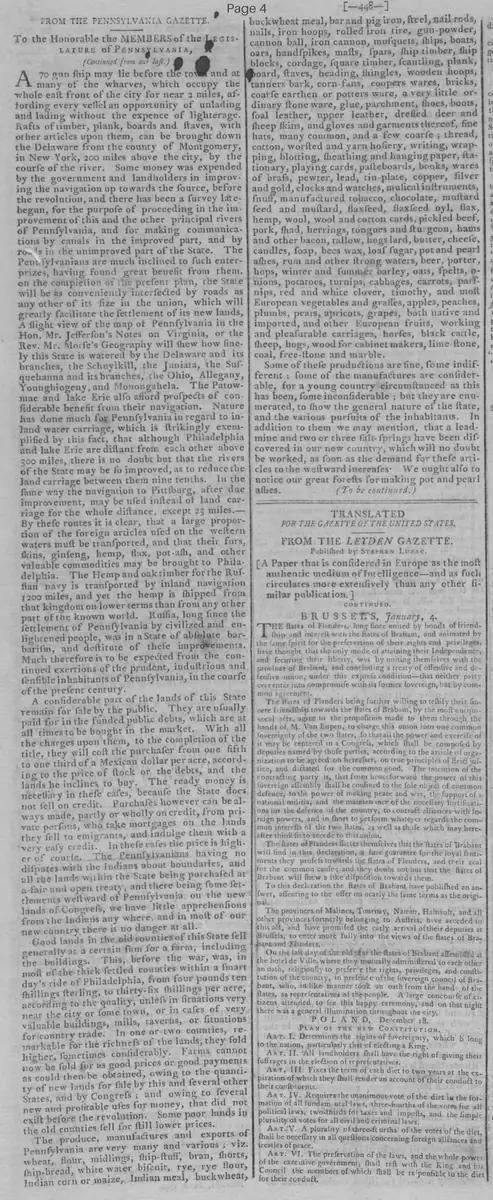
As many of the wharves, which occupy the whole east front of the city for near 2 miles, affording every vessel an opportunity of unlading and lading without the expense of lighterage. Rafts of timber, plank, boards and staves, with other articles upon them, can be brought down the Delaware from the county of Montgomery, in New-York, 200 miles above the city, by the course of the river. Some money was expended by the government and landholders in improving the navigation up towards the source, before the revolution, and there has been a survey lately begun, for the purpose of proceeding in the improvement of this and the other principal rivers of Pennsylvania, and for making communications by canals in the improved part, and by roads in the unimproved part of the State. The Pennsylvanians are much inclined to such enterprises, having found great benefit from them. On the completion of this present plan, the State will be as conveniently intersected by roads as any other of its size in the union, which will greatly facilitate the settlement of its new lands. A slight view of the map of Pennsylvania in the Hon. Mr. Jefferson's Notes on Virginia, or the Rev. Mr. Morse's Geography will show how finely this State is watered by the Delaware and its branches, the Schuylkill, the Juniata, the Susquehanna and its branches, the Ohio, Alleghany, Youghiogheny, and Monongahela. The Potomac and lake Erie also afford prospects of considerable benefit from their navigation. Nature has done much for Pennsylvania in regard to inland water carriage, which is strikingly exemplified by this fact, that although Philadelphia and lake Erie are distant from each other above 300 miles, there is no doubt but that the rivers of the State may be so improved, as to reduce the land carriage between them nine tenths. In the same way the navigation to Pittsburgh, after due improvement, may be used instead of land carriage for the whole distance, except 23 miles. By these routes it is clear, that a large proportion of the foreign articles used on the western waters must be transported, and that their furs, skins, ginseng, hemp, flax, pot-ash, and other valuable commodities may be brought to Philadelphia. The Hemp and oak timber for the Russian navy is transported by inland navigation 1200 miles, and yet the hemp is shipped from that kingdom on lower terms than from any other part of the known world. Russia, long since the settlement of Pennsylvania by civilized and enlightened people, was in a State of absolute barbarism, and destitute of these improvements. Much therefore is to be expected from the continued exertions of the prudent, industrious and sensible inhabitants of Pennsylvania, in the course of the present century.
A considerable part of the lands of this State remain for sale by the public. They are usually paid for in the funded public debts, which are at all times to be bought in the market. With all the charges upon them, to the completion of the title, they will cost the purchaser from one fifth to one third of a Mexican dollar per acre, according to the price of stock or the debts, and the lands he inclines to buy. The ready money is necessary in these cases, because the State does not sell on credit. Purchases however can always be made, partly or wholly on credit, from private persons, who take mortgages on the lands they sell to emigrants, and indulge them with very easy credit. In these cases the price is high. of course. The Pennsylvanians having no disputes with the Indians about boundaries, and a fair and open treaty, and there being some settlements westward of Pennsylvania on the new lands of Congress, we have little apprehensions from the Indians any where, and in most of our new country there is no danger at all.
Good lands in the old counties of this State sell generally at a certain sum for a farm, including the buildings. This, before the war, was, in most of the thick settled counties within a day's ride of Philadelphia, from four pounds ten shillings sterling, to thirty-six shillings per acre, according to the quality, unless in situations very near the city or some town, or in cases of very valuable buildings, mills, taverns, or situations for country trade. In one or two counties, remarkable for the richness of the lands, they sold higher, sometimes considerably. Farms cannot now be sold for as good prices or good payments as could then be obtained, owing to the quantity of new lands for sale by this and several other States, and by Congress; and owing to several new and profitable uses for money, that did not exist before the revolution. Some poor lands in the old counties sell for still lower prices.
The produce, manufactures and exports of Pennsylvania are very many and various; viz. wheat, flour, middlings, ship-stuff, bran, shorts, ship-bread, white water biscuit, rye, rye flour, Indian corn or maize, Indian meal, buckwheat, buckwheat meal, bar iron and pig iron, steel, nail rods, nails, iron hoops, rolled iron tire, gun-powder, cannon ball, iron cannon, muskets, ships, boats, oars, handspikes, mats, spars, ship timber, ship blocks, cordage, square timber, scantling, plank, board, staves, heading, shingles, wooden hoops, tanners bark, corn-fans, coopers wares, bricks, coarse earthen or potters ware, a very little ordinary stone ware, glue, parchment, shoes, boots, sole leather, upper leather, dressed deer and sheep skins, and gloves and garments thereof, fine hats, many common, and a few coarse; thread, cotton, worsted and yarn hosiery, writing, wrapping, blotting, sheathing and hanging paper, stationery, playing cards, pasteboards, books, wares of brass, pewter, lead, tin-plate, copper, silver and gold, clocks and watches, musical instruments, snuff, manufactured tobacco, chocolate, mustard seed and mustard, flaxseed, flaxseed oil, flax, hemp, wool, wool and cotton cards, pickled beef, pork, shad, herrings, tongues and sturgeon, hams and other bacon, tallow, hogs lard, butter, cheese, candles, soap, bees wax, loaf sugar, pot and pearl ashes, rum and other strong waters, beer, porter, hops, winter and summer barley, oats, pelts, onions, potatoes, turnips, cabbages, carrots, parsnips, red and white clover, timothy, and most European vegetables and grasses, apples, peaches, plums, pears, apricots, grapes, both native and imported, and other European fruits, working and pleasurable carriages, horses, black cattle, sheep, hogs, wood for cabinet makers, lime stone, coal, free-stone and marble.
Some of these productions are fine, some indifferent; some of the manufactures are considerable, for a young country circumstanced as this has been, some inconsiderable; but they are enumerated, to show the general nature of the state, and the various pursuits of the inhabitants. In addition to them we may mention, that a lead-mine and two or three salt-springs have been discovered in our new country, which will no doubt be worked, as soon as the demand for these articles to the westward increases: We ought also to notice our great forests for making pot and pearl ashes.
(To be continued.)
To the Honorable the MEMBERS of the LEGISLATURE Of PENNSYLVANIA,
(Continued from our last.)
As many of the wharves, which occupy the whole east front of the city for near 2 miles, affording every vessel an opportunity of unlading and lading without the expense of lighterage. Rafts of timber, plank, boards and staves, with other articles upon them, can be brought down the Delaware from the county of Montgomery, in New-York, 200 miles above the city, by the course of the river. Some money was expended by the government and landholders in improving the navigation up towards the source, before the revolution, and there has been a survey lately begun, for the purpose of proceeding in the improvement of this and the other principal rivers of Pennsylvania, and for making communications by canals in the improved part, and by roads in the unimproved part of the State. The Pennsylvanians are much inclined to such enterprises, having found great benefit from them. On the completion of this present plan, the State will be as conveniently intersected by roads as any other of its size in the union, which will greatly facilitate the settlement of its new lands. A slight view of the map of Pennsylvania in the Hon. Mr. Jefferson's Notes on Virginia, or the Rev. Mr. Morse's Geography will show how finely this State is watered by the Delaware and its branches, the Schuylkill, the Juniata, the Susquehanna and its branches, the Ohio, Alleghany, Youghiogheny, and Monongahela. The Potomac and lake Erie also afford prospects of considerable benefit from their navigation. Nature has done much for Pennsylvania in regard to inland water carriage, which is strikingly exemplified by this fact, that although Philadelphia and lake Erie are distant from each other above 300 miles, there is no doubt but that the rivers of the State may be so improved, as to reduce the land carriage between them nine tenths. In the same way the navigation to Pittsburgh, after due improvement, may be used instead of land carriage for the whole distance, except 23 miles. By these routes it is clear, that a large proportion of the foreign articles used on the western waters must be transported, and that their furs, skins, ginseng, hemp, flax, pot-ash, and other valuable commodities may be brought to Philadelphia. The Hemp and oak timber for the Russian navy is transported by inland navigation 1200 miles, and yet the hemp is shipped from that kingdom on lower terms than from any other part of the known world. Russia, long since the settlement of Pennsylvania by civilized and enlightened people, was in a State of absolute barbarism, and destitute of these improvements. Much therefore is to be expected from the continued exertions of the prudent, industrious and sensible inhabitants of Pennsylvania, in the course of the present century.
A considerable part of the lands of this State remain for sale by the public. They are usually paid for in the funded public debts, which are at all times to be bought in the market. With all the charges upon them, to the completion of the title, they will cost the purchaser from one fifth to one third of a Mexican dollar per acre, according to the price of stock or the debts, and the lands he inclines to buy. The ready money is necessary in these cases, because the State does not sell on credit. Purchases however can always be made, partly or wholly on credit, from private persons, who take mortgages on the lands they sell to emigrants, and indulge them with very easy credit. In these cases the price is high. of course. The Pennsylvanians having no disputes with the Indians about boundaries, and a fair and open treaty, and there being some settlements westward of Pennsylvania on the new lands of Congress, we have little apprehensions from the Indians any where, and in most of our new country there is no danger at all.
Good lands in the old counties of this State sell generally at a certain sum for a farm, including the buildings. This, before the war, was, in most of the thick settled counties within a day's ride of Philadelphia, from four pounds ten shillings sterling, to thirty-six shillings per acre, according to the quality, unless in situations very near the city or some town, or in cases of very valuable buildings, mills, taverns, or situations for country trade. In one or two counties, remarkable for the richness of the lands, they sold higher, sometimes considerably. Farms cannot now be sold for as good prices or good payments as could then be obtained, owing to the quantity of new lands for sale by this and several other States, and by Congress; and owing to several new and profitable uses for money, that did not exist before the revolution. Some poor lands in the old counties sell for still lower prices.
The produce, manufactures and exports of Pennsylvania are very many and various; viz. wheat, flour, middlings, ship-stuff, bran, shorts, ship-bread, white water biscuit, rye, rye flour, Indian corn or maize, Indian meal, buckwheat, buckwheat meal, bar iron and pig iron, steel, nail rods, nails, iron hoops, rolled iron tire, gun-powder, cannon ball, iron cannon, muskets, ships, boats, oars, handspikes, mats, spars, ship timber, ship blocks, cordage, square timber, scantling, plank, board, staves, heading, shingles, wooden hoops, tanners bark, corn-fans, coopers wares, bricks, coarse earthen or potters ware, a very little ordinary stone ware, glue, parchment, shoes, boots, sole leather, upper leather, dressed deer and sheep skins, and gloves and garments thereof, fine hats, many common, and a few coarse; thread, cotton, worsted and yarn hosiery, writing, wrapping, blotting, sheathing and hanging paper, stationery, playing cards, pasteboards, books, wares of brass, pewter, lead, tin-plate, copper, silver and gold, clocks and watches, musical instruments, snuff, manufactured tobacco, chocolate, mustard seed and mustard, flaxseed, flaxseed oil, flax, hemp, wool, wool and cotton cards, pickled beef, pork, shad, herrings, tongues and sturgeon, hams and other bacon, tallow, hogs lard, butter, cheese, candles, soap, bees wax, loaf sugar, pot and pearl ashes, rum and other strong waters, beer, porter, hops, winter and summer barley, oats, pelts, onions, potatoes, turnips, cabbages, carrots, parsnips, red and white clover, timothy, and most European vegetables and grasses, apples, peaches, plums, pears, apricots, grapes, both native and imported, and other European fruits, working and pleasurable carriages, horses, black cattle, sheep, hogs, wood for cabinet makers, lime stone, coal, free-stone and marble.
Some of these productions are fine, some indifferent; some of the manufactures are considerable, for a young country circumstanced as this has been, some inconsiderable; but they are enumerated, to show the general nature of the state, and the various pursuits of the inhabitants. In addition to them we may mention, that a lead-mine and two or three salt-springs have been discovered in our new country, which will no doubt be worked, as soon as the demand for these articles to the westward increases: We ought also to notice our great forests for making pot and pearl ashes.
(To be continued.)
What sub-type of article is it?
Geographical Description
Economic Survey
What themes does it cover?
Exploration
Triumph
What keywords are associated?
Pennsylvania
Delaware River
Inland Navigation
Land Sales
Farm Prices
Produce Exports
Manufactures
Where did it happen?
Pennsylvania
Story Details
Location
Pennsylvania
Event Date
Post Revolution
Story Details
Description of Pennsylvania's wharves, river navigation improvements, land sales practices, farm prices before and after the war, and extensive list of produce, manufactures, and exports, emphasizing economic potential and settlement opportunities.