Thank you for visiting SNEWPapers!
Sign up free
Bill Barlow's Budget
Douglas, Converse County, Wyoming
What is this article about?
The Fifty-second U.S. Congress ended on March 6 without action on silver, tariff, and antioption bills, passing 660 acts including World's Fair aid and minor tariff changes, amid stable appropriations and failed investigations.
Merged-components note: Continuation of the article on the Fifty-Second Congress session; text in second component starts mid-sentence ('dent, viz:') connecting directly to the first.
Clipping
OCR Quality
Full Text
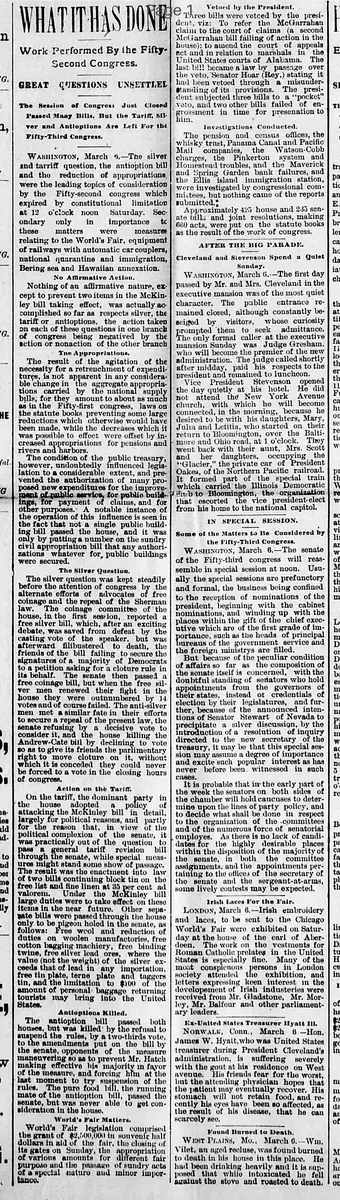
Work Performed By the Fifty
Second Congress.
GREAT
QUESTIONS
UNSETTLED
The Session of Congress Just Closed
Passed Many Bills, But the Tariff, Sil-
ver and Antioption Are Left For the
Fifty-Third Congress.
WASHINGTON, March 6.—The silver
and tariff question, the antioption bill
and the reduction of appropriations
were the leading topics of consideration
by the Fifty-second congress which
expired by constitutional limitation
at 12 o'clock noon Saturday. Secondary
only in importance to these
matters were measures relating to the World's Fair, equipment
of railways with automatic car couplers,
national quarantine and immigration,
Bering sea and Hawaiian annexation.
No Affirmative Action.
Nothing of an affirmative nature, ex-
cept to prevent two items in the McKin-
ley bill taking effect, was actually ac-
complished so far as respects silver, the
tariff or antioptions, the action taken
on each of these questions in one branch
of congress being negatived by the
action or nonaction of the other branch.
The Appropriations.
The result of the agitation of the
necessity for a retrenchment of expendi-
tures, is not apparent in any considera-
ble change in the aggregate appropria-
tions carried by the national supply
bills, for they amount to about as much
as in the Fifty-first congress, laws on
the statute books preventing some large
reductions which otherwise would have
been made, while the decreases which it
was possible to effect were offset by in-
creased appropriations for pensions and
rivers and harbors.
The condition of the public treasury,
however, undoubtedly influenced legis-
latiion to a considerable extent, and pre-
vented the authorization of many pro-
posed new expenditures for the improve-
ment of public service, for public build-
ings, for payment of claims, and for
other purposes. A notable instance of
the operation of this influence is seen in
the fact that not a single public build-
ing bill passed the house, and it was
only by putting a number on the sundry
civil appropriation bill that any authori-
zations whatever for public buildings
were secured.
The Silver Question.
The silver question was kept steadily
before the attention of congress by the
alternate efforts of advocates of free
coinage and the repeal of the Sherman
law. The coinage committee of the
house, in the first session, reported a
free silver bill, which, after an exciting
debate, was saved from defeat by the
casting vote of the speaker, but was
afterward filibustered to death, the
friends of the bill failing to secure the
signatures of a majority of Democrats
to a petition asking for a cloture rule in
its behalf. The senate then passed a
free coinage bill, but when the free sil-
ver men renewed their fight in the
house they were outnumbered by 14
votes and of course failed. The anti-silver
men met a similar fate in their efforts
to secure a repeal of the present law, the
senate refusing by a decisive vote to
consider it, and the house killing the
Andrew-Coxey bill by declining to vote
so as to give its friends the parliamentary
right to move cloture on it, without
which it is conceded they could never
be forced to a vote in the closing hours
of congress.
Action on the Tariff.
On the tariff, the dominant party
in the house adopted a policy of
attacking the McKinley bill in detail,
largely for political reasons, and partly
for the reason that, in view of the
political complexion of the senate, it
was practically out of the question to
pass a general tariff revision bill
through the senate, while special meas-
ures might stand some show of passage.
The result was the enactment into law
of two bills continuing block tin on the
free list and fine linen at 35 per cent ad
valorem. Under the McKinley bill
large duties were to take effect on these
items in the near future. Other sepa-
rate bills were passed through the house
only to be pigeon-holed in the senate, as
follows: Free wool and reduction of
duties on woolen manufactories, free
cotton bagging machinery, free binding
twine, free silver lead ores, where the
value (not the weight) of the silver ex-
ceeds that of lead in any importation,
free tin plate, terne plate and taggers
tin, and the limitation to 1/2 of the
amount of personal baggage returning
tourists may bring into the United
States.
Antioptions Killed.
The antioption bill passed both
houses, but was killed by the refusal to
suspend the rules, by a two-thirds vote,
to the amendments put on the bill by
the senate, opponents of the measure
maneuvering so as to prevent Mr. Hatch
making effective his majority in favor
of the measure, and forcing him at the
last moment to try suspension of the
rules. The pure food bill, the running
mate of the antioption bill, passed the
senate, but was never able to get con-
sideration in the house.
World's Fair Matters.
World's Fair legislation comprised
the grant of $2,000,000 in souvenir half
dollars in aid of the fair, the closing of
its gates on Sunday, the appropriation
of various amounts for different fair
purposes and the passage of sundry acts
of a special nature and minor impor-
tance.
dent, viz: To refer the McGarrahan
claim to the court of claims (a second
McGarrahan bill failing of action in the
house): to amend the court of appeals
act and in relation to marshals in the
United States courts of Alabama. The
last bill became a law by passage over
the veto. Senator Hoar (Rep.) stating it
had been vetoed through a misunder-
standing of its provisions.
The presi-
dent subjected three bills to a "pocket"
veto, and two other bills failed of en-
grossment in time for presentation to
him.
Investigations Conducted.
The pension and census offices, the
whisky trust, Panama Canal and Pacific
companies, the Watson-Cobb
charges, the Pinkerton system and
Homestead troubles, and the Maverick
and Spring Garden bank failures, and
the Ellis island immigration station,
were investigated by congressional com-
mittees, but nothing came of the reports
submitted.
Approximately 425 house and 235 sen-
ate bills and joint resolutions, making
660 acts, were put on the statute books
as the result of the work of congress.
What sub-type of article is it?
What keywords are associated?
What entities or persons were involved?
Where did it happen?
Domestic News Details
Primary Location
Washington
Event Date
March 6
Key Persons
Outcome
no affirmative action on silver, tariff, or antioptions; appropriations similar to previous congress; 660 acts passed; investigations conducted but no results.
Event Details
The Fifty-second Congress expired on March 6 without resolving key issues like silver coinage, tariff revision, and antioption bill. It passed bills on World's Fair aid, automatic car couplers, and minor tariff adjustments, but major economic measures failed due to inter-branch disagreements. Appropriations remained stable despite retrenchment efforts, influenced by treasury conditions.