Thank you for visiting SNEWPapers!
Sign up free
The Pensacola Journal
Pensacola, Escambia County, Florida
What is this article about?
Japan has shifted from debtor to creditor nation during the war, successfully issuing a 100,000,000 yen British loan in Tokio and investing heavily in Entente Allies' bonds, totaling over 515,000,000 yen, with a cash balance of about 1,200,000,000 yen to its credit.
Clipping
OCR Quality
Full Text
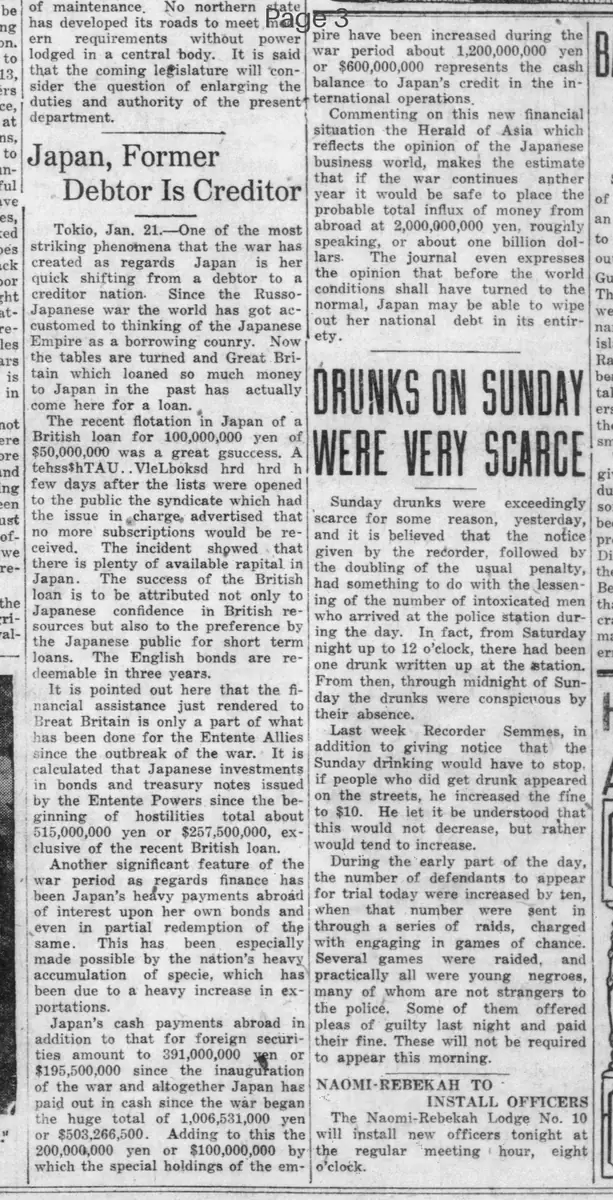
Tokio, Jan. 21.-One of the most striking phenomena that the war has created as regards Japan is her quick shifting from a debtor to a creditor nation. Since the Russo-Japanese war the world has got accustomed to thinking of the Japanese Empire as a borrowing country. Now the tables are turned and Great Britain which loaned so much money to Japan in the past has actually come here for a loan.
The recent flotation in Japan of a British loan for 100,000,000 yen of $50,000,000 was a great success. A few days after the lists were opened to the public the syndicate which had the issue in charge advertised that no more subscriptions would be received. The incident showed that there is plenty of available capital in Japan. The success of the British loan is to be attributed not only to Japanese confidence in British resources but also to the preference by the Japanese public for short term loans. The English bonds are redeemable in three years.
It is pointed out here that the financial assistance just rendered to Great Britain is only a part of what has been done for the Entente Allies since the outbreak of the war. It is calculated that Japanese investments in bonds and treasury notes issued by the Entente Powers since the beginning of hostilities total about 515,000,000 yen or $257,500,000, exclusive of the recent British loan.
Another significant feature of the war period as regards finance has been Japan's heavy payments abroad of interest upon her own bonds and even in partial redemption of the same. This has been especially made possible by the nation's heavy accumulation of specie, which has been due to a heavy increase in exportations.
Japan's cash payments abroad in addition to that for foreign securities amount to 391,000,000 yen or $195,500,000 since the inauguration of the war and altogether Japan has paid out in cash since the war began the huge total of 1,006,531,000 yen or $503,266,500. Adding to this the 200,000,000 yen or $100,000,000 by which the special holdings of the empire have been increased during the war period about 1,200,000,000 yen or $600,000.000 represents the cash balance to Japan's credit in the international operations.
Commenting on this new financial situation the Herald of Asia which reflects the opinion of the Japanese business world. makes the estimate that if the war continues another year it would be safe to place the probable total influx of money from abroad at 2,000,000,000 yen, roughly speaking. or about one billion dollars.
The journal even expresses the opinion that before the world conditions shall have turned to the normal, Japan may be able to wipe out her national debt in its entirety.
What sub-type of article is it?
What keywords are associated?
Where did it happen?
Foreign News Details
Primary Location
Tokio
Event Date
Jan. 21
Outcome
japanese investments in entente allies bonds total 515,000,000 yen ($257,500,000); cash balance to japan's credit about 1,200,000,000 yen ($600,000,000); potential to wipe out national debt if war continues.
Event Details
Japan shifts from debtor to creditor nation due to war; successful flotation of 100,000,000 yen British loan; heavy investments in Entente Powers; increased exports lead to specie accumulation and payments abroad totaling over 1,000,000,000 yen; Herald of Asia estimates further influx if war persists.