Thank you for visiting SNEWPapers!
Sign up free
Story
July 7, 1898
The Stark County Democrat
Canton, Stark County, Ohio
What is this article about?
An 1898 article discusses the potential return of crinoline and hoopskirts in New York fashion, gradual introduction of fuller skirts, and describes current trends in dresses, suits, linings, corsets, cloaks, and summer costumes, including outfits for Miss Virginia Fair.
Clipping
OCR Quality
98%
Excellent
Full Text
FASHIONS OF NEW YORK.
Is the Crinoline Coming Again Into Style?
LIKE VICE IN INSIDIOUS FORM.
American Women Would Rebel Against the Monstrosity if It Should Come All at Once, but May Submit to Its Introduction by Degrees.
[Copyright, 1898, by American Press Association.]
There is a grave question now before the women of this country, and it would scarcely be safe to predict what will be the outcome. It is as vexing and as difficult to answer as Hamlet's "to be or not to be," etc. I refer to the question of crinoline. If today all the stores filled their windows with full fledged hoopskirts, I do not think women would accept them at all. It is one thing to reach a point by slow and easy stages and another to 'have greatness thrust upon them' literally and figuratively both at once. The present plan is that skirts are set out around the bottom by one means or other more and more all the time until the first we know the mischief will be beyond repair. We all know that "vice seen too oft familiar with her face we first endure, then pity, then embrace." In support of my well founded fears, for I do fear hoopskirts, I may say that underskirts are made stiffer with flounces, made almost rigid by plaitings and bustles which now begin to creep downward toward the bottom ruffling, and the dresses have flouncings, have double skirts, have tunic and other draperies, all belonging to the hoopskirt period, and not only these things, but the general trend of things toward the fashions in hats, materials, designs and trimmings of gowns which were in vogue when hoops were last fashionable is too marked for any one to mistake. The empire jackets with points over the hips were a rage in those days. The overskirt, cut with points also, to which were sewed large, round jet buttons, were then seen everywhere. They are making a modest and tentative appearance here now, and I have seen quite a number as overskirts to new fall gowns. They called them peplums in the old days. They call them tunics now. There are no ball buttons on these, and perhaps that is why they are called differently this season.
The skirts with the sprung flounces are made to flare widely on the sides and spread to an unusual degree from the belt in the back. Some of the tunic overskirts have a lining with a deep bias flounce or shaped ruffle at the bottom sewed on it. This ruffle is of the dress material. The tunic overskirt then falls over the lining deeply enough to hide the joining. The overskirt is scalloped, pointed or undulated and edged, either with lace or plaiting of some plain goods to match the darkest color in the garment, or it has a narrow ribbon frilling, just something to define the overskirt clearly. The pointed shawl shaped skirt is much affected. This has a graceful sweep upon a slender figure, and when judiciously draped is very becoming to a stout one, making it look slim and lengthening and narrowing the lines.
Very nearly all the skirts are fitted to the figure at the top. The bell shape produced by the sprung or tunic flounced skirt is the forerunner of the hoop, and I don't know what we are going to do about it. I am glad, though, to note that the shapeless blouse has had its day, and we see among the designs for fall no end of neat, snug effects in waists, both for in and out door wear. One pleasing feature is the return of the tight basque, with its little revers showing a neat, white chemisette and white collar with a pretty tie. Sometimes there is a draped stock and no tie. Pretty snug basque bodices for tailor suits show beneath natty jackets. These jackets are cut off at the waist and have the skirt portion sewed to it in much the same style as those of men's cutaway coats, and they have jaunty little pockets. Speaking of this reminds me of a tailor suit just made for Miss Virginia Fair for Newport days. The material is cadet blue cloth, fine and firm. The skirt is entirely plain. There is a tight basque with tiny postilions in the back. The coat or jacket is made with the seam at the waist, and the cutaway skirt is finished in the back just like a man's coat. The front is thrown open by stitched revers, but it can be closed tightly by fancy agraffes. The collar to the basque is high with the top made to flare. A black satin bow is tied with short ends, as cravat. The sleeves are chatealine to the elbow, and from there up are somewhat gigot shape.
This same wealthy and pretty young Californian, who will wear no French goods, gowns or bonnets, has a very original and swell coat in empire shape. It is made of green, blue and black clan plaid in very large design. There is one lapel of red, blue, white and green plaid in another clan design, and the tudor collar is faced with the same. The cuffs are of the same, with a row of shawl fringe at the upper edge falling downward. Across the front are three tabs of red, garnet and black plaid in another size of pattern. These by buttons hold the front closed. The colors are so admirably arranged that the whole garment is not only novel, but artistic and beautiful. It is scarcely necessary to add that it is lined with plaid silk of still another clan. I am not up in the different clans enough to know what special families have been honored in the making of this garment, but it is worthy of them.
Buttons as fanciful trimming are coming in vogue again. Many very fetching fancies can be wrought out with simple little shire buttons. A case in point was a sea green taffeta reception dress. The skirt was plain around the bottom. The blouse was open in front to show a guimpe arrangement of a folded plaid silk fichu, which was also a guimpe and vest. The colors in the plaid were pink, white and pale green. The sleeves and belt were of plain taffeta. On the front of the blouse part and down the front breadth at each side was a trimming made of blocks of ivory silk in graduated sizes. These were inclosed inside of a barring made of very narrow white lace insertion. Each one of these blocks had a smoke pearl button in each corner, and at the bottom there were five buttons in graduated sizes at each of the corners. It is difficult to tell how very ornamental these were. Round, dull gilt buttons are seen on many of the fall suits, mostly in full or semimilitary sizes and shapes. Some have two and three sizes of the same design of buttons. Placed judiciously on a fine tailor suit they ornament it handsomely.
There is more attention given now to linings than I have ever seen before, and some of them are as pretty as the dresses themselves. Some new ways of weaving make some of the linings look like silk and even rustle like it. Some of it is moire, with satin stripes; others show opalescent colors, and other kinds again imitate satin and even surah and damask. They have various fanciful names, each being a trademark, but they were really long needed. It is curious to note that there are so many demands for things cheaper than the original ones. This has brought out thousands of goods of all description imitating the good and solid merchandise of yore, so that while one gets cheaper goods now they do not wear as long or give as good satisfaction. This is particularly true of corsets and shoes. One can buy corsets now that look all right for 50 to 75 cents where they used to cost from $2.50 to $5. The difference is that steel and all sorts of other devices to take the place of whalebone are used. Whalebone is very costly now, and few can afford to put it in the corsets, for the majority want cheaper wares. The best pays best in the long run, and a $5 pair of corsets will outwear 12 pairs of the cheap grades. That makes me think to mention that nearly all corsets this season have the long waisted effect. Those for bicycling are very short on the hips. Nearly all the cyclists, however, wear health waists, which are flexible and cannot injure.
The cloaks, wraps and coats for fall will all be much longer than they have been. The coats will be three-quarter length, and capes will be a full yard long, and perhaps more in some cases. Dolmans are seen in a few places as models for later manufacture, and these are of thick cloth, velvet or plush. There is a line of superb cloaking materials in black. Some have designs in frise figures on rich corded ground, others are heavy corded silks with a luster upon them never surpassed, others are brocaded, and still others have raised cords in all sorts of widths and designs. These will be heavy enough to bear fur as trimming, but many of them will be heavily beaded or garnished with passementerie.
Passementerie and fine jet wrought directly upon the material have both been a popular if costly trimming, and this coming fall and winter promise to surpass them all in the quantity used. The mantles and wraps of all kinds show deep and ample folds. The winter capes are not so wide around as those of last year, but let no lady throw aside her cape for that reason, as a couple of trumpet plaits laid in the back will diminish the surplus fullness and make it stylish, also give a place for a pretty bit of jet trimming.
Princess form in all kinds of gowns is a decided vogue. It all depends on how they are trimmed and of what material they are made, whether they are for tea gowns, reception, ball, street or home dresses or just morning wrappers.
Dotted swiss muslin has taken a great hold upon the favor of the dainty summer girl. These pretty white goods are so easily kept fresh and crisp and look so dressy while yet really simple that it is no wonder they are liked. A knot of delicate ribbon here and there, a little fluff of lace, and there you are with a breezy frock that needs nothing but a bunch of field daisies at the waist and a pretty girl inside to make a picture for an artist to portray.
MATE LEROY.
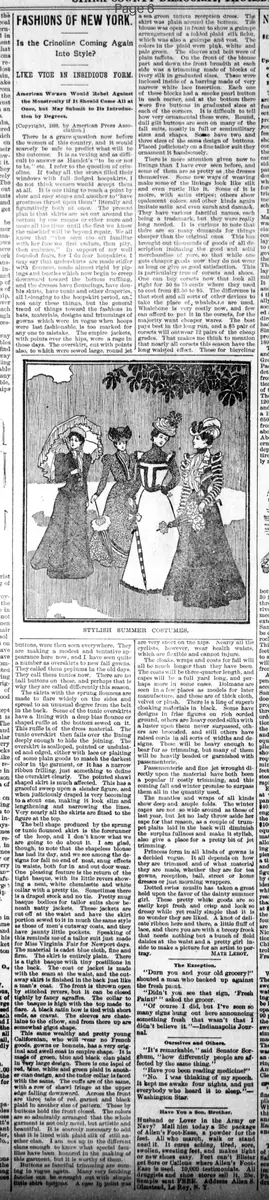
STYLISH SUMMER COSTUMES.
Is the Crinoline Coming Again Into Style?
LIKE VICE IN INSIDIOUS FORM.
American Women Would Rebel Against the Monstrosity if It Should Come All at Once, but May Submit to Its Introduction by Degrees.
[Copyright, 1898, by American Press Association.]
There is a grave question now before the women of this country, and it would scarcely be safe to predict what will be the outcome. It is as vexing and as difficult to answer as Hamlet's "to be or not to be," etc. I refer to the question of crinoline. If today all the stores filled their windows with full fledged hoopskirts, I do not think women would accept them at all. It is one thing to reach a point by slow and easy stages and another to 'have greatness thrust upon them' literally and figuratively both at once. The present plan is that skirts are set out around the bottom by one means or other more and more all the time until the first we know the mischief will be beyond repair. We all know that "vice seen too oft familiar with her face we first endure, then pity, then embrace." In support of my well founded fears, for I do fear hoopskirts, I may say that underskirts are made stiffer with flounces, made almost rigid by plaitings and bustles which now begin to creep downward toward the bottom ruffling, and the dresses have flouncings, have double skirts, have tunic and other draperies, all belonging to the hoopskirt period, and not only these things, but the general trend of things toward the fashions in hats, materials, designs and trimmings of gowns which were in vogue when hoops were last fashionable is too marked for any one to mistake. The empire jackets with points over the hips were a rage in those days. The overskirt, cut with points also, to which were sewed large, round jet buttons, were then seen everywhere. They are making a modest and tentative appearance here now, and I have seen quite a number as overskirts to new fall gowns. They called them peplums in the old days. They call them tunics now. There are no ball buttons on these, and perhaps that is why they are called differently this season.
The skirts with the sprung flounces are made to flare widely on the sides and spread to an unusual degree from the belt in the back. Some of the tunic overskirts have a lining with a deep bias flounce or shaped ruffle at the bottom sewed on it. This ruffle is of the dress material. The tunic overskirt then falls over the lining deeply enough to hide the joining. The overskirt is scalloped, pointed or undulated and edged, either with lace or plaiting of some plain goods to match the darkest color in the garment, or it has a narrow ribbon frilling, just something to define the overskirt clearly. The pointed shawl shaped skirt is much affected. This has a graceful sweep upon a slender figure, and when judiciously draped is very becoming to a stout one, making it look slim and lengthening and narrowing the lines.
Very nearly all the skirts are fitted to the figure at the top. The bell shape produced by the sprung or tunic flounced skirt is the forerunner of the hoop, and I don't know what we are going to do about it. I am glad, though, to note that the shapeless blouse has had its day, and we see among the designs for fall no end of neat, snug effects in waists, both for in and out door wear. One pleasing feature is the return of the tight basque, with its little revers showing a neat, white chemisette and white collar with a pretty tie. Sometimes there is a draped stock and no tie. Pretty snug basque bodices for tailor suits show beneath natty jackets. These jackets are cut off at the waist and have the skirt portion sewed to it in much the same style as those of men's cutaway coats, and they have jaunty little pockets. Speaking of this reminds me of a tailor suit just made for Miss Virginia Fair for Newport days. The material is cadet blue cloth, fine and firm. The skirt is entirely plain. There is a tight basque with tiny postilions in the back. The coat or jacket is made with the seam at the waist, and the cutaway skirt is finished in the back just like a man's coat. The front is thrown open by stitched revers, but it can be closed tightly by fancy agraffes. The collar to the basque is high with the top made to flare. A black satin bow is tied with short ends, as cravat. The sleeves are chatealine to the elbow, and from there up are somewhat gigot shape.
This same wealthy and pretty young Californian, who will wear no French goods, gowns or bonnets, has a very original and swell coat in empire shape. It is made of green, blue and black clan plaid in very large design. There is one lapel of red, blue, white and green plaid in another clan design, and the tudor collar is faced with the same. The cuffs are of the same, with a row of shawl fringe at the upper edge falling downward. Across the front are three tabs of red, garnet and black plaid in another size of pattern. These by buttons hold the front closed. The colors are so admirably arranged that the whole garment is not only novel, but artistic and beautiful. It is scarcely necessary to add that it is lined with plaid silk of still another clan. I am not up in the different clans enough to know what special families have been honored in the making of this garment, but it is worthy of them.
Buttons as fanciful trimming are coming in vogue again. Many very fetching fancies can be wrought out with simple little shire buttons. A case in point was a sea green taffeta reception dress. The skirt was plain around the bottom. The blouse was open in front to show a guimpe arrangement of a folded plaid silk fichu, which was also a guimpe and vest. The colors in the plaid were pink, white and pale green. The sleeves and belt were of plain taffeta. On the front of the blouse part and down the front breadth at each side was a trimming made of blocks of ivory silk in graduated sizes. These were inclosed inside of a barring made of very narrow white lace insertion. Each one of these blocks had a smoke pearl button in each corner, and at the bottom there were five buttons in graduated sizes at each of the corners. It is difficult to tell how very ornamental these were. Round, dull gilt buttons are seen on many of the fall suits, mostly in full or semimilitary sizes and shapes. Some have two and three sizes of the same design of buttons. Placed judiciously on a fine tailor suit they ornament it handsomely.
There is more attention given now to linings than I have ever seen before, and some of them are as pretty as the dresses themselves. Some new ways of weaving make some of the linings look like silk and even rustle like it. Some of it is moire, with satin stripes; others show opalescent colors, and other kinds again imitate satin and even surah and damask. They have various fanciful names, each being a trademark, but they were really long needed. It is curious to note that there are so many demands for things cheaper than the original ones. This has brought out thousands of goods of all description imitating the good and solid merchandise of yore, so that while one gets cheaper goods now they do not wear as long or give as good satisfaction. This is particularly true of corsets and shoes. One can buy corsets now that look all right for 50 to 75 cents where they used to cost from $2.50 to $5. The difference is that steel and all sorts of other devices to take the place of whalebone are used. Whalebone is very costly now, and few can afford to put it in the corsets, for the majority want cheaper wares. The best pays best in the long run, and a $5 pair of corsets will outwear 12 pairs of the cheap grades. That makes me think to mention that nearly all corsets this season have the long waisted effect. Those for bicycling are very short on the hips. Nearly all the cyclists, however, wear health waists, which are flexible and cannot injure.
The cloaks, wraps and coats for fall will all be much longer than they have been. The coats will be three-quarter length, and capes will be a full yard long, and perhaps more in some cases. Dolmans are seen in a few places as models for later manufacture, and these are of thick cloth, velvet or plush. There is a line of superb cloaking materials in black. Some have designs in frise figures on rich corded ground, others are heavy corded silks with a luster upon them never surpassed, others are brocaded, and still others have raised cords in all sorts of widths and designs. These will be heavy enough to bear fur as trimming, but many of them will be heavily beaded or garnished with passementerie.
Passementerie and fine jet wrought directly upon the material have both been a popular if costly trimming, and this coming fall and winter promise to surpass them all in the quantity used. The mantles and wraps of all kinds show deep and ample folds. The winter capes are not so wide around as those of last year, but let no lady throw aside her cape for that reason, as a couple of trumpet plaits laid in the back will diminish the surplus fullness and make it stylish, also give a place for a pretty bit of jet trimming.
Princess form in all kinds of gowns is a decided vogue. It all depends on how they are trimmed and of what material they are made, whether they are for tea gowns, reception, ball, street or home dresses or just morning wrappers.
Dotted swiss muslin has taken a great hold upon the favor of the dainty summer girl. These pretty white goods are so easily kept fresh and crisp and look so dressy while yet really simple that it is no wonder they are liked. A knot of delicate ribbon here and there, a little fluff of lace, and there you are with a breezy frock that needs nothing but a bunch of field daisies at the waist and a pretty girl inside to make a picture for an artist to portray.
MATE LEROY.
STYLISH SUMMER COSTUMES.
What sub-type of article is it?
Fashion Article
Trend Report
What themes does it cover?
Social Manners
What keywords are associated?
Crinoline Return
Hoopskirts
Fall Fashions
Tailor Suits
Corsets
Summer Costumes
New York Fashion
What entities or persons were involved?
Miss Virginia Fair
Mate Leroy
Where did it happen?
New York
Story Details
Key Persons
Miss Virginia Fair
Mate Leroy
Location
New York
Event Date
1898
Story Details
The article warns of the gradual return of crinoline and hoopskirts through evolving skirt styles, describes fall fashion trends including tunics, basques, jackets, buttons, linings, corsets, cloaks, and praises specific outfits like Miss Virginia Fair's tailor suit and coat, while noting cheaper imitations and summer muslin dresses.