Thank you for visiting SNEWPapers!
Sign up free
Story
September 13, 1830
Lynchburg Virginian
Lynchburg, Virginia
What is this article about?
In Philadelphia, a respected merchant's wife engages in a secret affair with a Brazilian consul living opposite their home, then elopes with him after a visit to relatives, abandoning her husband and young son, sparking public indignation.
Clipping
OCR Quality
95%
Excellent
Full Text
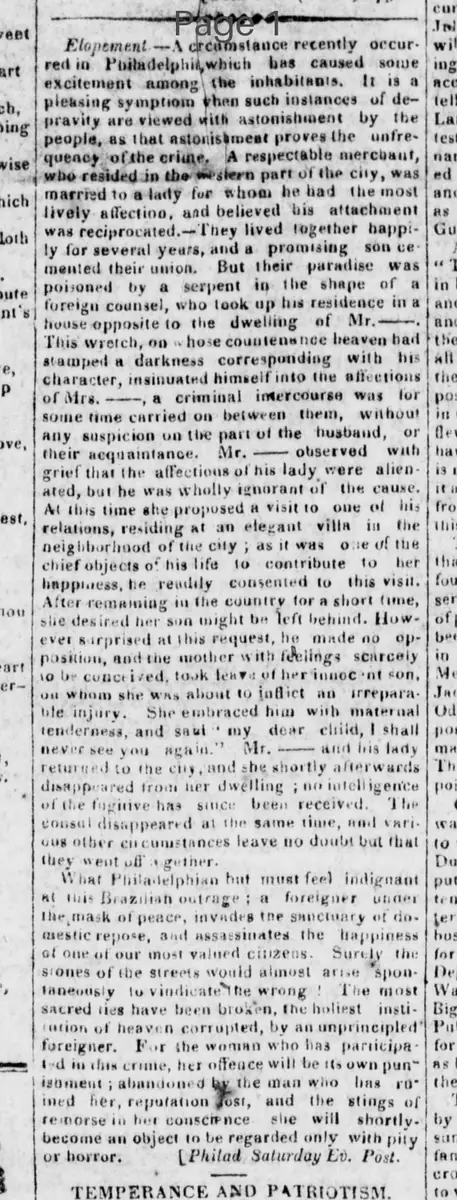
Elopement --A circumstance recently occurred in Philadelphia which has caused some excitement among the inhabitants. It is a pleasing symptom when such instances of depravity are viewed with astonishment by the people, as that astonishment proves the unfrequency of the crime. A respectable merchant, who resided in the western part of the city, was married to a lady for whom he had the most lively affection, and believed his attachment was reciprocated. They lived together happily for several years, and a promising son cemented their union. But their paradise was poisoned by a serpent in the shape of a foreign counsel, who took up his residence in a house opposite to the dwelling of Mr. --. This wretch, on whose countenance heaven had stamped a darkness corresponding with his character, insinuated himself into the affections of Mrs. ---, a criminal intercourse was for some time carried on between them, without any suspicion on the part of the husband, or their acquaintance. Mr. -- observed with grief that the affections of his lady were alienated, but he was wholly ignorant of the cause. At this time she proposed a visit to one of his relations, residing at an elegant villa in the neighborhood of the city; as it was one of the chief objects of his life to contribute to her happiness, he readily consented to this visit. After remaining in the country for a short time, she desired her son might be left behind. However surprised at this request, he made no opposition, and the mother with feelings scarcely to be conceived, took leave of her innocent son, on whom she was about to inflict an irreparable injury. She embraced him with maternal tenderness, and said 'my dear child, I shall never see you again.' Mr. --- and his lady returned to the city, and she shortly afterwards disappeared from her dwelling; no intelligence of the fugitive has since been received. The consul disappeared at the same time, and various other circumstances leave no doubt but that they went off together. What Philadelphian but must feel indignant at this Brazilian outrage; a foreigner under the mask of peace, invades the sanctuary of domestic repose, and assassinates the happiness of one of our most valued citizens. Surely the stones of the streets would almost arise spontaneously to vindicate the wrong! The most sacred ties have been broken, the holiest institution of heaven corrupted, by an unprincipled foreigner. For the woman who has participated in this crime, her offence will be its own punishment; abandoned by the man who has ruined her, reputation lost, and the stings of remorse in her conscience she will shortly become an object to be regarded only with pity or horror.
[Philad. Saturday Ev. Post.]
[Philad. Saturday Ev. Post.]
What sub-type of article is it?
Family Drama
Deception Fraud
Tragedy
What themes does it cover?
Betrayal
Deception
Family
What keywords are associated?
Elopement
Adultery
Philadelphia Scandal
Brazilian Consul
Family Betrayal
Abandonment
What entities or persons were involved?
Mr.
Mrs.
Brazilian Consul
Where did it happen?
Philadelphia
Story Details
Key Persons
Mr.
Mrs.
Brazilian Consul
Location
Philadelphia
Event Date
Recently
Story Details
A Philadelphia merchant's wife conducts a secret affair with a Brazilian consul opposite their home, proposes a visit to relatives to facilitate elopement, leaves her son behind with a farewell, and disappears with the consul, breaking her family and causing public outrage.