Thank you for visiting SNEWPapers!
Sign up free
Alexandria Daily Gazette, Commercial & Political
Alexandria, Virginia
What is this article about?
President Jefferson transmits to Congress diplomatic correspondence from US Minister William Pinkney in London with British Foreign Secretary George Canning, dated November-December 1808, clarifying misunderstandings over US proposals regarding British Orders in Council and the US embargo.
Merged-components note: This component merges the congressional proceedings from page 2 with its continuation on page 3, which includes detailed foreign diplomatic correspondence between U.S. and British officials regarding orders in council and international relations. The overall content fits foreign_news as it reports on international matters discussed in U.S. Congress.
Clippings
1 of 2
OCR Quality
Full Text
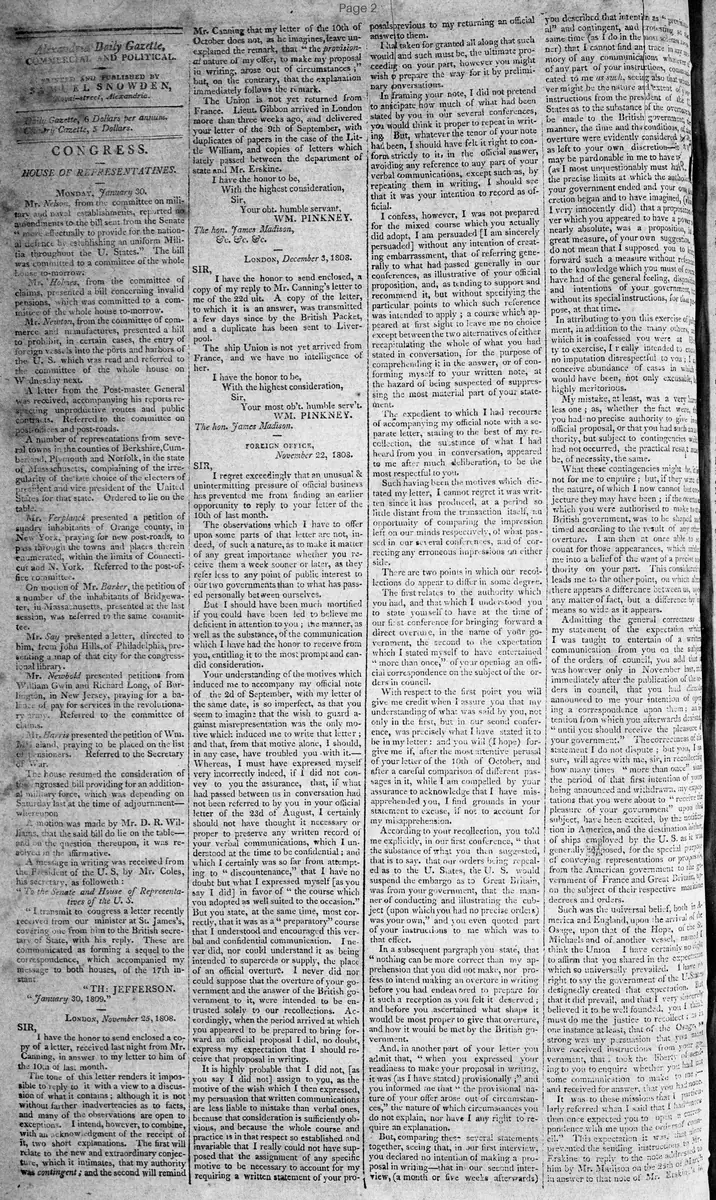
HOUSE OF REPRESENTATIVES.
Monday, January 30.
Mr. Nelson, from the committee on military and naval establishments, reported no amendments to the bill sent from the Senate "more effectually to provide for the national defence by establishing an uniform Militia throughout the U. States." The bill was committed to a committee of the whole house to-morrow.
Mr. Holmes, from the committee of claims, presented a bill concerning invalid pensions, which was committed to a committee of the whole house to-morrow.
Mr. Newton, from the committee of commerce and manufactures, presented a bill to prohibit, in certain cases, the entry of foreign vessels into the ports and harbors of the U. S. which was read and referred to the committee of the whole house on Wednesday next.
A letter from the Post-master General was received, accompanying his reports respecting unproductive routes and public contracts. Referred to the committee on post-offices and post-roads.
A number of representations from several towns in the counties of Berkshire, Cumberland, Plymouth and Norfolk, in the state of Massachusetts, complaining of the irregularity of the late choice of the electors of president and vice president of the United States for that state. Ordered to lie on the table.
Mr. Verplanck presented a petition of sundry inhabitants of Orange county, in New York, praying for new post-roads, to pass through the towns and places therein enumerated, within the limits of Connecticut and N. York. Referred to the post-office committee.
On motion of Mr. Barker, the petition of a number of the inhabitants of Bridgewater, in Massachusetts, presented at the last session, was referred to the same committee.
Mr. Say presented a letter, directed to him, from John Hills, of Philadelphia, presenting a map of that city for the congressional library.
Mr. Newbold presented petitions from William Gwin and Richard Long, of Burlington, in New Jersey, praying for a balance of pay for services in the revolutionary army. Referred to the committee of claims.
Mr. Harris presented the petition of Wm. McAlister, praying to be placed on the list of pensioners. Referred to the Secretary of War.
The house resumed the consideration of the engrossed bill providing for an additional military force, which was depending on Saturday last at the time of adjournment--
whereupon
A motion was made by Mr. D. R. Williams, that the said bill do lie on the table-- and on the question thereupon, it was resolved in the affirmative.
A message in writing was received from the President of the U. S, by Mr. Coles, his secretary, as followeth:
"To the Senate and House of Representatives of the U. S.
"I transmit to congress a letter recently received from our minister at St. James's, covering one from him to the British secretary of State, with his reply. These are communicated as forming a sequel to the correspondence, which accompanied my message to both houses, of the 17th instant.
"TH: JEFFERSON."
"January 30, 1809."
London, November 25, 1808.
SIR,
I have the honor to send enclosed a copy of a letter, received last night from Mr. Canning, in answer to my letter to him of the 10th of last month.
The tone of this letter renders it impossible to reply to it with a view to a discussion of what it contains; although it is not without farther inadvertencies as to facts, and many of the observations are open to exceptions. I intend, however, to combine, with an acknowledgment of the receipt of it, two short explanations. The first will relate to the new and extraordinary conjecture, which it intimates, that my authority was contingent; and the second will remind Mr. Canning that my letter of the 10th of October does not, as he imagines, leave unexplained the remark, that "the provisional nature of my offer, to make my proposal in writing, arose out of circumstances; but, on the contrary, that the explanation immediately follows the remark."
The Union is not yet returned from France. Lieut. Gibbon arrived in London more than three weeks ago, and delivered your letter of the 9th of September, with duplicates of papers in the case of the Little William, and copies of letters which lately passed between the department of state and Mr. Erskine.
I have the honor to be,
With the highest consideration,
Sir,
Your obt. humble servant,
WM. PINKNEY.
The hon. James Madison,
&c. &c. &c.
London, December 3, 1808.
SIR,
I have the honor to send enclosed, a copy of my reply to Mr. Canning's letter to me of the 22d ult. A copy of the letter, to which it is an answer, was transmitted a few days since by the British Packet and a duplicate has been sent to Liverpool.
The ship Union is not yet arrived from France, - and we have no intelligence of her.
I have the honor to be.
With the highest consideration,
Sir,
Your most ob't. humble serv't.
WM. PINKNEY.
The hon. James Madison.
FOREIGN OFFICE,
November 22, 1808.
SIR,
I regret exceedingly that an unusual & unintermitting pressure of official business has prevented me from finding an earlier opportunity to reply to your letter of the 10th of last month.
The observations which I have to offer upon some parts of that letter are not, indeed, of such a nature, as to make it matter of any great importance whether you receive them a week sooner or later, as they refer less to any point of public interest to our two governments than to what has passed personally between ourselves.
But I should have been much mortified if you could have been led to believe me deficient in attention to you; the manner, as well as the substance, of the communication which I have had the honor to receive from you, entitling it to the most prompt and candid consideration.
Your understanding of the motives which induced me to accompany my official note of the 2d of September, with my letter of the same date, is so imperfect, as that you seem to imagine that the wish to guard against misrepresentation was the only motive which induced me to write that letter: and that, from that motive alone, I should, in any case, have troubled you with it.-- Whereas, I must have expressed myself very incorrectly indeed, if I did not convey to you the assurance, that, if what had passed between us in conversation had not been referred to by you in your official letter of the 23d of August, I certainly should not have thought it necessary or proper to preserve any written record of your verbal communications, which I understood at the time to be confidential; and which I certainly was so far from attempting to "discountenance," that I have no doubt but what I expressed myself as you say I did in favor of "the course which you adopted as well suited to the occasion."
But you state, at the same time, most correctly, that it was as a "preparatory" course that I understood and encouraged this verbal and confidential communication. I never did, nor could understand it as being intended to supersede or supply, the place of an official overture. I never did nor could suppose that the overture of your government and the answer of the British government to it, were intended to be entrusted solely to our recollections. Accordingly, when the period arrived at which you appeared to be prepared to bring forward an official proposal I did, no doubt, express my expectation that I should receive that proposal in writing.
It is highly probable that I did not, [as you say I did not] assign to you, as the motive of the wish which I then expressed, my persuasion that written communications are less liable to mistake than verbal ones, because that consideration is sufficiently obvious, and because the whole course and practice is in that respect so established and invariable that I really could not have supposed that the assignment of any specific motive to be necessary to account for my requiring a written statement of your proposals previous to my returning an official answer to them.
Proceeding on your part, however you might would and such must be, the ultimate proposal I had taken for granted all along that such wish to prepare the way for it by preliminary conversations.
stated by you in our several conferences, to anticipate how much of what had been In framing your note, I did not pretend you would think it proper to repeat in writing But, whatever the tenor of your note had been, I should have felt it right to conform strictly to it, in the official answer, avoiding any reference to any part of your repeating them in writing. I should see verbal communications, except such as, by that it was your intention to record as official.
I confess, however, I was not prepared for the mixed course which you actually did adopt, I am persuaded [I am sincerely persuaded] without any intention of creating embarrassment, that of referring generally to what had passed generally in our conferences, as illustrative of your official proposition, and, as tending to support and recommend it, but without specifying the particular points to which such reference was intended to apply; a course which appeared at first sight to leave me no choice except between the two alternatives of either recapitulating the whole of what you had stated in conversation, for the purpose of comprehending it in the answer, or of conforming myself to your written note, at the hazard of being suspected of suppressing the most material part of your statement.
The expedient to which I had recourse of accompanying my official note with a separate letter, stating to the best of my recollection, the substance of what I had heard from you in conversation, appeared to me after much deliberation, to be the most respectful to you.
Such having been the motives which dictated my letter, I cannot regret it was written since it has produced, at a period so little distant from the transaction itself, an opportunity of comparing the impression left on our minds respectively, of what passed in our several conferences, and of correcting any erroneous impressions on either side.
There are two points in which our recollections do appear to differ in some degree.
The first relates to the authority which you had, and that which I understood you to state yourself to have at the time of our first conference for bringing forward a direct overture, in the name of your government, the second to the expectation which I stated myself to have entertained "more than once," of your opening an official correspondence on the subject of the orders in council.
With respect to the first point you will give me credit when I assure you that my understanding of what was said by you, not only in the first, but in our second conference. was precisely what I have stated it to be in my letter: and you will (I hope) forgive me if, after the most attentive perusal of your letter of the 10th of October, and after a careful comparison of different passages in it, while I am compelled by your assurance to acknowledge that I have misapprehended you, I find grounds in your statement to excuse, if not to account for my misapprehension.
According to your recollection. you told me explicitly, in our first conference, "that the substance of what you then suggested, that is to say. that our orders being repealed as to the U. States, the U. S. would suspend the embargo as to Great Britain, was from your government, that the manner of conducting and illustrating the subject (upon which you had no precise orders) was your own," and you even quoted part of your instructions to me which was to that effect.
In a subsequent paragraph you state, that "nothing can be more correct than my apprehension that you did not make, nor profess to intend making an overture in writing before you had endeavored to prepare for it such a reception as you felt it deserved; and before you ascertained what shape it would be most proper to give that overture, and how it would be met by the British government."
And, in another part of your letter you admit that, ".when you expressed your readiness to make your proposal in writing, it was (as I have stated) provisionally ;" and you informed me that "the provisional nature of your offer arose out of circumstances," the nature of which circumstances you do not explain, nor have I any right to require an explanation.
But, comparing these several statements together, seeing that, in our first interview, you declared no intention of making a proposal in writing--that in our second interview, (a month or five weeks afterwards) you described that intention as "provisional and contingent and as I do in the post sovereign ne that I cannot nd n ae n mory of any communications of any part of your instructions, communicated to me as such, seeing also tht h ver might be the nature aid extent instructions from the president of the u States as to the substance pf the overture be made to the British government, t manner, the time and the conditions, of. overture were evidently considered b as left to your own discretion--it ay may be pardonable in me to have r (as I most unquestionably must haR the precise limits at which the authority of your government ended and your own discretion began and to have imagined, (th) I very innocently did) that a proposition ver which you appeared to have a powers nearly absolute, was a proposition, in great measure, of your own suggestion.
do not mean that I supposed you to bri forward such a measure without referm to the knowledge which you must of cour have had of the general feeling, disposition and intentions of your government, tr without its special instructions, ior that p pose, at that time.
In attributing to you this exercise of judgment, in addition to the many others, at which it is confessed you were at lih ty to exercise, I really intended to com no imputation disrespectful to you ; It conceive abundance of cases in which would have been, not only excusable, b highly meritorious.
My mistake, at least, was a very har less one ; as, whether the fact were, t you had-no precise authority to give inr official proposal, or that you had such ana thority, but subject to contingencies wh had not occurred, the practical resu,t nus be, of necessity, the same.
What these contingencies might be, iti not for me to enquire ; but, if they ware d the nature, of which I now cannot but con jecture they may have been ; if the overture which you were authorised to make totte British government, was to be shaped ang timed according to the result of any other overture. I am then at once able to a0 count for those appearances, which misle me into a belief of the want of a precise an thority on your part. This consideration leads me to the other point, on which abon there appears a difference between us, upd any matter of fact, but a difference by n means so wide as it appears.
Admitting the general correctness : my statement of the expectation whid I was taught to entertain of a writter communication from you on the subje of the orders of council, you add that was however only in November last,amt immediatelv after the publication of the or ders in council, that you hud direcdly announced to me your intention of oper eing a correspondence upon them; ani tention from which you afterwards desistd, "until you should receive the pleasure i your government." The correctness of tls statement I do not dispute ; but you, I a sure, will agree with me, sir, in recollectiz how many times "more than once" sine the period of that first intention of yous being announced and withdrawn, my exper tations that you were about to "receive the pleasure of your government" upon thi subject, have been excited, by the notifca tion in America, and the destination hither, of ships employed bv the U. S. as it wa generally supposed, for the special purpose cf conveying representations or proposals from the American government to the go vernment of France and Great Britain, ur on the subject of their respective maritime decrees and orders.
Osage, upon that of the Hope, of the St merica and England, upon the arrival of the Such was the universal belief, both in A. Michaels and of another vessel, named I think the Union
I have certainly no right to affirm that you shared in the expectmti3 right to say the government of the U.Sats which so universally prevailed.
I have ra Bu that it did prevail, and that I very sincerely must do me the justice to recollect ; as h believed it to he well founded vou think one instance at least, that of the Osage, strong was my persuasion that you must have received instructions ing to you to enquire whether you had not vernment, that took the liberty of sends from your go and received for answer, that you had none. some communication to make to me j- larly referred when I said that I had "more these missions that particu- than once expected you to open a corrs eil." This expectation it was, that aome me upon the ordersof coun- instructions him by Mr. Madison on the 2sh of March Fisi to r brevented the in answer to that note of M E
which he communicated the orders in council particularly to that of the Osage, and to the executive council, and in allusion to these missions, particularly declaration in parliament which, I say, has no reference to France, it was, that I made that observation on the return here of that vessel after its expectation which had been founded here upon the information which you had given me, has been the subject of some misrepresentation (I will not say misrepresentation) in America. that "since the termination of Mr. Rose's mission, the American government had not made any communication here in the shape of remonstrance, or in a tone of irritation." Not aware, sir, that there is any other part of your letter which requires that I should trouble you with many observations. The report of your answer to the enquiry, which I took the liberty of making. "whether the orders in council of November were known to the government of the United States previously to the message of the president proposing the embargo, so as to be a moving consideration to that measure," does not appear, to differ, in any material degree, from my statement of it. That your answer to such an enquiry was official, or authorised by your government, I did not assert nor presume. I have already said, that it was not till you had, in your official letter of the 23d of August, referred to what passed in conversation, that I should have thought any such reference allowable on my part; and even then the generality of your reference precluded me from judging correctly, how much of what you had stated in conversation was from official authority, how much from your own personal information or opinion. You inform me that your answer to this question was of the latter description only: But, even if it were only from your own individual authority, it was very material, and highly gratifying to learn, that the embargo which had been some times represented, both here and in America, as the direct and immediate consequence of the orders in council of November, and as produced solely by them, was in your opinion "a measure of precaution, against reasonable anticipated peril." The purpose of this letter is not to renew the discussion upon the subject of your proposal, but merely to clear up any misunderstanding which had existed between us in the course of that discussion. I cannot conclude, however, without adverting very shortly to that part of your letter, in which you argue that the failure of France in the attempt to realise her gigantic project of the annihilation of the commerce of this country, removes all pretext for the continuance of the retaliatory system of Great Britain. This impotency of the enemy to carry his projects of violence and injustice into execution, might, with more propriety, be pleaded with him, as a motive for withdrawing decrees at once so indefensible and so little efficacious for their purpose, than represented as creating an obligation upon Great Britain to desist from the measures of defensive retaliation which those decrees have necessarily occasioned. If the foundation of the retaliating system of Great Britain was (as we contend it to have been) originally just, that system will be justifiably continued in force, not so long only as the decrees which produced it are mischievously operative, but until they are unequivocally abandoned. And if it be thus consistent with justice to persevere in that system, it is surely no mean motive of policy for such perseverance, that a premature departure from it, while the enemy's original provocation remains unrepealed, might lead to false conclusions, as to the efficacy of the decrees of France, and might hold out a dangerous temptation to that power to resort to the same system on any future occasion: A result which, not Great Britain alone, but all commercial nations are deeply interested in preventing. I have now, sir, only to express my sense of the candor and liberality with which this discussion has been conducted on your part, and my acknowledgements for the justice which you render to my disposition to treat you at all times with reciprocal respect, and to you with the attention, to which all as well as officially you have every claim. I cannot forego the hope that it may yet all to our lot to be instrumental in the renewal of that understanding between our two governments which is as congenial to the feelings as it is essential to the interests of both countries; which nothing but the forced and unnatural state of the world could have interrupted; and which there is, on the part of the British government, the most anxious and unabated desire to restore. I have the honor to be, With the highest consideration, Sir, Your most ob't. humble serv GEORGE CANNING. William Pinkney, esq. &c.
GREAT Cumberland Place, November 28, 1808. Sir, I have had the honor to receive your letter of the 22d instant, and to transmit a copy of it to my government. Without desiring to protract a discussion in the conduct of which neither your sincerity or mine, will, I feel assured, be doubted by any one, I may be permitted to say, that the authority under which I acted in our late communications, was not contingent, as you now appear to conjecture; and that the remark, contained in my letter of the 10th of October, "that the provisional nature of my offer, to make my proposal in writing, arose out of circumstances," will be found explained in the same letter, by passages which immediately follow the remark. I have said in my letter of the 10th of October, that "I had no precise instructions as to the manner of conducting and illustrating the subject" confided to my management; but you will suffer me to enter my friendly protest against all suppositions that "the manner, the time and the conditions of the overture were left to my own discretion,"-- that I had the power nearly absolute over it, or that it was "in a great measure of my own suggestion." I will trouble you no further, Sir, on this occasion than to assure you that nothing could give me more sincere pleasure than to see fulfilled the hope which you express, that it may yet fall to our lot to be instrumental in the renewal of a good understanding between our two governments. I have the honor to be, With the greatest consideration, &c. (Signed) WM. PINKNEY. The Right Honorable George Canning, &c. &c. The said message and the papers transmitted therewith were read and ordered to lie on the table.
What sub-type of article is it?
What keywords are associated?
What entities or persons were involved?
Where did it happen?
Foreign News Details
Primary Location
London
Event Date
November December 1808
Key Persons
Outcome
exchange of letters clarifying misunderstandings on us diplomatic authority and proposals regarding british orders in council and us embargo; no resolution reached, expressions of hope for renewed understanding.
Event Details
US Minister William Pinkney reports to James Madison on correspondence with British Foreign Secretary George Canning concerning prior negotiations on repealing British Orders in Council in exchange for suspending the US embargo. Canning's letter addresses differences in recollections of conversations and authority; Pinkney responds denying contingent authority and protesting mischaracterizations. Jefferson transmits this as a sequel to earlier correspondence.