Thank you for visiting SNEWPapers!
Sign up free
Editorial
September 4, 1830
New Hampshire Statesman And Concord Register
Concord, Merrimack County, New Hampshire
What is this article about?
The Boston Courier editorial quotes a 1816 speech by John C. Calhoun supporting protective tariffs for manufacturing and internal improvements to strengthen national union, highlighting his role as originator of the American System he now opposes with Southern allies.
Clipping
OCR Quality
95%
Excellent
Full Text
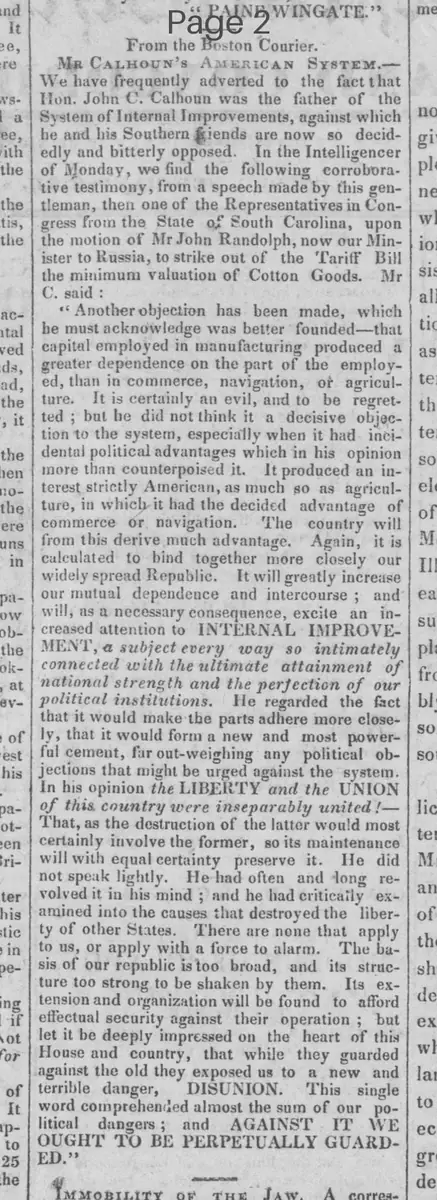
From the Boston Courier.
Mr. Calhoun's American System.—
We have frequently adverted to the fact that Hon. John C. Calhoun was the father of the System of Internal Improvements, against which he and his Southern friends are now so decidedly and bitterly opposed. In the Intelligencer of Monday, we find the following corroborative testimony, from a speech made by this gentleman, then one of the Representatives in Congress from the State of South Carolina, upon the motion of Mr. John Randolph, now our Minister to Russia, to strike out of the 'Tariff Bill the minimum valuation of Cotton Goods. Mr. C. said:
"Another objection has been made, which he must acknowledge was better founded—that capital employed in manufacturing produced a greater dependence on the part of the employed, than in commerce, navigation, or agriculture. It is certainly an evil, and to be regretted; but he did not think it a decisive objection to the system, especially when it had incidental political advantages which in his opinion more than counterpoised it. It produced an interest strictly American, as much so as agriculture, in which it had the decided advantage of commerce or navigation. The country will from this derive much advantage. Again, it is calculated to bind together more closely our widely spread Republic. It will greatly increase our mutual dependence and intercourse; and will, as a necessary consequence, excite an increased attention to INTERNAL IMPROVEMENT, a subject every way so intimately connected with the ultimate attainment of national strength and the perfection of our political institutions. He regarded the fact that it would make the parts adhere more closely, that it would form a new and most powerful cement, far out-weighing any political objections that might be urged against the system.
In his opinion the LIBERTY and the UNION of this country were inseparably united!—That, as the destruction of the latter would most certainly involve the former, so its maintenance will with equal certainty preserve it. He did not speak lightly. He had often and long revolved it in his mind; and he had critically examined into the causes that destroyed the liberty of other States. There are none that apply to us, or apply with a force to alarm. The basis of our republic is too broad, and its structure too strong to be shaken by them. Its extension and organization will be found to afford effectual security against their operation; but let it be deeply impressed on the heart of this House and country, that while they guarded against the old they exposed us to a new and terrible danger, DISUNION. This single word comprehended almost the sum of our political dangers; and AGAINST IT WE OUGHT TO BE PERPETUALLY GUARDED."
Mr. Calhoun's American System.—
We have frequently adverted to the fact that Hon. John C. Calhoun was the father of the System of Internal Improvements, against which he and his Southern friends are now so decidedly and bitterly opposed. In the Intelligencer of Monday, we find the following corroborative testimony, from a speech made by this gentleman, then one of the Representatives in Congress from the State of South Carolina, upon the motion of Mr. John Randolph, now our Minister to Russia, to strike out of the 'Tariff Bill the minimum valuation of Cotton Goods. Mr. C. said:
"Another objection has been made, which he must acknowledge was better founded—that capital employed in manufacturing produced a greater dependence on the part of the employed, than in commerce, navigation, or agriculture. It is certainly an evil, and to be regretted; but he did not think it a decisive objection to the system, especially when it had incidental political advantages which in his opinion more than counterpoised it. It produced an interest strictly American, as much so as agriculture, in which it had the decided advantage of commerce or navigation. The country will from this derive much advantage. Again, it is calculated to bind together more closely our widely spread Republic. It will greatly increase our mutual dependence and intercourse; and will, as a necessary consequence, excite an increased attention to INTERNAL IMPROVEMENT, a subject every way so intimately connected with the ultimate attainment of national strength and the perfection of our political institutions. He regarded the fact that it would make the parts adhere more closely, that it would form a new and most powerful cement, far out-weighing any political objections that might be urged against the system.
In his opinion the LIBERTY and the UNION of this country were inseparably united!—That, as the destruction of the latter would most certainly involve the former, so its maintenance will with equal certainty preserve it. He did not speak lightly. He had often and long revolved it in his mind; and he had critically examined into the causes that destroyed the liberty of other States. There are none that apply to us, or apply with a force to alarm. The basis of our republic is too broad, and its structure too strong to be shaken by them. Its extension and organization will be found to afford effectual security against their operation; but let it be deeply impressed on the heart of this House and country, that while they guarded against the old they exposed us to a new and terrible danger, DISUNION. This single word comprehended almost the sum of our political dangers; and AGAINST IT WE OUGHT TO BE PERPETUALLY GUARDED."
What sub-type of article is it?
Infrastructure
Economic Policy
Constitutional
What keywords are associated?
Calhoun
American System
Internal Improvements
Tariff Bill
National Union
Disunion
What entities or persons were involved?
John C. Calhoun
John Randolph
Southern Friends
Congress
Editorial Details
Primary Topic
Calhoun's Past Support For The American System Of Internal Improvements
Stance / Tone
Critical Of Calhoun's Inconsistency
Key Figures
John C. Calhoun
John Randolph
Southern Friends
Congress
Key Arguments
Calhoun Originated The System Of Internal Improvements
Protective Tariffs Foster American Manufacturing Interests
Internal Improvements Bind The Republic And Prevent Disunion
Liberty And Union Are Inseparably Linked