Thank you for visiting SNEWPapers!
Sign up free
The National Intelligencer And Washington Advertiser
Washington, District Of Columbia
What is this article about?
U.S. Senate debate on November 3, 1803, over a bill to fund the Louisiana Purchase treaty with France. Opponents like Tracy argue it's unconstitutional, citing limits on treaty power and state admission. Supporters like Breckinridge and Adams defend acquisition's benefits and constitutionality. Bill passes 26-5.
Merged-components note: These three components form a continuous narrative of the Senate debate on the Louisiana Treaty bill, spanning pages 1-3 with sequential reading orders and flowing text content.
Clippings
1 of 3
OCR Quality
Full Text
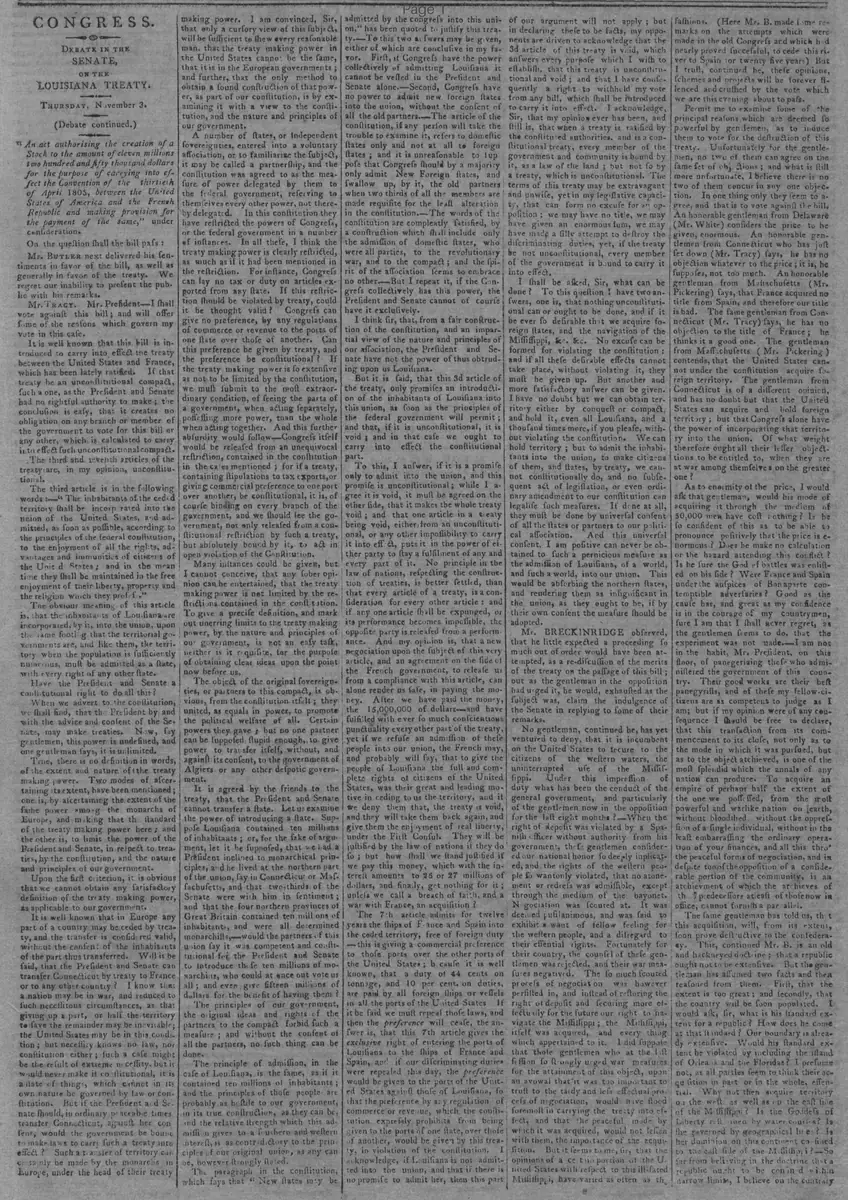
DEBATE IN THE SENATE,
ON THE LOUISIANA TREATY.
Thursday, November 3.
(Debate continued.)
"An act authorising the creation of a stock to the amount of eleven millions two hundred and fifty thousand dollars for the purpose of carrying into effect the Convention of the thirtieth of April 1803, between the United States of America and the French Republic and making provision for the payment of the same," under consideration.
On the question shall the bill pass:
Mr. BUTLER next delivered his sentiments in favor of the bill, as well as generally in favor of the treaty. We regret our inability to present the public with his remarks.
Mr. TRACY. Mr. President--I shall vote against this bill; and will offer some of the reasons which govern my vote in this case.
It is well known that this bill is introduced to carry into effect the treaty between the United States and France, which has been lately ratified. If that treaty be an unconstitutional compact, such a one, as the President and Senate had no rightful authority to make; the conclusion is easy, that it creates no obligation on any branch or member of the government to vote for this bill or any other, which is calculated to carry into effect such unconstitutional compact.
The third and seventh articles of the treaty are, in my opinion, unconstitutional.
The third article is in the following words: "The inhabitants of the ceded territory shall be incorporated into the union of the United States, and admitted, as soon as possible, according to the principles of the federal constitution, to the enjoyment of all the rights, advantages and immunities of citizens of the United States: and in the mean time they shall be maintained in the free enjoyment of their liberty, property and the religion which they profess."
The obvious meaning of this article is, that the inhabitants of Louisiana are incorporated, by it, into the union, upon the same footing that the territorial governments are, and like them, the territory when the population is sufficiently numerous, must be admitted as a state, with every right of any other state.
Have the President and Senate a constitutional right to do all this?
When we advert to the constitution we shall find, that the President by and with the advice and consent of the Senate, may make treaties. Now, say gentlemen, this power is undefined, and one gentleman says, it is unlimited.
True, there is no definition in words of the extent and nature of the treaty making power. Two modes of ascertaining its extent, have been mentioned; one is, by ascertaining the extent of the treaty power among the monarchs of Europe, and making that the standard of the treaty making power here; and the other is, to limit the power of the President and Senate, in respect to treaties, by the constitution, and the nature and principles of our government.
Upon the first criterion, it is obvious that we cannot obtain any satisfactory definition of the treaty making power, as applicable to our government.
It is well known that in Europe any part of a country may be ceded by treaty, and the transfer is considered valid, without the consent of the inhabitants of the part thus transferred. Will it be said, that the President and Senate can transfer Connecticut by treaty to France or to any other country? I know that a nation may be in war, and reduced to such necessitous circumstances, as that giving up a part, or half the territory to save the remainder may be inevitable; the United States may be in this condition; but necessity knows no law, nor constitution either; such a case might be the result of extreme necessity, but it would never make it constitutional, it is a state of things, which cannot in its own nature be governed by law or constitution. But if the President and Senate should, in ordinary peaceable times transfer Connecticut, against her consent, would the government be bound to make laws to carry such a treaty into effect? Such a transfer of territory can certainly be made by the monarchs in Europe, under the head of their treaty making power. I am convinced, Sir, that only a cursory view of this subject, will be sufficient to show every reasonable man, that the treaty making power in the United States cannot be the same, that it is in the European governments; and further, that the only method to obtain a sound construction of that power, as part of our constitution, is by examining it with a view to the constitution, and the nature and principles of our government.
A number of states, or independent sovereignties, entered into a voluntary association, or to familiarize the subject, it may be called a partnership, and the constitution was agreed to as the measure of power delegated by them to the federal government, reserving to themselves every other power, not thereby delegated. In this constitution they have restricted the powers of Congress, or the federal government in a number of instances. In all these, I think the treaty making power is clearly restricted, as much as if it had been mentioned in the restriction. For instance, Congress can lay no tax or duty on articles exported from any state. If this restriction should be violated by treaty, could it be thought valid? Congress can give no preference, by any regulations of commerce or revenue to the ports of one state over those of another. Can this preference be given by treaty, and the preference be constitutional? If the treaty making power is so extensive as not to be limited by the constitution, we must submit to the most extraordinary condition, of seeing the parts of a government, when acting separately, possessing more power, than the whole when acting together. And this further absurdity would follow--Congress itself would be released from an unequivocal restriction, contained in the constitution in the cases mentioned; for if a treaty containing stipulations to tax exports, or giving commercial preference to one port over another, be constitutional, it is, of course binding on every branch of the government, and we should see the government, not only released from a constitutional restriction by such a treaty, but absolutely bound by it, to act in open violation of the Constitution.
Many instances could be given, but I cannot conceive, that any sober opinion can be entertained, that the treaty making power is not limited by the restrictions contained in the constitution.
To give a precise definition, and mark out unerring limits to the treaty making power, by the nature and principles of our government, is not an easy task. Neither is it requisite, for the purpose of obtaining clear ideas upon the point now before us.
The object of the original sovereignties, or partners to this compact, is obvious, from the constitution itself; they united, as equals in power, to promote the political welfare of all. Certain powers they gave; but no one partner can be supposed stupid enough, to give power to transfer itself, without, and against its consent, to the government of Algiers or any other despotic government.
It is agreed by the friends to the treaty, that the President and Senate cannot transfer a state. Let us examine the power of introducing a state. Suppose Louisiana contained ten millions of inhabitants; or, for the sake of argument, let it be supposed, that we had a President inclined to monarchical principles, and he lived at the northern part of the union, say in Connecticut or Massachusetts, and that two-thirds of the Senate were with him in sentiment; and that the four northern provinces of Great Britain contained ten millions of inhabitants, and were all determined monarchists,--would the partners of this union say it was competent and constitutional for the President and Senate to introduce the ten millions of monarchists, who could at once out vote us all; and even give fifteen millions of dollars for the benefit of having them?
The principles of our government, the original ideas and rights of the partners to the compact forbid such a measure; and without the consent of all the partners, no such thing can be done.
The principle of admission, in the case of Louisiana, is the same, as if it contained ten millions of inhabitants; and the principles of those people are probably as hostile to our government, in its true construction, as they can be. And the relative strength which this admission gives to a southern and western interest, is as contradictory to the principles of our original union, as any can be, however strongly stated.
The paragraph in the constitution, which says that "New states may be admitted by the congress into this union," has been quoted to justify this treaty. To this two answers may be given, either of which are conclusive in my favor. First, if Congress have the power collectively of admitting Louisiana it cannot be vested in the President and Senate alone. Second, Congress have no power to admit new foreign states into the union, without the consent of all the old partners. The article of the constitution, if any person will take the trouble to examine it, refers to domestic states only and not at all to foreign states: and it is unreasonable to suppose that Congress should by a majority only admit New Foreign states, and swallow up, by it, the old partners when two thirds of all the members are made requisite for the least alteration in the constitution.--The words of the constitution are completely satisfied, by a construction which shall include only the admission of domestic states, who were all parties, to the revolutionary war, and to the compact; and the spirit of the association seems to embrace no other.--But I repeat it, if the Congress collectively has this power, the President and Senate cannot of course have it exclusively.
I think sir, that, from a fair construction of the constitution, and an impartial view of the nature and principles of our association, the President and Senate have not the power of thus obtruding upon us Louisiana.
But it is said, that this 3d article of the treaty, only promises an introduction of the inhabitants of Louisiana into this union, as soon as the principles of the federal government will permit; and that, if it is unconstitutional, it is void; and in that case we ought to carry into effect the constitutional part.
To this. I answer, if it is a promise only to admit into the union, and this promise is unconstitutional; while I agree it is void, it must be agreed on the other side, that it makes the whole treaty void: and that one article in a treaty being void, either from an unconstitutional, or any other impossibility to carry it into effect, puts it in the power of either party to say a fulfillment of any and every part of it. No principle in the law of nations, respecting the construction of treaties, is better settled, than that every article of a treaty, is a consideration for every other article: and if any one article shall be expunged, or its performance becomes impossible, the opposite party is released from a performance. And my opinion is, that a new negociation upon the subject of this very article, and an agreement on the side of the French government, to release us from a compliance with this article, can alone render us safe, in paying the money. After we have paid the money, the 15,000,000 of dollars--and have fulfilled with ever so much conscientious punctuality every other part of the treaty, yet if we refuse an admission of these people into our union, the French may, and probably will say, that to give the people of Louisiana the full and complete rights of citizens of the United States, was their great and leading motive in ceding to us the territory, and if we deny them that, the treaty is void, and they will take them back again, and give them the enjoyment of real liberty, under the First Consul. They will be justified by the law of nations if they do so; but how shall we stand justified if we pay this money, which with the interest amounts to 26 or 27 millions of dollars, and finally, get nothing for it; unless we call a breach of faith, and a war with France, an acquisition?
The 7th article admits for twelve years the ships of France and Spain into the ceded territory, free of foreign duty--this is giving a commercial preference to those ports over the other ports of the United States: because it is well known, that a duty of 44 cents on tonnage, and 10 per cent. on duties, are paid by all foreign ships or vessels in all the ports of the United States. If it be said we must repeal those laws, and then the preference will cease, the answer is, that this 7th article gives the exclusive right of entering the ports of Louisiana to the Ships of France and Spain, and if our discriminating duties were repealed this day, the preference would be given to the ports of the United States against those of Louisiana, so that the preference by any regulation of commerce or revenue, which the constitution expressly prohibits from being given to the ports of one state, over those of another, would be given by this treaty, in violation of the constitution. I acknowledge, if Louisiana is not admitted into the union, and that if there is no promise to admit her, then this part of our argument will not apply; but in declaring these to be facts, my opponents are driven to acknowledge that the 3d article of this treaty is void, which answers every purpose which I wish to establish, that this treaty is unconstitutional and void: and that I have consequently a right to withhold my vote from any bill, which shall be introduced to carry it into effect. I acknowledge, Sir, that my opinion ever has been, and still is, that when a treaty is ratified by the constituted authorities, and is a constitutional treaty. every member of the government and community is bound by it, as a law of the land; but not so by a treaty, which is unconstitutional. The terms of this treaty may be extravagant and unwise, yet in my legislative capacity, that can form no excuse for an opposition; we may have no title, we may have given an enormous sum, we may have made a silly attempt to destroy the discriminating duties, yet, if the treaty be not unconstitutional, every member of the government is bound to carry it into effect.
I shall be asked, Sir, what can be done? To this question I have two answers, one is, that nothing unconstitutional can or ought to be done, and if it be ever so desirable that we acquire foreign States, and the navigation of the Mississippi, &c. &c. No excuse can be formed for violating the constitution: and if all these desirable effects cannot take place, without violating it, they must be given up. But another and more satisfactory answer can be given.
I have no doubt but we can obtain territory either by conquest or compact, and hold it, even all Louisiana, and a thousand times more, if you please, without violating the constitution. We can hold territory; but to admit the inhabitants into the union. to make citizens of them, and states, by treaty, we cannot constitutionally do, and no subsequent act of legislation, or even ordinary amendment to our constitution can legalize such measures. If done at all, they must be done by universal consent of all the states or partners to our political association. And this universal consent, I am positive can never be obtained to such a pernicious measure as the admission of Louisiana, of a world, and such a world, into our union. This would be absorbing the northern states, and rendering them as insignificant in the union, as they ought to be, if by their own consent the measure should be adopted.
Mr. BRECKINRIDGE observed, that he little expected a proceeding so much out of order would have been attempted, as a re-discussion of the merits of the treaty on the passage of this bill; but as the gentleman in the opposition had urged it, he would, exhausted as the subject was, claim the indulgence of the Senate in replying to some of their remarks.
No gentleman, continued he, has yet ventured to deny, that it is incumbent on the United States to secure to the citizens of the western waters, the uninterrupted use of the Mississippi. Under this impression of duty what has been the conduct of the general government, and particularly of the gentlemen now in the opposition for the last eight months?--When the right of deposit was violated by a Spanish officer without authority from his government, the gentlemen considered our national honor so deeply implicated, and the rights of the western people so wantonly violated, that no atonement or redress was admissible, except through the medium of the bayonet. Negociation was scouted at. It was deemed pusillanimous, and was said to exhibit a want of fellow feeling for the western people, and a disregard to their essential rights. Fortunately for their country, the counsel of these gentlemen was rejected, and their war measures negatived. The so much scouted process of negociation was however persisted in, and instead of restoring the right of deposit and securing more effectually for the future our right to navigate the Mississippi; the Mississippi, itself was acquired, and every thing which appertained to it. I did suppose that those gentlemen who at the last session so strongly urged war measures for the attainment of this object, upon an avowal that it was too important to trust to the tardy and less effectual process of negociation, would have stood foremost in carrying the treaty into effect, and that the peaceful mode by which it was acquired, would not lessen with them, the importance of the acquisition. But it seems to me, sir, that the opinions of a certain portion of the United States with respect to this ill-fated Mississippi, have varied as often as the fashions. (Here Mr. B. made some remarks on the attempts which were made in the old Congress and which had nearly proved successful. to cede this river to Spain for twenty five years) But I trust, continued he. these opinions, schemes and projects will be forever silenced and crushed by the vote which we are this evening about to pass.
Permit me to examine some of the principal reasons which are deemed so powerful by gentlemen, as to induce them to vote for the destruction of this treaty. Unfortunately for the gentlemen, no two of them can agree on the same set of objections; and what is still more unfortunate, I believe there is no two of them concur in any one objection. In one thing only they seem to agree, and that is to vote against the bill.
An honorable gentleman from Delaware (Mr. White) considers the price to be given, enormous. An honorable gentleman from Connecticut who has just set down (Mr. Tracy) says, he has no objection whatever to the price; it is, he supposes, not too much. An honorable gentleman from Massachusetts (Mr. Pickering) says, that France acquired no title from Spain, and therefore our title is bad. The same gentleman from Connecticut (Mr. Tracy) says, he has no objection to the title of France; he thinks it a good one. The gentleman from Massachusetts (Mr. Pickering) contends, that the United States cannot under the constitution acquire foreign territory. The gentleman from Connecticut is of a different opinion, and has no doubt but that the United States can acquire and hold foreign territory: but that Congress alone have the power of incorporating that territory into the union. Of what weight therefore ought all their lesser objections to be entitled to, when they are at war among themselves on the greater one?
As to enormity of the price, I would ask that gentleman. would his mode of acquiring it through the medium of 50,000 men have cost nothing? Is he so confident of this as to be able to pronounce positively that the price is enormous? Does he make no calculation of the hazard attending this conflict? Is he sure the God of battles was enlisted on his side? Were France and Spain under the auspices of Bonaparte contemptible adversaries? Good as the cause has, and great as my confidence is in the courage of my Countrymen, sure I am that I shall never regret, as the gentleman seems to do, that the experiment was not made.--I am not in the habit, Mr. President, on this floor, of panegyrising those who administered the government of this country. Their good works are their best panegyrics, and of these my fellow-citizens are as competent to judge as I am; but if my opinion were of any consequence I should be free to declare, that this transaction from its commencement to its close, not only as to the mode in which it was pursued, but as to the object achieved, is one of the most splendid which the annals of any nation can produce. To acquire an empire of perhaps half the extent of the one we possess, from the most powerful and warlike nation on earth, without bloodshed. without the oppression of a single individual, without in the least embarrassing the ordinary operation of your finances, and all this through the peaceful forms of negociation, and in despite too of the opposition of a considerable portion of the community, is an achievement of which the archives of the predecessors at least of those now in office, cannot furnish a parallel.
The same gentleman has told us, that this acquisition, will, from its extent, soon prove destructive to the confederacy. This, continued Mr. B. is an old and hackneyed doctrine; that a republic ought not to be extensive. But the gentleman has assumed two facts and then reasoned from them. First, that the extent is too great: and secondly, that the country will be soon populated. I would ask, sir, what is his standard extent for a republic? How does he come at that standard? Our boundary is already extensive. Would his standard extent be violated by including the island of Orleans and the Floridas? I presume not, as all parties seem to think their acquisition in part or in the whole, essential. Why not then acquire territory on the west, as well as on the east side of the Mississippi? Is the Goddess of Liberty retained by water courses? Is the governed by geographical lines? Is her dominion on this Continent confined to the east side of the Mississippi? So far from believing in the doctrine that a republic ought to be confined within narrow limits, I believe on the contrary
that the more extensive its dominion, the more safe and more durable it will be.
In proportion to the number of hands you intrust the precious blessings of a free government to, in the same proportion do you multiply the chances for their preservation. I entertain therefore no fears for the confederacy on account of its extent. The American people too well know the art of governing and of being governed, to become the victims of party factions or of domestic tyranny. They not only understand the true theory of a free government, but as well understand a much rarer thing, the true art of practicing it. Had a great nation beyond the Atlantic, so often alluded to by some gentlemen on this floor, understood this practice but half as well as she did the theory, a very different result would have been produced by her revolution.
I believe, sir, there are a set of general causes which operate in every government, and either exalt and support it, or else involve it in ruin. If any particular cause has destroyed the government of a country, some general cause has preceded and produced the ruin. Whenever that general cause shall exist, it matters little whether the extent of the republic be great or small, for its destruction is equally inevitable.
But is the immense population of that country, even admitting its extent were too great, a necessary consequence, cannot the general government restrain that population within such bounds as may be judged proper? Will gentlemen say that this is impracticable? Let us not then, sir, assume to ourselves so much wisdom and foresight in attempting to decide upon things which properly belong to those who are to succeed us. It is enough for us to make the acquisition: the time and manner of disposing of it, must be left to posterity.
If they do not improve the means of national prosperity and greatness which we have placed in their hands, the fault or the fully will lie with them. But nothing is more remote is more clear to me than that this acquisition will tend to strengthen the confederacy. It is evident. as this country had passed out of the hands of Spain, that whether it remained with France, or should be acquired by England, its population would have been attempted. Such is the policy of all nations but Spain. From whence would that population come? Certainly not from Europe. It would come almost exclusively from the United States. The question then would simply be, is the confederacy more in danger from Louisiana when colonized by American people under American jurisdiction, or when populated by Americans under the controul of some foreign, powerful and rival nation? Or in other words, whether it would be safer for the United States to populate this country how and when she pleased, or permit some foreign nation to do it at her expense?
The gentlemen from Delaware and Massachusetts both contend, that the 3d article of the treaty is unconstitutional, and our consent to its ratification a nullity, because the United States cannot acquire foreign territory. I am really at a loss how to understand gentlemen. They admit, if I do understand them, that the acquisition of part at least of this country is essential to the United States, and must be made. That this acquisition must extend to the soil ; and to use the words of their resolutions last session, "That it is not consistent with the dignity of the union to hold a right so important by a tenure so uncertain."
How I ask is this certain tenure to be acquired but by conquest, or by a purchase of the soil? Did not gentlemen intend when they urged its seizure, that the United States, if successful, should hold it in absolute sovereignty? Were any constitutional difficulties then in the way? And will they now be so good as to point out that part of the constitution which authorizes us to acquire territory by conquest; but forbids us to acquire it by treaty? But if gentlemen are not satisfied with any of the expositions which have been given to the 3rd article of the treaty, is there not one way at least by which this territory can be held? Cannot the constitution be so amended, (if it should be necessary) as to embrace this territory? If the authority to acquire foreign territory be not included in the treaty making power, it remains with the people; and in that way all the doubts and difficulties of gentlemen may be completely removed; and that too without affording France the smallest grounds of exception to the literal execution on our part, of that article of the treaty.
Suppose, continues the same gentleman, we should discover before the end of the session that France had acquired from Spain no title to Louisiana ; would you not put it out of your power to withhold the stock, by passing this bill. If such a discovery had any possibility of existence, there would be some force in the objection; but with the information before us, such discovery is impossible. By the Treaty, France declares and covenants that she has an incontestable title. Spain has sanctioned that covenant by a similar declaration, that the right is in France, and has parted so far as is in her power with the possession by the delivery to France of the royal order for its surrender. It would therefore be a strange discovery now to make, that France had no title, nevertheless the declarations and acts of Spain to the contrary. But how could we reconcile such conduct to ourselves and to the world, after what has passed? A purchase has been made from France, and no exception during the negotiation taken to her title: The treaty has been ratified and proclaimed by the President; Congress have passed an act authorizing him to take possession: He has no doubt made the arrangements, and is at this moment carrying into execution the injunctions of that act: but when we are about to fulfil the only stipulation which is important to France, we are called on to hold our hands, and examine if we cannot discover some flaw in the title we have purchased. Is this a candid, a becoming, an honorable course of proceeding? Would it not rather be a diplomatic and legislative coup de main, to avail ourselves of the possession of this country, which France and the world might justly call perfidy? It certainly would; and the rejection or even postponement of this bill on such grounds, would in my opinion afford France no trifling pretext for the non-execution of the treaty on her part.
It is said, that there is something mysterious in the very face of the treaty, for no consideration is stated to be given for this territory. The gentleman has certainly not examined these instruments with attention : and I shall merely refer him to the ninth article of the treaty. That article expressly refers to the conventions and declares them to be a part of it. Those conventions which are to be ratified jointly and at the same time with the treaty, state the consideration.
I had hoped, sir, that the gentleman from Connecticut, (Mr. Tracy) from the trouble he was so good as to give himself yesterday in assisting to amend this bill, would have voted for it: But it seems he is constrained to vote to day against it. He asks, if the United States have power to acquire and add new states to the Union, can they not also cede states? Can they not for example cede Connecticut to France? I answer they cannot; but for none of the reasons assigned by him. The government of the United States cannot cede Connecticut, because, 1st, it would be annihilating part of that sovereignty of the nation which is whole and entire, and upon which the government of the United States is dependant for its existence ; and 2dly, because the 4th section of the 4th article of the constitution forbids it. But how does it follow as a consequence, that because the United States cannot cede an existing state, they cannot acquire a new state? He admits explicitly, that Congress may acquire territory and hold it as a territory, but cannot incorporate it into the Union. By this construction he admits the power to acquire territory under a modification infinitely more dangerous than the unconditional admission of a new state ; for by his construction, territories and citizens are considered and held as the property of the government of the United States, and may consequently be used as dangerous engines in the hands of the government against the states and people.
Could we not, says the same gentleman, incorporate in the Union some foreign nation containing ten millions of inhabitants, Africa for instance, and thereby destroy our government? Certainly the thing would be possible if congress would do it, and the people consent to it : but it is supposing so extreme a case and is so barely possible, that it does not merit serious refutation. It is also possible and equally probable that republicanism itself may one day or other become unfashionable (for I believe it is not without its enemies) and that the people of America may call for a King. From such hypotheses it is impossible to deduce any thing for or against the construction contended for. The true construction must depend on the manifest import of the instrument and the good sense of the community.
The same gentleman in reply to the observations which fell from the gentleman from South Carolina, as to the admission of new states, observes that altho' Congress may admit new states, the President and Senate who are but a component part, cannot. Apply this doctrine to the case before us. How Could Congress by any mode of legislation admit this country into the union until it was acquired ? and how can this acquisition be made except through the treaty making power? Could the gentleman rise in his place and move for leave to bring in a bill for the purchase of Louisiana and its admission into the Union ! I take it that no transaction of this or any other kind with a foreign power can take place except thro' the Executive Department, and that in the form of a treaty, agreement or convention. When the acquisition is made, Congress can then make such disposition of it as may be expedient.
In the search for objections to this treaty the same gentleman has discovered, that it is not the business of France to deliver possession of this country, because the 2d article of the convention says, we are to take possession of it; and another gentleman on the same point observes, that the possession may possibly be an incomplete one, for the President, for aught he knows, may consider the seizing a twig, or the knocker of a door sufficient. Here is another instance of an objection which is refuted by a mere reference to the instrument itself; for the 4th and 5th articles of the treaty expressly stipulate, that the government of France shall send a commissary to Louisiana to receive it and all its dependencies from the officers of Spain, and in the name of the French Republic to transmit it to the commissary or agent of the United States. As to the other objection which is founded on a doubt whether the President will take complete possession or not, it really exhibits the most unconstitutional distrust of the Executive Department, which I have ever witnessed. If he cannot be trusted, who are to be the judges whether this delivery of possession be complete or not? Does the gentleman intend that the two Houses of Congress shall take upon themselves the management of this business ? But greater trusts have been confided to former Presidents. Have gentlemen forgotten the law of '98 or '99, which enabled the then President, not only to raise an army, but to go to war, if in his opinion exigencies should require it? Have they forgotten a more recent event; the resolutions proposed by themselves at the last session, authorizing the President to raise an army of 50,000 men, and take possession of this country by force? The confidence of gentlemen in the President was then abundant indeed, but now he cannot be trusted to receive peaceable possession of that, which but a few months ago, they were anxious to authorize him to take by conquest from both France and Spain.
Although the gentleman from Connecticut declares, that he has no objection to the title of France, nor to the price agreed to be given; and although he admits the United States have power under the constitution to purchase and to hold the country as territory, yet still he cannot vote for the measure. Has that gentleman, and those who mean to give a similar vote, well weighed the state of things which will result, in case they should be successful in their opposition?
Is not the national honor pledged to procure this right? what course do gentlemen mean to pursue to attain it? or do they mean to abandon near a million of your western citizens to ruin and despair? If you reject this treaty, with what face can you open another negotiation ?- What President would venture another mission, or what minister could be prevailed on to be made the instrument of another negotiation? You adopt the treaty, direct possession to be taken of the country, and then refuse to pay for it. What palliation can we offer to our western citizens for a conduct like this? Will they be content with the refined and metaphysical reasonings and constructions upon which gentlemen have bottomed their opposition to day ? Will it be satisfactory to them to be told, that the title is good, the price low, the finances competent, and the authority at least to purchase constitutional; but that the country is too extensive, and that the admission of these people to all the privileges we ourselves enjoy is not permitted by the constitution. It will not, sir.
Without disparagement Mr. President to any portion of America, I hesitate not to declare that I believe the people of the Western states are as sincerely attached to the confederacy and to the true principles of the constitution, as any other quarter of the Union. A great portion of them have emigrated from the Atlantic states and are attached to them by all those ties which so strongly bind societies together. The present generation may therefore possibly be disposed to endure much. But can you hope that those attachments, or dispositions to acquiesce in wrongs, will descend to our sons. Let no such calculations, I pray you, be made either upon us, or on those who are to succeed us. They will prove fallacious. There is a point of endurance beyond which even the advocates for passive obedience and non-resistance cannot expect men to pass. That point is at once the moment you solemnly declare by your vote, that a part of your citizens shall not enjoy those natural rights and advantages of which they are unjustly deprived and which you have the complete power to restore to them.
Then it is that gentleman may talk of danger to the union. Then it is I shall begin to tremble for my country: And then it is, and not till then, I shall agree with gentlemen that the confederacy is in danger.
MR. ADAMS.-It is not my intention to trespass long, upon the patience of the Senate, on a subject which has already been debated, almost to satiety.-But as objections on Constitutional grounds have been raised against the bill under discussion, I will say a very few words in justification of the vote which I think it my duty to give.
The objections against the passage of the bill, as far as my recollection serves me, are two. The first, started by the honorable gentleman from Delaware, who opened this debate. The second, urged by several of the other members, who have spoken upon the question.
The gentleman from Delaware admits the necessity of making the provision, for carrying into execution on our part, the treaty which has been duly ratified by the Senate, provided, we can obtain complete and undoubted possession of the territory ceded us by France, in that treaty. But he observes that the term possession is indefinite. That it may mean nothing more than the delivery of a twig, or of the knob of a door. That from sources, of the authenticity of which we have no reason to doubt, we are informed that Spain is very far from acquiescing in the cession of this territory to us—that probably the Spanish officers will not deliver peaceable possession, and that we ought not to put out of our own hands the power of withholding the payment of this money, until it shall be ascertained beyond all question, that the territory, for which it is the consideration, is in our hand. But, Sir, admitting that the word possession were of itself not sufficiently precise, I think with the gentleman last up, that the fourth and fifth articles of the treaty, read by him, render it so in this instance. The fourth stipulating that the French commissary shall do every act necessary to receive the country from the Spanish officers, and transmit it to the agent of the United States—and the fifth, providing, not only that all the military posts shall be delivered to us and that the troops, whether of France or Spain, shall cease to occupy them, but that those troops shall all be embarked, within three months after the ratification of the treaty. Now, when the country has been formally surrendered to us, when all the military posts are in our hands, and when all the troops, French or Spanish, have been embarked, what possible adverse possession can there be to contend against ours? Until all these conditions shall have been fulfilled on the part of France, neither the convention nor the bill before us, requires the payment of money on ours ; and we may safely trust the execution of the law to the discretion of the President of the United States. For even if I could see any reason for distrusting him in the exercise of such a power, under different circumstances, which I certainly do not, still in the present case, his own interest, and the weight of responsibility resting upon him are ample security to us, against any incautious precipitation on his part in the payment of the money. On the other hand, I am extremely solicitous that every tittle of the engagements on our part in these conventions should be performed with the most scrupulous good faith, and I see no purpose of utility that can be answered by postponing the determination on the passage of this bill.
But it has been argued that the bill ought not to pass, because the treaty itself in an unconstitutional, or to use the words of the gentleman from Connecticut, an extra-constitutional act, because it contains engagements, which the powers of the Senate, were not competent to ratify; the powers of Congress not competent to confirm, and even as two of the gentlemen have contended, not even the legislatures of the number of states requisite to effect an amendment of the constitution, are adequate to sanction. It is, therefore, say they, a nullity. We cannot fulfil our part of its conditions, and on our failure in the performance of any one stipulation, France may consider herself as absolved from the obligations of the whole treaty on hers. I do not conceive it necessary to enter into the merits of the treaty at this time. The proper occasion for that discussion is past. But allowing even that this is a case for which the constitution has not provided, it does not in my mind follow, that the treaty is a nullity, or that its obligations either on us or on France, must necessarily be cancelled.
For my own part, I am free to confess, that the third article and more especially the seventh, contain engagements placing us in a dilemma, from which I see no plausible mode of extricating ourselves but by an amendment, or rather an addition to the constitution. The gentleman from Connecticut, (Mr. Tracy) both on a former occasion, and in this day's debate, appears to me to have shown this to demonstration. But what is this more, than saying that the President and Senate have bound the nation to engagements which require the co-operation of more extensive powers than theirs, to carry them into execution.- Nothing is more common in the negotiations between nation and nation, than for a minister to agree to and sign articles, beyond the extent of his powers. This is what your ministers in the very case before you, have confessedly done. It is well known that their powers did not authorize them to conclude this treaty ; but they acted for the benefit of their country, and this house by a large majority has advised to the ratification of their proceedings. Suppose then, not only that the ministers who signed, but the President and Senate who ratified this compact, have exceeded their powers. Suppose that the other House of Congress, who have given their assent by passing this and other bills for the fulfilment of the obligations it imposes on us, have exceeded their powers. Nay, suppose even that the majority of states competent to amend the constitution in other cases, could not amend it in this, without exceeding their powers; and this is the extremest point to which any gentleman on this floor has extended his scruples. Suppose all this ; and there still remains in the country a power, competent to adopt and sanction every part of our engagements and to carry them entirely into execution. For notwithstanding the objections and apprehensions of many individuals, of many wise, able and excellent men, in various parts of the union, yet such is the public favor attending the transaction which commenced by the negotiation of this treaty, and which I hope will terminate in our full, undisturbed and undisputed possession of the ceded territory, that I firmly believe if an amendment to the constitution, amply sufficient for the accomplishment of every thing for which we have contracted, shall be proposed, as I think it ought, it will be adopted by the legislature of every state in the union. We can, therefore, fulfil our part of the conventions, and this is all that France has a right to require of us. France never can have the right to come and say—" I am discharged from the obligation of this treaty, because your President and Senate in ratifying it, exceeded their powers,"—or this would be interfering in the internal arrangements of our government. It would be intermeddling in questions with which she has no concern, and which must be settled altogether by ourselves. The only question for France is whether she has contracted with the department of our government, authorized to make treaties; and this being clear, her only right is to require that the conditions stipulated in our name be punctually and faithfully performed. I trust they will be so performed, and will cheerfully lend my hand to every act necessary for the purpose. For I consider the object as of the highest advantage to us ; and the gentleman from Kentucky himself, who has displayed with so much eloquence the immense importance to this union, of the possession of the ceded country, cannot carry his ideas further on that subject than I do.
With these impressions, sir, perceiving in the first objection no substantial reason, requiring the postponement, and in the second no adequate argument for the rejection of this bill, I shall give my vote in its favor.
Mr. NICHOLAS.-Mr. President, so much has been said upon this subject that but little remains for me to say, as I mean to confine myself to a few observations that I have not heard made by others. It is extraordinary that arguments to show the unconstitutionality of the treaty, should be addressed to this Senate, to prevent its execution, after two thirds of this body have advised and consented to its ratification The motive for this must be what was suggested by the gentleman from South Carolina ; an expectation of making impressions unfavorable to the treaty; and that, after the full discussion that has been had, the friends of the treaty, would not deem it necessary to refute arguments so unreasonably repeated.
The gentlemen on the other side differ among themselves. The two gentlemen from Delaware say, that if peaceable possession is given of Louisiana. this bill ought to pass, the other gentlemen who have spoken in opposition to it have declared, that if they believed the constitution was not violated by the treaty, they should think themselves bound to vote for the bill. To this Senate it cannot be necessary to answer arguments, denying the power of the government to make such a treaty; it has already been affirmed, so far as we could affirm it, by two thirds of this body ; it is then only now necessary, to show that we ought to pass the bill at this time. In addition to the reasons which have been so ably and forcibly urged by my friends, I will remark, that the treaty making power of this government is so limited that engagements to pay money cannot be carried into effect without the consent and co-operation of Congress. This was solemnly decided after a long discussion of several weeks, by the House of Representatives, which made the appropriations for carrying the British treaty into effect, and such I believe is the understanding of nine tenths of the American people, as to the construction of their constitution, This decision must be also known to foreigners, and if not, they are bound to know the extent of the powers of the government with which they treat. If this bill should be rejected, I ask gentlemen whether they believe, that France would or ought, to execute the treaty on her part. It is known to the French government, that the President and Senate cannot create stock, nor provide for the payment of either principal or interest of stock; and if that government should be informed that a bill, authorizing the issue of stock to pay for the purchase, "after possession shall be delivered," had been rejected by the only department of our government competent to the execution of that part of the treaty, they would have strong ground to suspect, that we did not mean to execute the treaty on our part;. particularly when they are informed, that the arguments not agreed in opposition to the bill, were grounded upon a belief, that the government of the United States had not a constitutional power to execute the treaty. Of one thing I am confident, that if they have the disposal of us, which some gentlemen have this day expressed of them, the country will not be delivered to the agents of our government. Should this bill be rejected.
The gentleman from Connecticut,
finding himself unable to combat or refute
the able and ingenious exposition
of the 3rd article of the treaty given by
my colleague, has attempted to lean
the force of his observations by representing
him as having given a construction
to the constitution, by which the
treaty making power is rendered omnipotent.
This is an artifice often practiced.
But in this instance as in all others,
it must fail of producing the intended
effect with such an assembly as this.
The gentleman from Massachusetts had
read and commented on the constitution
in such a manner as to make an impression,
that it was declared in the sixth
article, that the constitution, the laws of
the United States and all treaties made
or to be made in pursuance thereof, shall
be the supreme law of the land. My
colleague showed that the constitution
had not been correctly quoted. and stated
that the expression of the constitution
was "all treaties made or to be made
under the authority of the United
States," that the legislative power was
defined and that the treaty making power
was not defined, though not unlimited.
and this is evident and palpable;
for if the treaty making power is trammelled
in the manner that some gentlemen
now contend it is, why declare that
the laws made in pursuance of the constitution
and all treaties made or which
shall be made under the authority of the
United States are the supreme laws of the
land? The reason is obvious, the legislative
power is limited in a manner that
it was neither intended, nor was it practicable
to limit the treaty making
power. The power of legislation was
only meant to be given for certain and
particular purposes; all other legislative
powers were reserved to the states,
whereas the whole treaty making power
of the nation was vested in the President,
to be exercised with the advice
and consent of the Senate. To refute
the arguments of my colleague, it is
necessary to show, that the powers of the
President and Senate in their treaty
making capacity, are defined and limited,
either by special grants of power
which exclude powers not given, or by
particular reservations. Upon an examination
of the constitution it will be
found that the powers are neither specified
nor are there any reservations.
But it must not be inferred from this,
that we believe the treaty making power
is unlimited. The Constitution imposes
particular and general limitations
upon the powers of the government of
the United States. No department of the
government can do any of the
things that are prohibited by the constitution.
Nor would they be justifiable
in not doing what is positively enjoined
upon them to do. I do not believe
therefore that the President and Senate
would cede a state or any part of a state,
because our common defence was one
of the great purposes for which the government
was formed, and because the
constitution guarantees to every state in
the Union a republican form of government,
and engages to protect each
of them against invasion.
If the special grants of power to
Congress are to be considered as limitations
of the treaty making power, the
power of making treaties does not substantially
exist in this government; and
if our time would permit it, I would
show that a commercial treaty cannot
be formed, without interfering with the
power given to Congress to regulate
commerce, lay and collect duties, imposts,
&c. and that no other treaty can
be formed that will not require an engagement
for the payment of money, or,
in one way or other the exercise of one
or more of the powers vested in Congress.
To make ours a practicable government,
it must be understood that the
treaty making power may negotiate
respecting many of the subjects upon
which Congress may legislate, but that
Congress are not bound to carry into
execution such compacts (where an act
of theirs is necessary to give them effect)
unless they approve of them. And
this must be fully understood by all nations
with whom such compacts may be
formed. Upon every other subject proper
for a national compact, not inconsistent
with our constitution, and under
the limitations by me stated, a treaty
may be negotiated and absolutely concluded
by the treaty making power, so
as to bind the nation.
The gentleman from Connecticut
(Mr. Tracy) must consider the grant of
power to the legislature as a limitation
of the treaty making power, for he says,
"that the power to admit new states,
and to make citizens is given to Congress,
and not to the treaty making
power": therefore an engagement in a
treaty to do either of these things is
unconstitutional. I cannot help expressing
my surprise, at that gentleman's
giving that opinion, and I think myself
justifiable in saying, that if it is now
his opinion, it was not always so: The
contrary opinion is the only justification
of that gentleman's approbation of
the British treaty, and of his vote for
carrying it into effect. By that treaty
a great number of persons had a right
to become American citizens immediately;
not only without a law, but contrary
to an existing law. And by that
treaty many of the powers specially
given to Congress were exercised by the
treaty making power. It is for gentlemen
who supported that treaty, to reconcile
the construction given by them
to the constitution in its application to
that instrument, with their exposition
of it at this time.
If the third article of the treaty is an
engagement to incorporate the territory
of Louisiana into the union of the United
States, and to make it a state, it cannot
be considered as an unconstitutional exercise
of the treaty making power; for
it will not be asserted by any rational
man that the territory is incorporated
as a state by the treaty itself; when it
is expressly declared that "the inhabitants
shall be incorporated in the union
of the United States, and admitted as
soon as possible, according to the principles
of the federal constitution."
Evidently referring the question of incorporation,
in whatever character it
was to take place, to the competent authority;
and leaving to that authority,
to do it, at such time, and in such manner
as they may think proper. If, as
some gentlemen suppose, Congress possesses
this power, they are free to exercise
it in the manner that they may think
most conducive to the public good. If
it can only be done by an amendment
to the constitution, it is a matter of discretion
with the states whether they
will do it or not: for it cannot be done
"according to the principles of the federal
constitution," if the Congress or
the states are deprived of that discretion,
which is given to the first, and secured
to the last by the constitution. In the
third section of the fourth article of the
Constitution it is said, "new states may
be admitted by the Congress into this
union." If Congress have the power, it
is derived from this source; for there
are no other words in the constitution
that can by any construction that can
be given to them, be considered as conveying
this power. If Congress have
not this power, the constitutional mode
would be by an amendment to the constitution.
If it should be conceded then
that the admission of this territory into
the union, as a state, was in the contemplation
of the contracting parties, it
must be understood with a reservation of
the right of this Congress, or of the states
to do it, or not: the words "admitted
as soon as possible," must refer to the
voluntary admission in one of the two
modes that I have mentioned; for in no
other way can a state be admitted into
this union.
MR. COCKE.—MR. PRESIDENT
It is with reluctance I rise at this late
hour of the day to claim your attention
on a subject that has been so
ably discussed, but the deep interest the
state must feel that I have the honor in
part to represent pleads my apology
and requires that the objections made
to the passage of this bill should meet
my answer.
Gentlemen appear to have rested their
objections on two grounds; first the
constitutionality; secondly, the expediency
of passing the bill at this time—
these objections when we give them
their full weight, cannot appear well
founded or consistent with opinions
formerly delivered by the gentlemen on
this floor, at a time when they contemplated
taking New-Orleans and the
Floridas by military force. Here, however,
I must except the gentleman from
New-Jersey (Mr. Dayton) and freely
confess that he has been consistent, and
that a manly consistency has accompanied
him through the whole of this
business, although I believe him to have
been mistaken in point of true policy.
But what must we think of gentlemen
on whom this sudden change has taken
place, and who now exclaim against the
passage of this bill, when we recollect
that last winter they were ready to storm
the Spanish garrisons, and who then
promised by their valour to secure us a
free trade down the Mississippi, and to
make New Orleans and the Floridas
their own. Did the Constitution then
form a barrier against them? They must
excuse me, if in point of candour I
cannot compliment them, for they have
not only voted against the treaty that
secures to us more than they could have
contemplated by their arms and their
valor, but they have also voted against
the law for carrying the objects of that
treaty into effect, after the treaty has
been ratified, and the exchange of ratifications
taken place in due form; and
now, sir, we hear those warlike spirits
expressing their fears, that the western
Country will soon become too powerful
for the east, and that a separation must
inevitably take place between us. I ask
gentlemen the ground on which they
build their fears. It cannot be, sir,
that we have paid less respect to the
laws of the Union than any other portion
of our fellow citizens, or have we
in any instance shown less regard for our
government, or its honest administration?
Is it then that gentlemen had determined
in their own minds to treat us
with such marked indifference, or injustice.
as should rouse us to just resentment.
When that shall be the case. I
agree with my friend from Kentucky,
that there is a point beyond which we
cannot go; but let not gentlemen be
alarmed at the acquisition of Louisiana,
this new world as they please to call it,
and which they seem at so great a loss
to know what to do with. Since, sir,
we have made it our own I trust we
shall find capacity sufficient to govern
it. For why all those fears? Is it not
the true interest of all to be united, and
will not our mutual interest and
love of country bind us together. It
certainly will. But gentlemen appear
as if they thought our late acquisition
has made us too rich, and seek to know
how we shall dispose of that vast country.
When that shall be the question
before us, there will be but little difficulty
on that subject, and for myself I
promise the gentlemen I shall without
hesitation say what I may think will
best accord with the interest and bind
in friendship every part of this Union.
It must, however, be recollected that
about six or eight months past these
gentlemen had no constitutional objections,
or conscientious scruples, on this
subject. Had they then taken New-
Orleans and the Floridas, will the gentlemen
now tell us that they intended
to return it again to those from whom
they might have taken it. Would
they then have said the constitution limited
them to certain bounds? If so,
I would ask what are the constitutional
limitations? It has none, sir, in that
respect, and I contend that the treaty
making powers in this country are competent
to the full and free exercise of
their best judgment in making treaties
without limitation of power; for on
every subject in which that power is
called to act. it must act on its own responsibility.
Our Government is indeed
the government of the people; the constitution
is the instrument of their choice;
it is that instrument that grants the
power I contend for, and which says
that the President shall have power, by
and with the advice and consent of the
Senate, to make treaties, provided two
thirds of the senators present concur.
This power then, sir, passes out of the
hands of the people by their consent,
and is vested for the time limited by
themselves, and until the period they
have chosen for the free exercise of their
elective rights shall return. On the
ground of expediency little need to be
said, and I hope gentlemen will excuse
me if I again repeat a desire to know
the extent of their objects, when they
so loudly clamoured for war. Were I
as suspicious as themselves, I might
readily indulge a belief, from the present
state of things, that they wished to
check the rising growth of the western
people, by getting them into a war,
make them a handsome bow and leave
them to fight their battles.
But happily our treaty secures us against
all such apprehensions, and I hope
we shall pass the bill now before you,
as necessary for carrying into effect the
conditions of our treaty with good
faith.
The gentleman from Delaware, (Mr.
White) should have stated me more correctly,
he should have said that I contended
that if his favorite plan of cession
took place, that the power to whom
the cession was made would entice our
citizens by every means and by the very
means that the gentleman seems to
wish to put in their power to settle west
of the Mississippi; that in an event like
that we might as well pass laws to prevent
the fish from swimming up the
Chesapeake as to prevent our citizens from
migrating to that country; and I again
warn gentlemen of the dangerous tendency
of such cession, and assure them
that I am not among those that believe
that France, Spain, or even the British
government would govern that country
more to our interest than we shall do,
nor do I credit a doctrine so absurd as to
believe the people of the western country
will abandon their interest and prostitute
their honour to create dangers so
imminent, as the gentlemen from Connecticut
(Mr. Hillhouse) seems to apprehend,
and who is so fearful of the day in
which the western people shall give laws
to the union, but if ever it should so
happen I hope they will be at least as
just and salutary as they were when that
honorable gentleman and his friends
formed the political majority in this
house.
The question was then taken on the
passage of the bill, and carried in the
affirmative.
YEAS—Messrs. Adams, Anderson,
Bailey, Baldwin, Bradley, Breckenridge,
Brown, Butler, Cocke, Condit, Day-
ton, Ellery, Franklin, Jackson, Lo-
gan, Maclay, Nicholas, Olcott, Plum-
er, Potter, Israel Smith, John Smith,
Stone, Taylor, Worthington, Wright—
26.
NAYS—Mess. Hillhouse, Pickering,
Vining, Tracy, Wells, White—5.
What sub-type of article is it?
What themes does it cover?
What keywords are associated?
What entities or persons were involved?
Where did it happen?
Story Details
Key Persons
Location
United States Senate
Event Date
Thursday, November 3, 1803
Story Details
Senate debate on bill authorizing stock for Louisiana Purchase treaty implementation. Tracy opposes on constitutional grounds regarding state admission and commercial preferences. Breckinridge defends acquisition's strategic value and rebuts objections. Adams and others support, emphasizing good faith and potential amendment. Bill passes 26-5.