Thank you for visiting SNEWPapers!
Sign up free
Editorial
November 24, 1827
New Hampshire Statesman And Concord Register
Concord, Merrimack County, New Hampshire
What is this article about?
This 1827 Concord editorial warns New-Hampshire voters of Jacksonian leaders' schemes to manipulate the state election and legislature for presidential electors and congressional seats. It critiques tactics like feigned tolerance of differing presidential views to secure local offices, quotes other papers, and urges administration supporters to unite against such intrigue, emphasizing honest politics over caucusing and amalgamation fears.
Clipping
OCR Quality
98%
Excellent
Full Text
CONCORD:
SATURDAY, NOVEMBER 24, 1827.
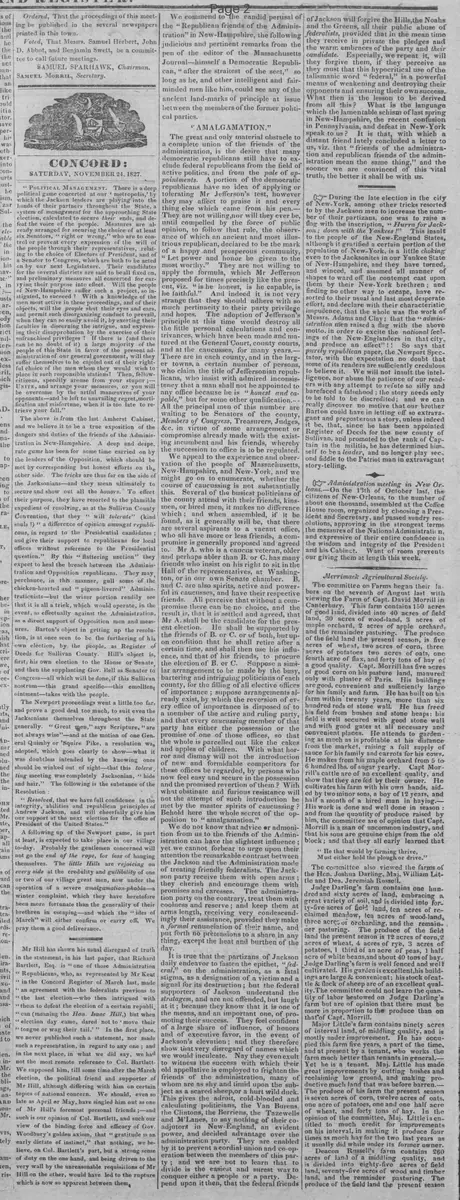
POLITICAL MANAGEMENT. There is a deep political game concerted at our 'metropolis,' by which the Jackson leaders are playing into the hands of their partners throughout the State, a system of management for the approaching State election, calculated to secure their ends, and defeat the voice of the people. Measures are already arranged for securing the choice of at least six Senators, "right or wrong," who are to control or prevent every expression of the will of the people through their representatives, relating to the choice of Electors of President, and of a Senator to Congress, which are both to be acted on by our next Legislature. Their candidates for the several districts are said to be all fixed on, and preliminary measures all concerted for carrying their purpose into effect. Will the people of New-Hampshire suffer such a project, so instigated, to succeed? With a knowledge of the men most active in these proceedings, and of their objects, will the people shut their eyes and ears, and permit such disorganizing conduct to prevail, when they can so easily avoid it, by exerting their faculties in discerning the intrigue, and expressing their disapprobation by the exercise of their enfranchised privileges? If there is (and there can be no doubt of it) a large majority of the people of this State in favor of the present administration of our general government, will they suffer themselves to be cajoled out of their rightful choice of the men whom they would wish to place in such responsible stations? Then, fellow-citizens, speedily arouse from your stupor;—
UNITE, and arrange your measures, or you will be overcome by the artful manoeuvres of your opponents—and be left to unavailing regret, mortification and misfortune, when it is too late to retrieve your fall."
The above is from the last Amherst Cabinet, and we believe it to be a true exposition of the dangers and duties of the friends of the Administration in New-Hampshire. A deep and desperate game has been for some time carried on by the leaders of the Opposition, which should be met by corresponding but honest efforts on the other side. The tricks are thus far on the side of the Jacksonians—and they mean ultimately to secure and show out all the honors. To effect their purpose, they have resorted to the plausible expedient of resolving, as at the Sullivan County Convention, that they "will tolerate" (kind souls!) "a difference of opinion amongst republicans, in regard to the Presidential candidates; and give their support to republicans for local offices without reference to the Presidential question." By this "flattering unction" they expect to heal the breach between the Administration and Opposition republicans. They may perchance, in this manner, gull some of the chicken-hearted and "pigeon-livered" Administrationists—but the wiser portion readily see that it is all a trick, which would operate, in the event, as effectually against the Administration, as a direct support of Opposition men and measures. Barton's object in getting up the resolution, is at once seen to be the furthering of his own election, by the people, as Register of Deeds for Sullivan County. Hill's object is, first, his own election to the House or Senate and then the supplanting Gov. Bell as Senator to Congress—all which will be done, if this Sullivan nostrum—this grand specific—this emollient ointment—takes with the people.
The Newport proceedings went a little too far, and prove a good deal too much, to suit even the Jacksonians themselves throughout the State generally. "Great men," says Scripture, "are not always wise"—and at the motion of one General Quimby or 'Squire Pike, a resolution was adopted, which goes clearly to show—what it was doubtless intended by the knowing ones should be winked out of sight—that this tolerating meeting was completely Jacksonian, "hide and hair." The following is the substance of the Resolution:
"Resolved, that we have full confidence in the integrity, abilities and republican principles of Andrew Jackson, and will cheerfully give him our support at the next election for the office of President of the United States."
A following up of the Newport game, in part at least, is expected to take place in our village to-day. Probably the gentlemen concerned will not go the end of the rope, for fear of hanging themselves. The little Hills are rejoicing on every side at the credulity and gullibility of one or two of our village great men, now under the operation of a severe amalgamation-phobia—a winter complaint, which they have heretofore been more fortunate than the generality of their brethren in escaping—and which the "ides of March" will either confirm or carry off. We pray them a good deliverance.
Mr. Hill has shown his usual disregard of truth in the statement, in his last paper, that Richard Bartlett, Esq. is "one of those Administration Republicans, who, as represented by Mr. Kent in the Concord Register of March last, made an agreement with the federalists previous to the last election—who then intrigued with them to defeat the election of a certain republican (meaning the Hon. Isaac Hill,) but when election day came, dared not to move their tongue or wag their tail.' " In the first place, we never published such a statement, nor made such a representation, in regard to any one; and in the next place, in what we did say, we had not the most remote reference to Col. Bartlett. We supposed him, till some time after the March election, the political friend and supporter of Mr. Hill, although differing with him on certain topics of national concern. We should, even so late as April or May, have singled him out as one of Mr. Hill's foremost personal friends;—and such is our opinion of Col. Bartlett, and such our view of the binding force and efficacy of Gov. Woodbury's golden axiom, that "gratitude is an early dictate of instinct," that nothing, we believe, on Col. Bartlett's part, but a strong sense of duty on the one hand, and being driven to the very wall by the unreasonable requisitions of Mr. Hill on the other, would have led to the rupture which is now so apparent between them.
We commend to the candid perusal of the "Republican friends of the Administration" in New-Hampshire, the following judicious and pertinent remarks from the pen of the editor of the Massachusetts Journal—himself a Democratic Republican, "after the straitest of the sect," so long as he, and other intelligent and fair-minded men like him, could see any of the ancient land-marks of principle at issue between the members of the former political parties.
"AMALGAMATION."
The great and only material obstacle to a complete union of the friends of the administration, is the desire that many democratic republicans still have to exclude federal republicans from the field of active politics, and from the pale of appointments. A portion of the democratic republicans have no idea of applying or tolerating Mr. Jefferson's test, however they may affect to praise it and every thing else which came from his pen. They are not willing, nor will they ever be, until compelled by the force of public opinion, to follow that rule, the observance of which an ancient and most illustrious republican, declared to be the mark of a happy and prosperous community, "Let power and honor be given to the most worthy." They are not willing to apply the formula, which Mr. Jefferson proposed for times precisely like the present, viz. "is he honest, is he capable, is he faithful." And indeed it is not very strange that they should adhere with so much pertinacity to their party privilege and hopes. The adoption of Jefferson's principle at this time would destroy all the little personal calculations and contrivances, which have been made and matured at the General Court, county courts, and at the caucuses, for many years. There are in each county, and in the larger towns, a certain number of persons, who claim the title of Jeffersonian republicans, who insist with admired inconsistency that a man shall not be appointed to any office because he is "honest and capable," but for some other qualification. All the principal men of this number are waiting to be Senators of the county, Members of Congress, Treasurers, Judges, &c. in virtue of some arrangement or compromise already made with the existing incumbent and his friends, whereby the succession to office is to be regulated. We appeal to the experience and observation of the people of Massachusetts, New-Hampshire, and New-York, and we might go on to enumerate, whether the course of caucussing is not substantially this. Several of the busiest politicians of the county attend with their friends, kinsmen, or hired men, it makes no difference which; and when assembled, if it be found, as it generally will be, that there are several aspirants to a vacant office, who all have more or less friends, a compromise is generally proposed and agreed to. Mr. A. who is a caucus veteran, older and perhaps abler than B. or C. has many friends who insist on his right to sit in the Hall of the representatives, at Washington, or in our own Senate chamber. B. and C. are also spirits, active and powerful in caucuses, and have their respective friends. All perceive that without a compromise there can be no choice, and the result is, that it is settled and agreed, that Mr. A. shall be the candidate for the present election. He shall be supported by the friends of B. or C. or of both, but upon condition that he shall retire after a certain time, and shall then use his influence, and that of his friends, to procure the election of B. or C. Suppose a similar arrangement to be made by the busy, bartering and intriguing politicians of each county, for the filling of all elective offices of importance; suppose arrangements already exist, by which the reversion of every office of importance is disposed of to a member of the active and ruling party, and that every caucussing member of that party has either the possession or the promise of one of those offices, so that the whole is parcelled out like the cakes and apples of children. With what horror and dismay will not the introduction of new and formidable competitors for these offices be regarded, by persons who now feel easy and secure in the possession and the promised reversion of them? With what obstinate and furious resistance will not the attempt of such introduction be met by the master spirits of caucussing? Behold here the whole secret of the opposition to "amalgamation."
We do not know that advice or admonition from us to the friends of the Administration can have the slightest influence; yet we cannot forbear to urge upon their attention the remarkable contrast between the Jackson and the Administration mode of treating friendly federalists. The Jackson party receive them with open arms; they cherish and encourage them with promises and caresses. The administration party on the contrary, treat them with coolness and reserve; and keep them at arms length, receiving very condescendingly their assistance, provided they make a formal renunciation of their name, and put forth no pretensions to a share in any thing, except the heat and burden of the day. It is true that the partisans of Jackson daily endeavor to fasten the epithet, "federal," on the administration, as a fatal stigma, as a designation of a victim and a signal for its destruction; but the federal supporters of Jackson understand the stratagem, and are not offended, but laugh at it; because they know that it is one of the means, and an important one, of promoting their success. They feel confident of a large share of influence, of honors and of executive favor, in the event of Jackson's elevation: and they therefore show that very disregard of names which we would inculcate. Nay they even exult to witness the success with which their old appellative is employed to frighten the friends of the administration, many of whom are as shy and timid upon the subject as a scared sheep, or a hurt wild duck. This gives the adroit, cold-blooded and calculating politicians, the Van Burens, the Clintons, the Berriens, the Tazewells and M'Lanes, to say nothing of their co-adjutors in New-England, an evident power, and decided advantage over the administration party. They are enabled by it to prevent a cordial union and co-operation between the members of this party; and we are not to learn that to divide is the easiest and surest way to conquer either a people or a party. Depend upon it then, that the federal friends of Jackson will forgive the Hills, the Noahs and the Greens, all their public abuse of federalists, provided that in the mean time they receive in private the pledges and the warm embraces of the party and their candidate. Especially, we repeat it, will they forgive them, if they perceive as they must that this hypocritical use of the talismanic word "federal," is a powerful means of weakening and destroying their opponents and ensuring their own success.
What then is the lesson to be derived from all this? What is the language which the lamentable schism of last spring in New-Hampshire, the recent confusion in Pennsylvania, and defeat in New-York speak to us? It is that, with which a distant friend lately concluded a letter to us, viz. that "friends of the administration and republican friends of the administration mean the same thing," and the sooner we are convinced of this vital truth, the better it shall be with us.
During the late election in the city of New-York, among other tricks resorted to by the Jackson men to increase the number of their partisans, one was to raise a flag with the inscription, "Hurra for Jackson; down with the Yankees!" This insult to the people of the New-England States, although it gratified a certain portion of the population of New-York, is a little choking even to the Jacksonites in our Yankee State of New-Hampshire, and they have turned, and winced, and assumed all manner of shapes to ward off the contempt cast upon them by their New-York brethren; and finding no other way to escape, have resorted to their usual and last most desperate effort, and declare with their characteristic impudence, that the whole was the work of Messrs. Adams and Clay: that the "administration men raised a flag with the above motto, in order to excite the national feelings of the New-Englanders in that city, and produce an effect!!" So says that purely republican paper, the Newport Spectator, with the expectation no doubt that some of its readers are sufficiently credulous to believe it. We will not insult the intelligence, nor abuse the patience of our readers with any attempt to refute so silly and barefaced a falsehood; the story needs only to be told to be discredited; and we can really discover no motive that our brother Barton could have in letting off so extravagant and preposterous a story, unless indeed it be, that, since he has been appointed Register of Deeds for the new county of Sullivan, and promoted to the rank of Captain in the militia, he has determined himself to be a leader, and no longer play second fiddle to the Patriot man in extravagant story-telling.
SATURDAY, NOVEMBER 24, 1827.
POLITICAL MANAGEMENT. There is a deep political game concerted at our 'metropolis,' by which the Jackson leaders are playing into the hands of their partners throughout the State, a system of management for the approaching State election, calculated to secure their ends, and defeat the voice of the people. Measures are already arranged for securing the choice of at least six Senators, "right or wrong," who are to control or prevent every expression of the will of the people through their representatives, relating to the choice of Electors of President, and of a Senator to Congress, which are both to be acted on by our next Legislature. Their candidates for the several districts are said to be all fixed on, and preliminary measures all concerted for carrying their purpose into effect. Will the people of New-Hampshire suffer such a project, so instigated, to succeed? With a knowledge of the men most active in these proceedings, and of their objects, will the people shut their eyes and ears, and permit such disorganizing conduct to prevail, when they can so easily avoid it, by exerting their faculties in discerning the intrigue, and expressing their disapprobation by the exercise of their enfranchised privileges? If there is (and there can be no doubt of it) a large majority of the people of this State in favor of the present administration of our general government, will they suffer themselves to be cajoled out of their rightful choice of the men whom they would wish to place in such responsible stations? Then, fellow-citizens, speedily arouse from your stupor;—
UNITE, and arrange your measures, or you will be overcome by the artful manoeuvres of your opponents—and be left to unavailing regret, mortification and misfortune, when it is too late to retrieve your fall."
The above is from the last Amherst Cabinet, and we believe it to be a true exposition of the dangers and duties of the friends of the Administration in New-Hampshire. A deep and desperate game has been for some time carried on by the leaders of the Opposition, which should be met by corresponding but honest efforts on the other side. The tricks are thus far on the side of the Jacksonians—and they mean ultimately to secure and show out all the honors. To effect their purpose, they have resorted to the plausible expedient of resolving, as at the Sullivan County Convention, that they "will tolerate" (kind souls!) "a difference of opinion amongst republicans, in regard to the Presidential candidates; and give their support to republicans for local offices without reference to the Presidential question." By this "flattering unction" they expect to heal the breach between the Administration and Opposition republicans. They may perchance, in this manner, gull some of the chicken-hearted and "pigeon-livered" Administrationists—but the wiser portion readily see that it is all a trick, which would operate, in the event, as effectually against the Administration, as a direct support of Opposition men and measures. Barton's object in getting up the resolution, is at once seen to be the furthering of his own election, by the people, as Register of Deeds for Sullivan County. Hill's object is, first, his own election to the House or Senate and then the supplanting Gov. Bell as Senator to Congress—all which will be done, if this Sullivan nostrum—this grand specific—this emollient ointment—takes with the people.
The Newport proceedings went a little too far, and prove a good deal too much, to suit even the Jacksonians themselves throughout the State generally. "Great men," says Scripture, "are not always wise"—and at the motion of one General Quimby or 'Squire Pike, a resolution was adopted, which goes clearly to show—what it was doubtless intended by the knowing ones should be winked out of sight—that this tolerating meeting was completely Jacksonian, "hide and hair." The following is the substance of the Resolution:
"Resolved, that we have full confidence in the integrity, abilities and republican principles of Andrew Jackson, and will cheerfully give him our support at the next election for the office of President of the United States."
A following up of the Newport game, in part at least, is expected to take place in our village to-day. Probably the gentlemen concerned will not go the end of the rope, for fear of hanging themselves. The little Hills are rejoicing on every side at the credulity and gullibility of one or two of our village great men, now under the operation of a severe amalgamation-phobia—a winter complaint, which they have heretofore been more fortunate than the generality of their brethren in escaping—and which the "ides of March" will either confirm or carry off. We pray them a good deliverance.
Mr. Hill has shown his usual disregard of truth in the statement, in his last paper, that Richard Bartlett, Esq. is "one of those Administration Republicans, who, as represented by Mr. Kent in the Concord Register of March last, made an agreement with the federalists previous to the last election—who then intrigued with them to defeat the election of a certain republican (meaning the Hon. Isaac Hill,) but when election day came, dared not to move their tongue or wag their tail.' " In the first place, we never published such a statement, nor made such a representation, in regard to any one; and in the next place, in what we did say, we had not the most remote reference to Col. Bartlett. We supposed him, till some time after the March election, the political friend and supporter of Mr. Hill, although differing with him on certain topics of national concern. We should, even so late as April or May, have singled him out as one of Mr. Hill's foremost personal friends;—and such is our opinion of Col. Bartlett, and such our view of the binding force and efficacy of Gov. Woodbury's golden axiom, that "gratitude is an early dictate of instinct," that nothing, we believe, on Col. Bartlett's part, but a strong sense of duty on the one hand, and being driven to the very wall by the unreasonable requisitions of Mr. Hill on the other, would have led to the rupture which is now so apparent between them.
We commend to the candid perusal of the "Republican friends of the Administration" in New-Hampshire, the following judicious and pertinent remarks from the pen of the editor of the Massachusetts Journal—himself a Democratic Republican, "after the straitest of the sect," so long as he, and other intelligent and fair-minded men like him, could see any of the ancient land-marks of principle at issue between the members of the former political parties.
"AMALGAMATION."
The great and only material obstacle to a complete union of the friends of the administration, is the desire that many democratic republicans still have to exclude federal republicans from the field of active politics, and from the pale of appointments. A portion of the democratic republicans have no idea of applying or tolerating Mr. Jefferson's test, however they may affect to praise it and every thing else which came from his pen. They are not willing, nor will they ever be, until compelled by the force of public opinion, to follow that rule, the observance of which an ancient and most illustrious republican, declared to be the mark of a happy and prosperous community, "Let power and honor be given to the most worthy." They are not willing to apply the formula, which Mr. Jefferson proposed for times precisely like the present, viz. "is he honest, is he capable, is he faithful." And indeed it is not very strange that they should adhere with so much pertinacity to their party privilege and hopes. The adoption of Jefferson's principle at this time would destroy all the little personal calculations and contrivances, which have been made and matured at the General Court, county courts, and at the caucuses, for many years. There are in each county, and in the larger towns, a certain number of persons, who claim the title of Jeffersonian republicans, who insist with admired inconsistency that a man shall not be appointed to any office because he is "honest and capable," but for some other qualification. All the principal men of this number are waiting to be Senators of the county, Members of Congress, Treasurers, Judges, &c. in virtue of some arrangement or compromise already made with the existing incumbent and his friends, whereby the succession to office is to be regulated. We appeal to the experience and observation of the people of Massachusetts, New-Hampshire, and New-York, and we might go on to enumerate, whether the course of caucussing is not substantially this. Several of the busiest politicians of the county attend with their friends, kinsmen, or hired men, it makes no difference which; and when assembled, if it be found, as it generally will be, that there are several aspirants to a vacant office, who all have more or less friends, a compromise is generally proposed and agreed to. Mr. A. who is a caucus veteran, older and perhaps abler than B. or C. has many friends who insist on his right to sit in the Hall of the representatives, at Washington, or in our own Senate chamber. B. and C. are also spirits, active and powerful in caucuses, and have their respective friends. All perceive that without a compromise there can be no choice, and the result is, that it is settled and agreed, that Mr. A. shall be the candidate for the present election. He shall be supported by the friends of B. or C. or of both, but upon condition that he shall retire after a certain time, and shall then use his influence, and that of his friends, to procure the election of B. or C. Suppose a similar arrangement to be made by the busy, bartering and intriguing politicians of each county, for the filling of all elective offices of importance; suppose arrangements already exist, by which the reversion of every office of importance is disposed of to a member of the active and ruling party, and that every caucussing member of that party has either the possession or the promise of one of those offices, so that the whole is parcelled out like the cakes and apples of children. With what horror and dismay will not the introduction of new and formidable competitors for these offices be regarded, by persons who now feel easy and secure in the possession and the promised reversion of them? With what obstinate and furious resistance will not the attempt of such introduction be met by the master spirits of caucussing? Behold here the whole secret of the opposition to "amalgamation."
We do not know that advice or admonition from us to the friends of the Administration can have the slightest influence; yet we cannot forbear to urge upon their attention the remarkable contrast between the Jackson and the Administration mode of treating friendly federalists. The Jackson party receive them with open arms; they cherish and encourage them with promises and caresses. The administration party on the contrary, treat them with coolness and reserve; and keep them at arms length, receiving very condescendingly their assistance, provided they make a formal renunciation of their name, and put forth no pretensions to a share in any thing, except the heat and burden of the day. It is true that the partisans of Jackson daily endeavor to fasten the epithet, "federal," on the administration, as a fatal stigma, as a designation of a victim and a signal for its destruction; but the federal supporters of Jackson understand the stratagem, and are not offended, but laugh at it; because they know that it is one of the means, and an important one, of promoting their success. They feel confident of a large share of influence, of honors and of executive favor, in the event of Jackson's elevation: and they therefore show that very disregard of names which we would inculcate. Nay they even exult to witness the success with which their old appellative is employed to frighten the friends of the administration, many of whom are as shy and timid upon the subject as a scared sheep, or a hurt wild duck. This gives the adroit, cold-blooded and calculating politicians, the Van Burens, the Clintons, the Berriens, the Tazewells and M'Lanes, to say nothing of their co-adjutors in New-England, an evident power, and decided advantage over the administration party. They are enabled by it to prevent a cordial union and co-operation between the members of this party; and we are not to learn that to divide is the easiest and surest way to conquer either a people or a party. Depend upon it then, that the federal friends of Jackson will forgive the Hills, the Noahs and the Greens, all their public abuse of federalists, provided that in the mean time they receive in private the pledges and the warm embraces of the party and their candidate. Especially, we repeat it, will they forgive them, if they perceive as they must that this hypocritical use of the talismanic word "federal," is a powerful means of weakening and destroying their opponents and ensuring their own success.
What then is the lesson to be derived from all this? What is the language which the lamentable schism of last spring in New-Hampshire, the recent confusion in Pennsylvania, and defeat in New-York speak to us? It is that, with which a distant friend lately concluded a letter to us, viz. that "friends of the administration and republican friends of the administration mean the same thing," and the sooner we are convinced of this vital truth, the better it shall be with us.
During the late election in the city of New-York, among other tricks resorted to by the Jackson men to increase the number of their partisans, one was to raise a flag with the inscription, "Hurra for Jackson; down with the Yankees!" This insult to the people of the New-England States, although it gratified a certain portion of the population of New-York, is a little choking even to the Jacksonites in our Yankee State of New-Hampshire, and they have turned, and winced, and assumed all manner of shapes to ward off the contempt cast upon them by their New-York brethren; and finding no other way to escape, have resorted to their usual and last most desperate effort, and declare with their characteristic impudence, that the whole was the work of Messrs. Adams and Clay: that the "administration men raised a flag with the above motto, in order to excite the national feelings of the New-Englanders in that city, and produce an effect!!" So says that purely republican paper, the Newport Spectator, with the expectation no doubt that some of its readers are sufficiently credulous to believe it. We will not insult the intelligence, nor abuse the patience of our readers with any attempt to refute so silly and barefaced a falsehood; the story needs only to be told to be discredited; and we can really discover no motive that our brother Barton could have in letting off so extravagant and preposterous a story, unless indeed it be, that, since he has been appointed Register of Deeds for the new county of Sullivan, and promoted to the rank of Captain in the militia, he has determined himself to be a leader, and no longer play second fiddle to the Patriot man in extravagant story-telling.
What sub-type of article is it?
Partisan Politics
What keywords are associated?
Jacksonian Intrigue
New Hampshire Politics
Administration Unity
Political Amalgamation
Caucusing
Federalists
Presidential Election
Sullivan County Convention
What entities or persons were involved?
Andrew Jackson
Isaac Hill
Richard Bartlett
Gov. Bell
John Quincy Adams Administration
Martin Van Buren
Dewitt Clinton
John Berrien
Littleton Tazewell
Louis Mclane
Samuel Bell
Editorial Details
Primary Topic
Jacksonian Political Intrigue And Calls For Administration Unity In New Hampshire
Stance / Tone
Strongly Pro Administration, Anti Jacksonian
Key Figures
Andrew Jackson
Isaac Hill
Richard Bartlett
Gov. Bell
John Quincy Adams Administration
Martin Van Buren
Dewitt Clinton
John Berrien
Littleton Tazewell
Louis Mclane
Samuel Bell
Key Arguments
Jackson Leaders Are Plotting To Control The Legislature Through Fixed Senate Choices To Influence Presidential Electors And Congressional Seats
Tactics Like Tolerating Presidential Differences For Local Offices Are Tricks To Undermine Administration Support
Critique Of Amalgamation Fears And Caucusing As Barriers To Honest Politics Based On Jeffersonian Principles
Urge Unity Among Administration Friends, Including Federalists, To Counter Jacksonian Strategies
Denial Of False Accusations Against Richard Bartlett And Defense Of His Loyalty
Contrast Jackson Party's Embrace Of Federalists With Administration's Reserve
Dismissal Of Jacksonian Claims About New York Election Flag As Falsehood