Thank you for visiting SNEWPapers!
Sign up free
Trainman News
Indianapolis, Marion County, Indiana
What is this article about?
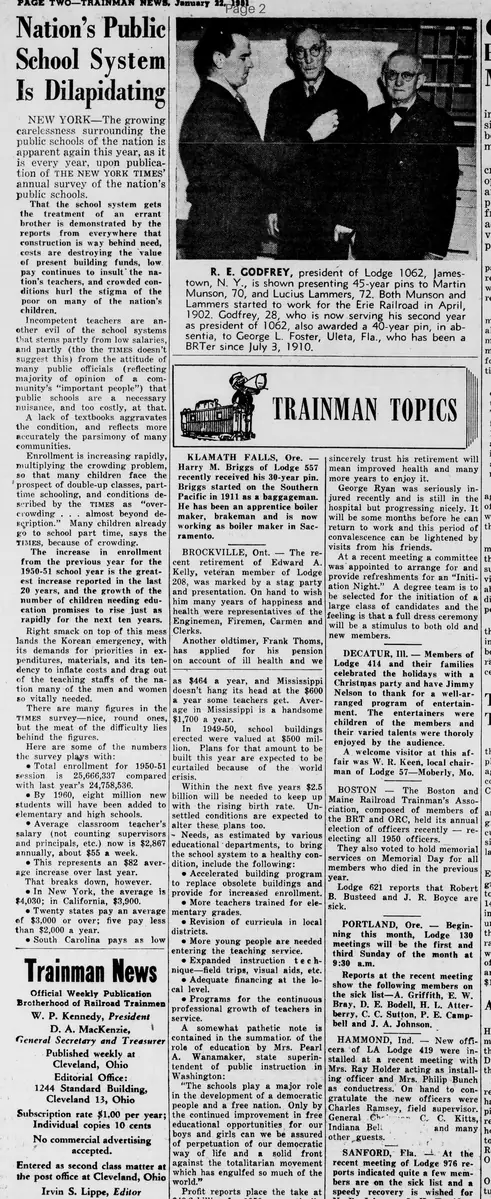
The New York Times' annual survey reveals the deteriorating state of U.S. public schools in 1950-51, with overcrowding, low teacher pay, construction delays, textbook shortages, and impacts from the Korean War. Enrollment rose to 25.6 million, with needs for more buildings and teachers.
Merged-components note: Image at top of page likely illustrates the school system article, merged based on spatial overlap and reading order.
Clipping
OCR Quality
Full Text
School System
Is Dilapidating
NEW YORK - The growing carelessness surrounding the public schools of the nation is apparent again this year, as it is every year, upon publication of THE NEW YORK TIMES' annual survey of the nation's public schools.
That the school system gets the treatment of an errant brother is demonstrated by the reports from everywhere that construction is way behind need, costs are destroying the value of present building funds, low pay continues to insult the nation's teachers, and crowded conditions hurl the stigma of the poor on many of the nation's children.
Incompetent teachers are another evil of the school systems that stems partly from low salaries and partly (though the TIMES doesn't suggest this) from the attitude of many public officials (reflecting majority of opinion of a community's "important people") that public schools are a necessary nuisance, and too costly, at that.
A lack of textbooks aggravates the condition, and reflects more accurately the parsimony of many communities.
Enrollment is increasing rapidly, multiplying the crowding problem, so that many children face the prospect of double-up classes, part-time schooling, and conditions described by the TIMES as "overcrowding . . . almost beyond description." Many children already go to school part time, says the TIMES, because of crowding.
The increase in enrollment from the previous year for the 1950-51 school year is the greatest increase reported in the last 20 years, and the growth of the number of children needing education promises to rise just as rapidly for the next ten years.
Right smack on top of this mess lands the Korean emergency, with its demands for priorities in expenditures, materials, and its tendency to inflate costs and drag out of the teaching staffs of the nation many of the men and women so vitally needed.
There are many figures in the TIMES survey - nice, round ones, but the meat of the difficulty lies behind the figures.
Here are some of the numbers the survey plays with:
Total enrollment for 1950-51 session is 25,666,337 compared with last year's 24,758,536.
• By 1960, eight million new students will have been added to elementary and high schools.
• Average classroom teacher's salary (not counting supervisors and principals, etc.) now is $2,867 annually, about $55 a week.
This represents an $82 average increase over last year.
That breaks down, however.
• In New York, the average is $4,030; in California, $3,900.
• Twenty states pay an average of $3,000 or over; five pay less than $2,000 a year.
South Carolina pays as low as $464 a year, and Mississippi doesn't hang its head at the $600 a year some teachers get. Average in Mississippi is a handsome $1,700 a year.
In 1949-50, school buildings erected were valued at $500 million. Plans for that amount to be built this year are expected to be curtailed because of the world crisis.
Within the next five years $2.5 billion will be needed to keep up with the rising birth rate. Unsettled conditions are expected to alter these plans too.
Needs, as estimated by various educational departments, to bring the school system to a healthy condition, include the following:
Accelerated building program to replace obsolete buildings and provide for increased enrollment.
More teachers trained for elementary grades.
Revision of curricula in local districts.
More young people are needed entering the teaching service.
Expanded instruction technique - field trips, visual aids, etc.
Adequate financing at the local level.
Programs for the continuous professional growth of teachers in service.
A somewhat pathetic note is contained in the summation of the role of education by Mrs. Pearl A. Wanamaker, state superintendent of public instruction in Washington:
"The schools play a major role in the development of a democratic people and a free nation. Only by the continued improvement in free educational opportunities for our boys and girls can we be assured of perpetuation of our democratic way of life and a solid front against the totalitarian movement which has engulfed so much of the world."
What sub-type of article is it?
What themes does it cover?
What keywords are associated?
What entities or persons were involved?
Where did it happen?
Story Details
Key Persons
Location
United States
Event Date
1950 51 School Year
Story Details
The New York Times survey highlights the dilapidated state of U.S. public schools due to underfunding, overcrowding, low teacher salaries, construction delays, textbook shortages, and the Korean War's impact, with enrollment surging to 25.6 million and projections for further growth.