Thank you for visiting SNEWPapers!
Sign up free
The Virginian
Lynchburg, Virginia
What is this article about?
In September 1827 near Natchez, Mississippi, a duel between Dr. Maddox and Samuel H. Wells ended peacefully, but escalated into a deadly shootout involving Gen. Cuney, Col. Crane, James Bowie, Major Wright, and the Blanchard brothers, resulting in two deaths and multiple injuries.
Clipping
OCR Quality
Full Text
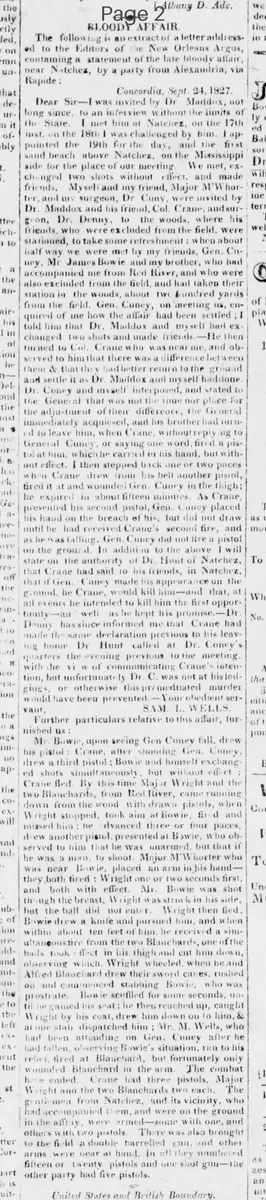
The following is an extract of a letter addressed to the Editors of the New Orleans Argus, containing a statement of the late bloody affair, near Natchez, by a party from Alexandria, via Rapides:
Concordia, Sept. 24, 1827.
Dear Sir—I was invited by Dr. Maddox, not long since, to an interview without the limits of the State, I met him at Natchez, on the 17th inst. on the 18th I was challenged by him. I appointed the 19th for the day, and the first sand beach above Natchez, on the Mississippi side for the place of our meeting. We met, exchanged two shots without effect, and made friends. Myself and my friend, Major M'Whorter, and my surgeon, Dr. Cuny, were invited by Dr. Maddox and his friend, Col. Crane, and surgeon, Dr. Denny, to the woods, where his friends, who were excluded from the field, were stationed, to take some refreshment: when about half way we were met by my friends, Gen. Cuney, Mr. James Bowie and my brother, who had accompanied me from Red River, and who were also excluded from the field, and had taken their station in the woods, about two hundred yards from the field. Gen. Cuney, on meeting us, enquired of me how the affair had been settled; I told him that Dr. Maddox and myself had exchanged two shots and made friends—He then turned to Col. Crane who was near me, and observed to him that there was a difference between them & that they had better return to the ground and settle it as Dr. Maddox and myself had done. Dr. Cuney and myself interposed, and stated to the General that was not the time nor place for the adjustment of their difference, the General immediately acquiesced, and his brother had turned to leave him, when Crane, without replying to General Cuney, or saying one word, fired a pistol at him, which he carried in his hand, but without effect. I then stepped back one or two paces when Crane drew from his belt another pistol, fired it at and wounded Gen. Cuney in the thigh; he expired in about fifteen minutes. As Crane presented his second pistol, Gen. Cuney placed his hand on the breach of his, but did not draw until he had received Crane's second fire, and as he was falling, Gen. Cuney did not fire a pistol on the ground. In addition to the above I will state on the authority of Dr. Hunt of Natchez, that Crane had said to his friends, in Natchez, that if Gen. Cuney made his appearance on the ground, he Crane, would kill him—and that, at all events he intended to kill him the first opportunity—as well as he kept his promise.—Dr. Denny has since informed me that Crane had made the same declaration previous to his leaving home. Dr. Hunt called at Dr. Cuney's quarters the evening previous to the meeting with the view of communicating Crane's intention, but unfortunately Dr. C. was not at his lodgings, or otherwise this premeditated murder would have been prevented.—Your obedient servant,
SAM. H. WELLS.
Further particulars relative to this affair, furnished us:
Mr. Bowie, upon seeing Gen. Cuney fall, drew his pistol: Crane, after shooting Gen. Cuney, drew a third pistol; Bowie and himself exchanged shots simultaneously, but without effect. Crane fled. By this time Major Wright and the two Blanchards, from Red River, came running down from the wood with drawn pistols, when Wright stopped, took aim at Bowie, fired and missed him: he advanced three or four paces, drew another pistol, presented at Bowie, who observed to him that he was unarmed, but that if he was a man, to shoot. Major M'Whorter who was near Bowie, placed a pistol in his hand—they both fired: Wright one or two seconds first, and both with effect. Mr. Bowie was shot through the breast, Wright was struck in his side, but the ball did not enter. Wright then fled. Bowie drew a knife and pursued him, and when within about ten feet of him, he received a simultaneous fire from the two Blanchards, one of the balls took effect in his thigh and cut him down, observing which, Wright wheeled, when he and Alfred Blanchard drew their sword canes, rushed on and commenced stabbing Bowie, who was prostrate. Bowie scuffled for some seconds, until he regained his seat; he then reached up, caught Wright by his coat, drew him down on to him, & at one stab dispatched him: Mr. M. Wells, who had been attending on Gen. Cuney after he had fallen, observing Bowie's situation, ran to his relief, fired at Blanchard, but fortunately only wounded Blanchard in the arm. The combat here ended. Crane had three pistols. Major Wright and the two Blanchards two each. The gentlemen from Natchez, and its vicinity, who had accompanied them, and were on the ground in the affray, were armed—some with one, and others with two pistols. They also brought to the field a double barrelled gun, and other arms were near at hand. In all they numbered fifteen or twenty pistols and one shot gun—the other party had five pistols.
What sub-type of article is it?
What keywords are associated?
What entities or persons were involved?
Where did it happen?
Domestic News Details
Primary Location
Near Natchez, Mississippi
Event Date
September 19, 1827
Key Persons
Outcome
gen. cuney killed by col. crane; major wright killed by james bowie; james bowie wounded in breast and thigh; one blanchard wounded in arm; combat ended with crane and others fleeing.
Event Details
A duel between Dr. Maddox and Sam. H. Wells on September 19, 1827, near Natchez ended amicably after two shots, but en route to refreshments, Col. Crane shot and killed Gen. Cuney after a verbal challenge. This sparked a shootout involving James Bowie, Major Wright, and the Blanchard brothers, leading to further deaths and injuries amid armed groups from both sides.