Thank you for visiting SNEWPapers!
Sign up free
Editorial
March 2, 1803
The National Intelligencer And Washington Advertiser
Washington, District Of Columbia
What is this article about?
This editorial argues against receding the Territory of Columbia to Maryland and Virginia, emphasizing the need for a permanent constitutional seat of government independent of state control. It advocates for internal self-government and representation for the territory without making it a state, ensuring its prosperity and alignment with American principles.
Clipping
OCR Quality
95%
Excellent
Full Text
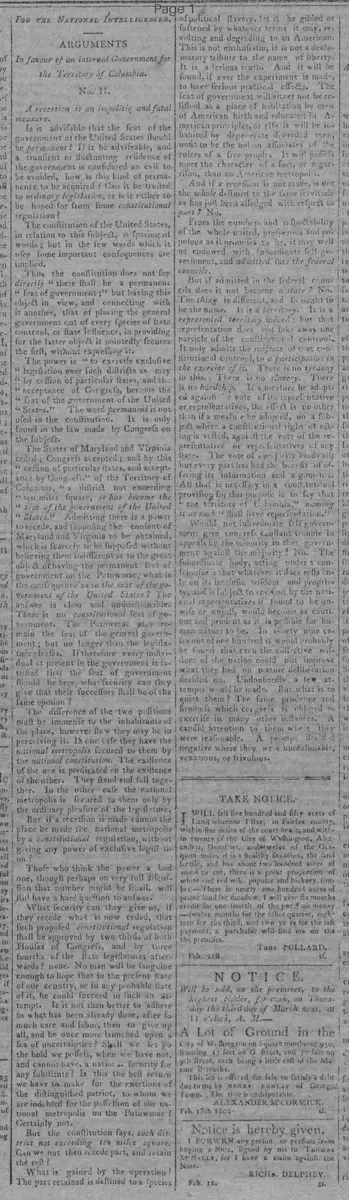
FOR THE NATIONAL INTELLIGENCER,
ARGUMENTS.
In favour of an internal Government for the Territory of Columbia.
No. II.
A recession is an impolitic and fatal measure.
Is it advisable that the seat of the government of the United States should be permanent? If it be advisable, and a transient or fluctuating residence of the government is considered an evil to be avoided, how is this kind of permanence to be acquired? Can it be trusted to ordinary legislation, or is it rather to be hoped for from some constitutional regulation?
The constitution of the United States, in relation to this subject, is sparing of words; but in the few words which it uses some important consequences are implied.
Thus the constitution does not say directly "there shall be a permanent seat of government;" but having this object in view, and connecting with it another, that of placing the general government out of every species of state controul, or state influence, in providing for the latter object it pointedly secures the first, without expressing it.
The power is "to exercise exclusive legislation over such districts as may by cession of particular states, and the acceptance of Congress, become the seat of the government of the United States." The word permanent is not used in the constitution. It is only found in the law made by Congress on the subject.
The States of Maryland and Virginia ceded; Congress accepted; and by this "cession of particular states, and acceptance by Congress," of the Territory of Columbia, "a district not exceeding ten miles square, it has become the seat of the government of the United States." Admitting there is a power to recede, and supposing the consent of Maryland and Virginia to be obtained, which is scarcely to be supposed without believing them indifferent as to the great object of having the permanent seat of government on the Potomac, what is the consequence as to the seat of the government of the United States? The answer is clear and unquestionable. There is no constitutional seat of government. The Potomac may remain the seat of the general government; but no longer than the legislature pleases. If therefore every individual at present in the government is satisfied that the seat of government should be here, what security can they give that their successors shall be of the same opinion?
The difference of the two positions must be immense to the inhabitants of the place, however slow they may be in perceiving it. In one case they have the national metropolis secured to them by the national constitution. The existence of the one is predicated on the existence of the other. They stand and fall together. In the other case the national metropolis is secured to them only by the ordinary pleasure of the legislature.
But if a recession is made cannot the place be made the national metropolis by a constitutional regulation, without giving any power of exclusive legislation?
Those who think the power a bad one, though perhaps on very full discussion that number might be small, will still have a hard question to answer. What security can they give us, if they recede what is now ceded, that such proposed constitutional regulation shall be approved by two thirds of both Houses of Congress, and by three fourths of the state legislatures afterwards? none. No man will be sanguine enough to hope that in the present state of our country, or in any probable state of it, he could succeed in such an attempt. Is it not then better to adhere to what has been already done, after so much care and labor, than to give up all, and be once more launched upon a Sea of uncertainties? Shall we let go the hold we possess, when we have not, and cannot have, a national security for any substitute? Is this the best return we have to make for the exertions of the distinguished patriot, to whom we are indebted for the possession of the national metropolis on the Potomac? Certainly not.
But the constitution says, such district not exceeding ten miles square. Can we not then recede part, and retain the rest?
What is gained by the operation? The part retained is destined to a species of political slavery, be it gilded or softened by whatever terms it may, revolting and degrading to an American.
This is not enthusiasm, it is not a declamatory tribute to the name of liberty. It is a serious truth. And it will be found, if ever the experiment is made, to have serious practical effects. The seat of government will either not be peopled as a place of habitation by men of American birth and educated in American principles, or else it will be inhabited by degenerate descended men, unfit to be the bosom associates of the rulers of a free people. It will possess more the character of a fort, or a garrison, than an American metropolis.
And if a recession is not made, is not the whole destined to the same servitude as has just been alleged with respect to part? No.
From the numbers and respectability of the whole united, prosperous and populous as it promises to be, it may well be endowed with subordinate self-government, and admitted into the federal councils.
But if admitted into the federal councils does it not become a state? No. The thing is different, and so ought to be the name. It is a territory. It is a represented territory indeed; but that representation does not take away one particle of the constitutional controul. It only admits the subjects of that constitutional controul, to a participation in the exercise of it. There is no tyranny in this. There is no slavery. There is no hardship. If a measure be adopted against the vote of its representative or representatives, the effect is no other than if a measure be adopted, on a subject where a constitutional right of acting is vested, against the vote of the representative or representatives of any state. The vote of a majority binds all; but every part has had the benefit of offering its information and arguments.
All that is necessary in a constitutional provision for this purpose is to say that "the territory of Columbia," naming it as such "shall have representation."
Would not subordinate self government give congress constant trouble in appeals by the minority in that government against the majority? No. The subordinate body, acting under a consciousness that whatever it does rests only on its intrinsic wisdom and propriety, and is subject to revision by the national representatives if found to be unwise or unjust, would become as cautious and prudent as it is possible for human nature to be. In ninety nine cases out of one hundred it would probably be found that even the collective wisdom of this nation could not improve what they had on mature deliberation decided on. Undoubtedly a few attempts would be made. But what is to resist them? The same prudence and firmness which congress is obliged to exercise in many other instances. A candid attention to them where they were reasonable. A prompt decided negative where they were unreasonable, vexatious, or frivolous.
ARGUMENTS.
In favour of an internal Government for the Territory of Columbia.
No. II.
A recession is an impolitic and fatal measure.
Is it advisable that the seat of the government of the United States should be permanent? If it be advisable, and a transient or fluctuating residence of the government is considered an evil to be avoided, how is this kind of permanence to be acquired? Can it be trusted to ordinary legislation, or is it rather to be hoped for from some constitutional regulation?
The constitution of the United States, in relation to this subject, is sparing of words; but in the few words which it uses some important consequences are implied.
Thus the constitution does not say directly "there shall be a permanent seat of government;" but having this object in view, and connecting with it another, that of placing the general government out of every species of state controul, or state influence, in providing for the latter object it pointedly secures the first, without expressing it.
The power is "to exercise exclusive legislation over such districts as may by cession of particular states, and the acceptance of Congress, become the seat of the government of the United States." The word permanent is not used in the constitution. It is only found in the law made by Congress on the subject.
The States of Maryland and Virginia ceded; Congress accepted; and by this "cession of particular states, and acceptance by Congress," of the Territory of Columbia, "a district not exceeding ten miles square, it has become the seat of the government of the United States." Admitting there is a power to recede, and supposing the consent of Maryland and Virginia to be obtained, which is scarcely to be supposed without believing them indifferent as to the great object of having the permanent seat of government on the Potomac, what is the consequence as to the seat of the government of the United States? The answer is clear and unquestionable. There is no constitutional seat of government. The Potomac may remain the seat of the general government; but no longer than the legislature pleases. If therefore every individual at present in the government is satisfied that the seat of government should be here, what security can they give that their successors shall be of the same opinion?
The difference of the two positions must be immense to the inhabitants of the place, however slow they may be in perceiving it. In one case they have the national metropolis secured to them by the national constitution. The existence of the one is predicated on the existence of the other. They stand and fall together. In the other case the national metropolis is secured to them only by the ordinary pleasure of the legislature.
But if a recession is made cannot the place be made the national metropolis by a constitutional regulation, without giving any power of exclusive legislation?
Those who think the power a bad one, though perhaps on very full discussion that number might be small, will still have a hard question to answer. What security can they give us, if they recede what is now ceded, that such proposed constitutional regulation shall be approved by two thirds of both Houses of Congress, and by three fourths of the state legislatures afterwards? none. No man will be sanguine enough to hope that in the present state of our country, or in any probable state of it, he could succeed in such an attempt. Is it not then better to adhere to what has been already done, after so much care and labor, than to give up all, and be once more launched upon a Sea of uncertainties? Shall we let go the hold we possess, when we have not, and cannot have, a national security for any substitute? Is this the best return we have to make for the exertions of the distinguished patriot, to whom we are indebted for the possession of the national metropolis on the Potomac? Certainly not.
But the constitution says, such district not exceeding ten miles square. Can we not then recede part, and retain the rest?
What is gained by the operation? The part retained is destined to a species of political slavery, be it gilded or softened by whatever terms it may, revolting and degrading to an American.
This is not enthusiasm, it is not a declamatory tribute to the name of liberty. It is a serious truth. And it will be found, if ever the experiment is made, to have serious practical effects. The seat of government will either not be peopled as a place of habitation by men of American birth and educated in American principles, or else it will be inhabited by degenerate descended men, unfit to be the bosom associates of the rulers of a free people. It will possess more the character of a fort, or a garrison, than an American metropolis.
And if a recession is not made, is not the whole destined to the same servitude as has just been alleged with respect to part? No.
From the numbers and respectability of the whole united, prosperous and populous as it promises to be, it may well be endowed with subordinate self-government, and admitted into the federal councils.
But if admitted into the federal councils does it not become a state? No. The thing is different, and so ought to be the name. It is a territory. It is a represented territory indeed; but that representation does not take away one particle of the constitutional controul. It only admits the subjects of that constitutional controul, to a participation in the exercise of it. There is no tyranny in this. There is no slavery. There is no hardship. If a measure be adopted against the vote of its representative or representatives, the effect is no other than if a measure be adopted, on a subject where a constitutional right of acting is vested, against the vote of the representative or representatives of any state. The vote of a majority binds all; but every part has had the benefit of offering its information and arguments.
All that is necessary in a constitutional provision for this purpose is to say that "the territory of Columbia," naming it as such "shall have representation."
Would not subordinate self government give congress constant trouble in appeals by the minority in that government against the majority? No. The subordinate body, acting under a consciousness that whatever it does rests only on its intrinsic wisdom and propriety, and is subject to revision by the national representatives if found to be unwise or unjust, would become as cautious and prudent as it is possible for human nature to be. In ninety nine cases out of one hundred it would probably be found that even the collective wisdom of this nation could not improve what they had on mature deliberation decided on. Undoubtedly a few attempts would be made. But what is to resist them? The same prudence and firmness which congress is obliged to exercise in many other instances. A candid attention to them where they were reasonable. A prompt decided negative where they were unreasonable, vexatious, or frivolous.
What sub-type of article is it?
Constitutional
What keywords are associated?
Territory Of Columbia
Seat Of Government
Recession
Constitutional Regulation
Exclusive Legislation
Self Government
Representation
Potomac
Permanent Seat
What entities or persons were involved?
Congress
States Of Maryland And Virginia
Territory Of Columbia
Distinguished Patriot
Editorial Details
Primary Topic
Arguments Against Recession Of The Territory Of Columbia And For Internal Government
Stance / Tone
Strongly In Favor Of Permanent Constitutional Seat And Subordinate Self Government
Key Figures
Congress
States Of Maryland And Virginia
Territory Of Columbia
Distinguished Patriot
Key Arguments
A Recession Would Eliminate The Constitutional Basis For A Permanent Seat Of Government, Leaving It Subject To Legislative Whim.
The Constitution Implies Permanence Through Exclusive Legislation Over Ceded Districts To Avoid State Control.
Partial Recession Would Impose Political Slavery On The Retained Portion, Degrading It To A Garrison Like Status.
The Full Territory Should Receive Subordinate Self Government And Representation Without Becoming A State, Preserving Constitutional Control.
Such Representation Allows Participation Without Tyranny, Similar To State Representations.
Subordinate Government Would Be Cautious And Rarely Require Congressional Intervention.