Thank you for visiting SNEWPapers!
Sign up free
Story
April 21, 1838
The Native American
Washington, District Of Columbia
What is this article about?
Newspaper report praises Professor Espy of Philadelphia's lecture on meteorology in the Hall of Representatives, highlighting his clear explanations of winds, storms, and tornadoes, and stressing the science's importance for society.
Clipping
OCR Quality
95%
Excellent
Full Text
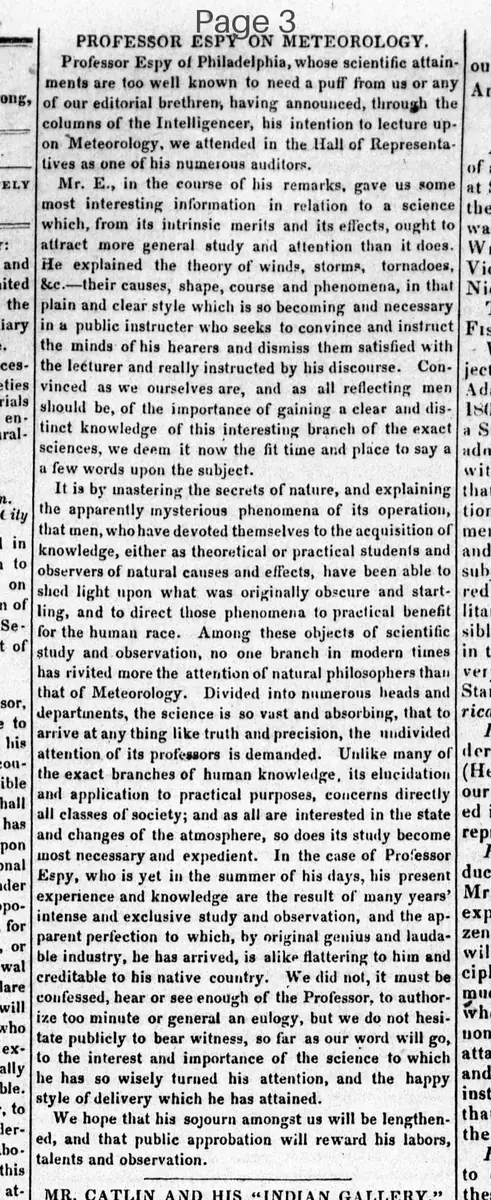
PROFESSOR ESPY ON METEOROLOGY.
Professor Espy of Philadelphia, whose scientific attainments are too well known to need a puff from us or any of our editorial brethren, having announced, through the columns of the Intelligencer, his intention to lecture upon Meteorology, we attended in the Hall of Representatives as one of his numerous auditors.
Mr. E., in the course of his remarks, gave us some most interesting information in relation to a science which, from its intrinsic merits and its effects, ought to attract more general study and attention than it does.
He explained the theory of winds, storms, tornadoes, &c.-their causes, shape, course and phenomena, in that plain and clear style which is so becoming and necessary in a public instructor who seeks to convince and instruct the minds of his hearers and dismiss them satisfied with the lecturer and really instructed by his discourse. Convinced as we ourselves are, and as all reflecting men should be, of the importance of gaining a clear and distinct knowledge of this interesting branch of the exact sciences, we deem it now the fit time and place to say a few words upon the subject.
It is by mastering the secrets of nature, and explaining the apparently mysterious phenomena of its operation, that men, who have devoted themselves to the acquisition of knowledge, either as theoretical or practical students and observers of natural causes and effects, have been able to shed light upon what was originally obscure and startling, and to direct those phenomena to practical benefit of the human race. Among these objects of scientific study and observation, no one branch in modern times has riveted more the attention of natural philosophers than that of Meteorology. Divided into numerous heads and departments, the science is so vast and absorbing, that to arrive at any thing like truth and precision, the undivided attention of its professors is demanded. Unlike many of the exact branches of human knowledge, its elucidation and application to practical purposes, concerns directly all classes of society; and as all are interested in the state and changes of the atmosphere, so does its study become most necessary and expedient. In the case of Professor Espy, who is yet in the summer of his days, his present experience and knowledge are the result of many years intense and exclusive study and observation, and the apparent perfection to which, by original genius and laudable industry, he has arrived, is alike flattering to him and creditable to his native country. We did not, it must be confessed, hear or see enough of the Professor, to authorize too minute or general an eulogy, but we do not hesitate publicly to bear witness, so far as our word will go, to the interest and importance of the science to which he has so wisely turned his attention, and the happy style of delivery which he has attained.
We hope that his sojourn amongst us will be lengthened, and that public approbation will reward his labors, talents and observation.
Professor Espy of Philadelphia, whose scientific attainments are too well known to need a puff from us or any of our editorial brethren, having announced, through the columns of the Intelligencer, his intention to lecture upon Meteorology, we attended in the Hall of Representatives as one of his numerous auditors.
Mr. E., in the course of his remarks, gave us some most interesting information in relation to a science which, from its intrinsic merits and its effects, ought to attract more general study and attention than it does.
He explained the theory of winds, storms, tornadoes, &c.-their causes, shape, course and phenomena, in that plain and clear style which is so becoming and necessary in a public instructor who seeks to convince and instruct the minds of his hearers and dismiss them satisfied with the lecturer and really instructed by his discourse. Convinced as we ourselves are, and as all reflecting men should be, of the importance of gaining a clear and distinct knowledge of this interesting branch of the exact sciences, we deem it now the fit time and place to say a few words upon the subject.
It is by mastering the secrets of nature, and explaining the apparently mysterious phenomena of its operation, that men, who have devoted themselves to the acquisition of knowledge, either as theoretical or practical students and observers of natural causes and effects, have been able to shed light upon what was originally obscure and startling, and to direct those phenomena to practical benefit of the human race. Among these objects of scientific study and observation, no one branch in modern times has riveted more the attention of natural philosophers than that of Meteorology. Divided into numerous heads and departments, the science is so vast and absorbing, that to arrive at any thing like truth and precision, the undivided attention of its professors is demanded. Unlike many of the exact branches of human knowledge, its elucidation and application to practical purposes, concerns directly all classes of society; and as all are interested in the state and changes of the atmosphere, so does its study become most necessary and expedient. In the case of Professor Espy, who is yet in the summer of his days, his present experience and knowledge are the result of many years intense and exclusive study and observation, and the apparent perfection to which, by original genius and laudable industry, he has arrived, is alike flattering to him and creditable to his native country. We did not, it must be confessed, hear or see enough of the Professor, to authorize too minute or general an eulogy, but we do not hesitate publicly to bear witness, so far as our word will go, to the interest and importance of the science to which he has so wisely turned his attention, and the happy style of delivery which he has attained.
We hope that his sojourn amongst us will be lengthened, and that public approbation will reward his labors, talents and observation.
What sub-type of article is it?
Historical Event
Curiosity
What themes does it cover?
Triumph
Moral Virtue
What keywords are associated?
Meteorology Lecture
Professor Espy
Winds Storms
Tornadoes
Scientific Study
What entities or persons were involved?
Professor Espy
Where did it happen?
Hall Of Representatives
Story Details
Key Persons
Professor Espy
Location
Hall Of Representatives
Story Details
Professor Espy lectures on meteorology, explaining winds, storms, and tornadoes; the reporter praises his clear style, the professor's achievements, and the science's practical benefits.