Thank you for visiting SNEWPapers!
Sign up free
The Sun
New York, New York County, New York
What is this article about?
On Christmas in Manhattan, the Salvation Army gave 3,200 uncooked family dinners and hosted a massive sit-down feast for 5,000+ poor at Madison Square Garden, featuring turkey and pudding, aided by donors like Frank Tilford and volunteers amid a remarkable charitable effort.
Merged-components note: Continuation of Salvation Army Christmas dinner story across pages 1 and 2; sequential reading order and matching text content.
Clippings
1 of 2
OCR Quality
Full Text
PRICE TWO CENTS
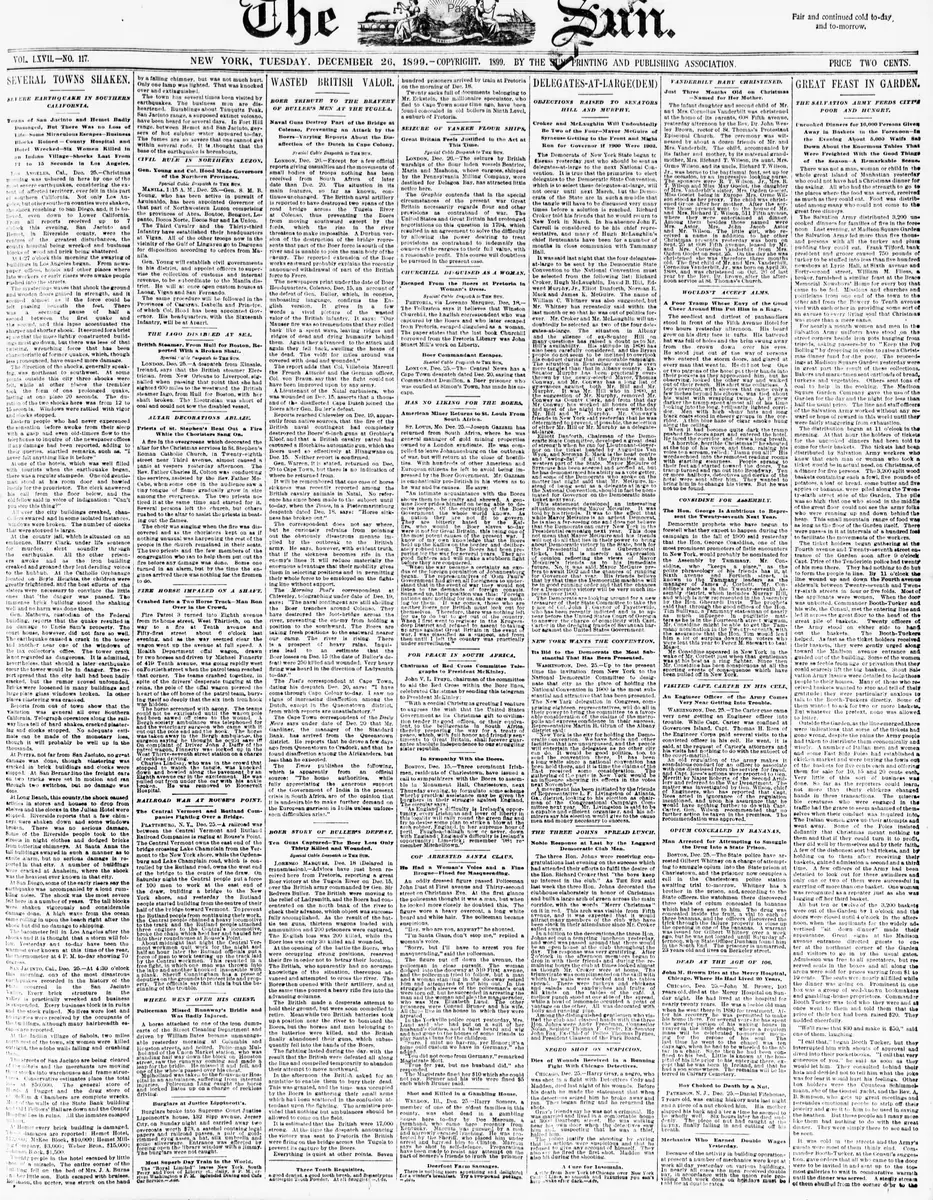
GREAT FEAST IN GARDEN.
THE SALVATION ARMY FEEDS CITY POOR AND HUNGRY.
Uncooked Dinners for 16,000 Persons Given Away in Baskets in the Forenoon—In the Evening About 5,000 Waifs Sat Down About the Enormous Tables That Were Freighthed With the Good Things of the Season—A Remarkable Scene
There was not a man, woman or child in the whole great island of Manhattan yesterday who could not have had a Christmas dinner for the asking. All who had the strength to go to the places where the food was served, received as much as they could eat. Food was distributed among many who could not come to the great free dinners.
The Salvation Army distributed 3,200 uncooked dinners for families of five in the forenoon. Last evening, at Madison Square Garden, the Salvation Army fed more than five thousand persons with all the turkey and plum pudding they could eat. Frank Tilford, bank president and grocer caused 750 pounds of turkey to be stuffed into less than five hundred newsboys at Lyric Hall, at Sixth avenue and Forty-second street. William M. Evarts, broker, furnished a similar feast at the Brace Memorial Newsboys' Home for every boy that came to be fed. Missions and churches and politicians from one end of the town to the other and from the Bowery to Tenth avenue vied with each other in providing some sort of an excuse to every living soul that Christmas was more than a mere name.
For nearly a month women and men in the Salvation Army uniform have stood on the street corners beside iron pots hanging from tripods, asking passers-by to "Keep the Pot Boiling" by dropping in coins to raise a Christmas dinner fund for the poor. The proceedings at Madison Square Garden yesterday were in great part the result of these collections. Bakers and marketmen sent cartloads of bread, turkeys and vegetables. Others sent tons of coal to help in the cooking. The Madison Square Garden Company gave the use of the Garden for the day and the night for less than half the usual price. The line and staff officers of the Salvation Army worked without any reward or hope of reward in this world until they were fairly staggering from exhaustion.
The distribution began at 11 o'clock in the morning. At that hour the holders of tickets for the uncooked dinners had been told to come for their baskets. The tickets had been distributed by Salvation Army workers who knew that each man or woman who took a ticket would be in actual need on Christmas of a dinner for five persons. The 3,200 split wood baskets containing each a fowl, five pounds of potatoes, a loaf of bread, some butter and five apples or bananas, were piled along the Twenty-sixth street side of the Garden. The pile was so high that one who stood in the middle of the great floor could not see the army folk who were running up and down behind the heap. This small mountain range of food was as long as the floor of the Garden itself. There were passes in it at intervals of a hundred feet to facilitate the movements of the workers.
The ticket holders began gathering at the Fourth avenue and Twenty-seventh street entrance of the Garden soon after 9 o'clock. Capt. Price of the Tenderloin police had twenty of his men there. They had nothing to do but to form the people in line. By 11 o'clock the line wound up and down the Fourth avenue sidewalk between Twenty-seventh and Twenty-sixth streets in four or five folds. Most of the applicants were women. When the door was unbolted, Commander Booth-Tucker and his wife, the Consul, met the entering line and led it across the great floor to the head of the great pile of baskets. Twenty officers of the Army stood on either side to hand out the baskets. The Booth-Tuckers helped. As fast as the ticket holders received their baskets, they were gently urged along toward the Madison avenue entrance and guided out of the building. Some of the women were so feeble from age or privation that they could scarcely lift the big baskets. Stout Salvation Army lassies were detailed to help those people to their homes. Many of those who received baskets wanted to stop and tell of their gratitude; they were particularly anxious to talk to the Booth-Tuckers directly. Some of them wanted to ask for two or more baskets. But whatever the pretext, none was allowed to loiter.
Outside the Garden, as the line emerged, there were indications that some of the tickets had gone wrong, despite the pains the Army people had taken to distribute them economically and wisely. A number of Italian men and women and some East Side Poles had established a chicken market and were buying the fowls out of the baskets for five cents each and offering them for sale for 10, 15 and 20 cents each. Very little of this sort of business was done. So far as the reporters could learn, not more than thirty chickens changed hands in these transactions. The miserable creatures who were engaged in the traffic had the grace to seem ashamed of themselves when their conduct was inquired into. The Italian women gave up their attempts and went away. Some of the Poles insisted defiantly that Christmas meant nothing to them and that if they could turn it to profit, they did well by themselves and by their faith.
A few of the dishonest sort had tickets, and by holding on to them after receiving their baskets, gained admission a second and a third time. A few officers of the Army had been detailed to look out for these swindlers and only one or two of them were successful in carrying off more than one basket. One woman was recognized as a repeater just as she was lugging off her third basket.
All but ten or twelve of the 3,200 baskets were out of the Garden by 1 o'clock and the doors were closed until 4 o'clock in the afternoon, when the applicants for the widely advertised "sit down dinner" made their appearance. Great signs at the Madison avenue entrance directed guests to enter at the northeast corner of the Garden and visitors to go in by the usual gates. Admission was free to all spectators, but reserved seats in the boxes and all along the arena were sold for prices varying from $1 to 10 cents. The seats were nearly all filled while the dinner was going on. Prominent in one box was a group of well-known bookmakers and gambling-house proprietors. Commander Booth Tucker was told who they were and at once went to them and told them that the price of their box had been raised $20. They nodded cheerfully.
"We'll raise that $30 and make it $50," said one of them, laughing.
"I call that," began Booth Tucker, but they interrupted him with shouts of approval and dived into their pocketbooks. "I call that very generous of you," he said as soon as they would let him. They consulted behind their hats and decided not to tell him what the joke was for fear it would hurt his feelings. Other box holders were the Countess Schimmelmann, she of the Gospel yacht, and the Rev. A. B. Simpson, who gets up great meetings and persuades emotional people to strip off their jewelry and give it to him to be used in saving the heathen. But these people and many more like them had nothing to do with the great dinner. They were simply there to see and to be seen.
It was cold in the streets and the Army's guests were most of them thinly clad. Commander Booth-Tucker, at the Consul's suggestion, gave orders that all who came to the door were to be invited in and sent up to the topmost galleries to wait in comparative warmth until the dinner was served. After a steady stream of them had shuffled from the corner door to the top of the Garden the dinner gong sounded and they were marshalled down the stairways and seated at the tables.
The tables were in two long rows down the middle of the floor, with a broad aisle between them. They were covered with white oilcloth and set with iron knives and forks and spoons and white crockery. There were no glasses. Each guest had a plate and a napkin. The tables were about 500 feet long. At the upper end of each was a raised platform on which stood a Salvation Army band. The bands played alternately during the dinner.
The guests were seated as fast as they came in. There was no attempt to classify them. Men, women and children sat side by side. The women were in the majority. Many of them had babies in their arms. The children were mostly little girls from 4 to 10 years old. There were very few boys under 12. The men were nearly all middle-aged or old. There were very few young men. The faces of the guests were of all colors, from the fairest white to the deepest black. There were Italians, Poles, Russians, Germans, Irish, negroes, Chinese and Americans. The negroes predominated. The Italians and Poles came next. There were a few Chinese. The Americans were in the minority.
The dinner consisted of roast turkey, cranberry sauce, mashed potatoes, bread and coffee. Plum pudding and fruit were served later. The turkey was carved at long tables behind the guests. The carvers were Salvation Army officers and helpers. Each guest was served with a whole turkey wing or leg, or with the breast, as he or she preferred. The portions of turkey were very generous. No one was allowed to go away hungry. The coffee was served in tin cups. The bread was in thick slices. The cranberry sauce was in small dishes. The mashed potatoes were heaped on the plates.
The guests ate with evident relish. There was very little talking. The bands played lively tunes. The guests kept time with their knives and forks. The clatter of the knives and forks and the scraping of the chairs on the floor made a continuous din. The guests ate rapidly. Many of them had two helpings of turkey. The plum pudding was served in large slices. The fruit consisted of apples and oranges.
The dinner began at 5 o'clock and lasted until 8 o'clock. About 5,000 persons were served. The guests went out as they came in, through the Madison avenue entrance. They were given tracts as they went out. The tracts were in English, Italian, Polish, German, Yiddish and Chinese. The guests took the tracts without reading them.
The Salvation Army officers and helpers worked without cessation during the dinner. They carved the turkeys, served the coffee, carried the plates, wiped the tables and washed the dishes. The officers were cheerful and smiling. The helpers were tired and serious. The guests were grateful and happy.
stairway and up the stairs to the long galleries. They were not nice to look at. Their faces and bad habits and too little to eat. They were haggard and lined with hard treatment eyed the bluecoats who pointed out the way to them with furtive sidelong glances. Many were lame and deformed. Almost all were dirty. There was about one woman to every ten men.
A man came up to Capt. Price as he was watching them file last. "Do you see any crooks there, Captain?" he asked. The Captain turned on him almost savagely.
"I made up in my mind before I came over here," he said, "that I wouldn't see anything but hungry folks who were in hard luck. I don't see anything else—I'm seeing most too much of that for any one man to stand."
From the gallery the guests looked out on the Garden as brilliantly lighted as for the circus or the French ball. Across one end of the hall was a "Welcome" in letters ten feet high. At the other was "Praise God from whom all blessings flow." Signs equally large on the sides of the Garden proclaimed a Merry Christmas and a Happy New Year.
On the floor of the Garden the long tables were stretched from one end to the other. There were ten rows of them, with seats in all for 2,200 diners. A wooden plate, a china cup and a knife and fork were at each place. A colonel with fifty men and girl officers in uniform were stationed at each of five cross-sections of the hall. Out of the cellar rose odors of coffee and turkey and plum pudding. In the bandstand on the north side of the Garden was a big brass band, thumping out noisy marches and popular songs until the iron girders rang.
Those who looked up from the floor and saw the fringe of faces that looked down over the gallery railing at the tables will never forget it as long as they live. Bitterness, hatred, malice and all uncharitableness, sorrow, wretched pride, despair, plain starvation and stolid indifference were all there crowding one another. From them came no murmur of talk. They were waiting in silence. One well-dressed woman whose attention had been called to this horrible frieze by the man who had brought her into the garden, burst into tears before her eye had travelled half the length of the garden and broke down utterly. "The man, greatly confused," led her to the door and took her away in a cab.
It had been calculated that the galleries held just about as many as there was room for at the tables. When the galleries were filled it was nearly 6 o'clock. The door by which the guests entered was closed for a short time. Led by policemen and Salvation lassies the men, women and children in the galleries were marched down to the floor and out among the rows of tables. There was no crowding and no hurrying. Sometimes there was something of a scramble when members of a family tried to get seats together, but it was all fairly good natured.
When nearly all the seats were filled the band was silent. Trumpet calls rang out from the four corners of the Garden. Commander Booth-Tucker stood on a chair in the bandstand and waved his hat. Everybody stood up, the band struck up and the whole assemblage, rich and poor, hungry and well-filled, saints and sinners sang the Doxology, clear through in a mighty constantly swelling chorus. Even the fat policemen lifted their helmets and sang. Booth who was conspicuous in all the multitude by his long white hair and his flaming scarlet coat, beat time with his visored cap. In the silence that followed the amen, Joe the Turk "rattled the sleigh bells on his great parti-colored prayer meeting umbrella," waved it aloft and shouted:
"Hallelujah! Praise the Lord!"
"Hallelujah" shouted hundreds of voices all over the hall, from the groups of army officers.
"There'll be a hot time in the old town to-night," bellowed the band and the dinner was started.
Girls with red ribboned bonnets and girls without bonnets chased one another in scurrying procession down the long aisles and back again. Equally active crews of red shirted men worked among them. The white aprons of the waiters were inscribed with printed texts that came rather prominently before the eyes of the diners as they were served.
"Praise the Lord, Oh My Soul," read one, and "Jesus is Mighty to Save," another. At long tables against the arena boxes were men armed with meat axes who unceasingly dismembered turkeys and whacked them into convenient pieces. Others scooped mashed potatoes and stuffing out of twenty-gallon cans. Others sliced continuously at rolls of plum pudding. There was no fear that the food would be exhausted: enough had been provided to fill the tables three times. It had been arranged that whatever was left over should be distributed to-morrow among the plenty of needy ones of whom the Army knows.
The people ate as though they were afraid the food would be taken from them before they had enough. Where so many were to be fed it was inevitable that some should be served before others, and those who received their dinners last were inclined to clamor. They need have had no fear. Any who asked had a second helping of anything except pudding. As a precaution against the tendency of the small boy to attempt to make himself into a plum pudding trust, to the neglect of more nutritious food, the allowance of pudding was limited.
Half an hour after the first 2,000 were seated they began to rise and make their way to the doors. Nearly all of them insisted on shaking hands with their waiters before going out. Many shook hands with all the Salvation Army folk they could find, and some even approached the policemen in their gratitude. Meanwhile the galleries had been filled up anew, and by the time a clean knife and fork and coffee cup had been put before each chair the tables were crowded again. The change was made with perfect smoothness.
"A few stragglers came in after these, in turn, had gone. At eight o'clock the doors were closed. But as late as 9 o'clock woe-begone, unshaven human wrecks came to the doors and asked the police whether they were too late. The police sent most of them away. They had been told to come at 5 o'clock and if they weren't hungry enough to be less than three hours late "they deserved no dinners."
The army people sent out scouts and gathered in a few squads of these shiftless among the shiftless, but at 10 o'clock it was announced that the dinner would have to stop and it did.
There was a moving picture representation of the Passion Play at Oberammergau, and a Salvation Army concert after the dinner. Commander Booth-Tucker made a brief address.
What sub-type of article is it?
What themes does it cover?
What keywords are associated?
What entities or persons were involved?
Where did it happen?
Story Details
Key Persons
Location
Madison Square Garden, Manhattan
Event Date
Christmas Day
Story Details
The Salvation Army distributed 3,200 uncooked dinners in baskets to needy families in the forenoon and fed over 5,000 poor individuals a sit-down Christmas dinner of turkey, potatoes, cranberry sauce, bread, coffee, plum pudding, and fruit at Madison Square Garden in the evening, with donations from various sources and volunteer efforts ensuring no one went hungry.