Thank you for visiting SNEWPapers!
Sign up free
The Intelligencer, & Petersburg Commercial Advertiser
Petersburg, Virginia
What is this article about?
A 'Brunswick Farmer' addresses citizens of Brunswick County, Virginia, critiquing the Chesterfield Memorial and advocating for legislative measures to ascertain public sentiment on calling a convention to amend the state constitution, emphasizing republican principles and rights.
Clipping
OCR Quality
Full Text
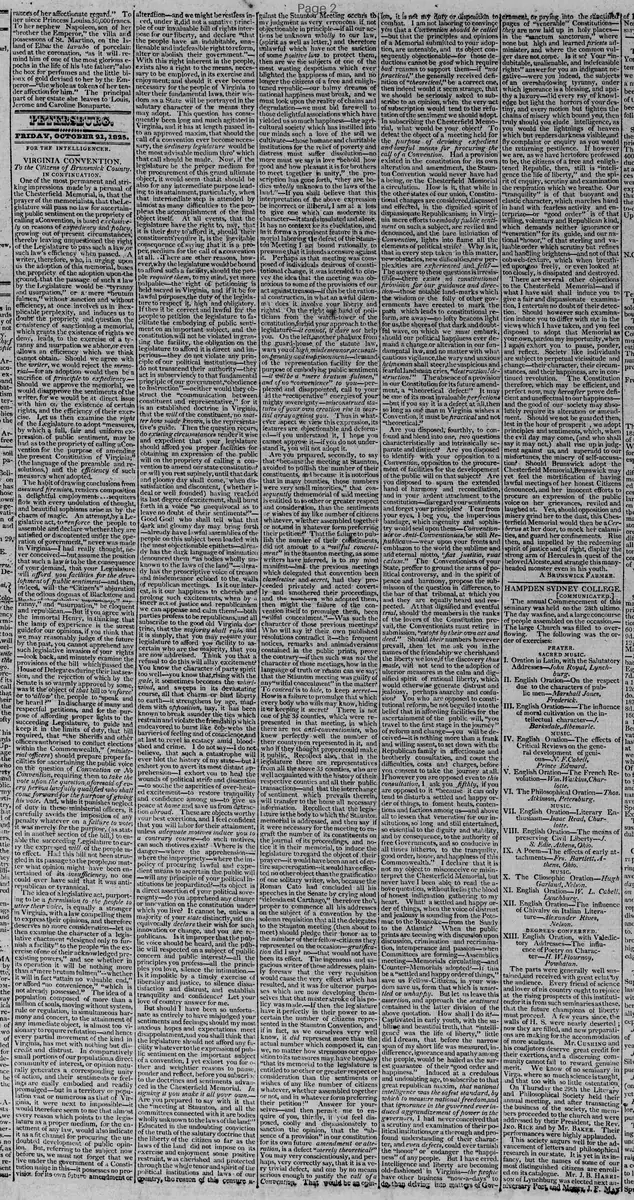
To the Citizens of Brunswick County.
IN CONTINUATION.
One of the most permanent and striking impressions made by a perusal of the Chesterfield Memorial, is, that the prayer of the memorialists, that the Legislature will pass no law for ascertaining public sentiment on the propriety of calling a Convention, is based exclusively on reasons of expediency and policy, growing out of present circumstances, thereby leaving unquestioned the right of the Legislature to pass such a law, or such law's efficiency when passed. A writer, therefore, who, in urging upon us the adoption of this memorial, bases the propriety of the adoption upon the ground that the passage of such a law by the Legislature would be "tyranny and usurpation," or a mere "brutum fulmen," without sanction and without efficiency, at once involves us in inexplicable perplexity, and induces us to doubt the propriety and question the consistency of sanctioning a memorial, which grants the existence of rights we deny, leads to the exercise of a tyranny and usurpation we abhor, or even allows an efficiency which we think cannot obtain. Should we agree with the writer, we would reject the memorial—for an adoption would then be a sacrifice of principle to expediency. Should we approve the memorial, we would disapprove the sentiments of the writer, for we would be at direct issue with him on the existence of certain rights, and the efficiency of their exercise. Let us then examine the right of the Legislature to adopt "measures, by which a full, fair and uniform expression of public sentiment, may be had as to the propriety of calling a Convention for the purpose of amending the present Constitution of Virginia;" (the language of the preamble and resolutions,) and the efficiency of such measures when adopted.
The habit of drawing conclusions from assumed premises, renders composition a delightful employment—non sequiturs flow with every undulation of thought, and beautiful sophisms arise as by the charm of magic. An attempt, by a Legislative act, to "enforce the people to assemble and declare—whether they are satisfied or discontented under the operation of government," never was made in Virginia—I had really thought, never conceived—but assume the position that such a law is to be the consequence of your demand, that your Legislature will afford you facilities for the development of public sentiment—and then, indeed, will the "Citizen's" abjuration of the odious dogmas of Blackstone and such-false supremacy, "tyranny," and "usurpation," be eloquent and republican.—But if you agree with the immortal Henry, in thinking that the lamp of experience is the surest guide for our opinions, if you think that we may reasonably judge of the future by the past, you cannot apprehend any such legislative invasion of your rights—look back, and minutely examine the provisions of the bill which passed the House of Delegates during their last session, and the rejection of which by the Senate is so warmly approved by some, was it the object of that bill to 'enforce or to 'allow' the people to "speak and be heard?" In discharge of many and respectful petitions, and for the purpose of affording proper lights to the succeeding Legislature, to guide and keep it in the limits of duty, that bill required, that "the Sheriffs and other officers authorised to conduct elections within the Commonwealth," (ministerial officers) should prepare proper facilities for ascertaining the public voice on the question of Convention or No Convention, requiring them to take the vote upon the question aforesaid of every person lawfully qualified who shall come forward for the purpose of giving his vote. And, while it punishes neglect of duty in these ministerial officers, it carefully avoids the imposition of any penalty whatever on a failure to vote; it was merely for the purpose, (as stated in another section of the bill,) to enable the succeeding Legislature to carry the expressed will of the people into effect. "Had this bill not been strangled in its passage to the people, no matter what opinion might have been entertained of its insufficiency, no one could ever have said that it was anti-republican or tyrannical.
The idea of a legislative act, purporting to be a permission to the people to utter their voice, is equally a stranger in Virginia, with a law compelling them to express their opinions, and therefore deserves no more consideration—let us then examine the character of a legislative enactment "designed only to furnish a facility" to the people "in the exercise of one of their acknowledged pre-existing powers," and see whether in its operation it will be nothing more than a "mere brutum fulmen"—whether it will in fact "attain no valuable end," or afford "no convenience," "which is not already possessed." The idea of a population composed of more than a million of souls, moving without system, rule or regulation, in simultaneous harmony and concert, to the attainment of any immediate object, is almost too visionary to require refutation—and hence every partial movement of the kind in Virginia, has met with nothing but discredit and distrust. In comparatively small portions of our population, a direct community of interest, or opinion naturally generates a corresponding unity of action, and their sentiments or feelings are easily embodied and readily promulgated—but in a territory or population vast or numerous as that of Virginia, it were next to impossible—it would therefore seem to me that almost every reason which points to the legislature as a proper medium, for the enactment of any law, would also indicate it as a fit channel for procuring the undoubted development of public opinion. But, referring to the subject now before us, we must not forget that we live under the government of a Constitution unique in this—it possesses no provision for its own future amendment or alteration—and we might be restless indeed, under it, did not a sanative principle of our invaluable bill of rights interpose for our liberty, and declare "that the people have an indubitable, unalienable and indefeasible right to reform, alter or abolish their government."
With this right inherent in the people, exists also a right to the means, necessary to be employed, in its exercise and enjoyment: and should it ever become necessary for the people of Virginia to alter their fundamental laws, their wisdom as a State will be portrayed in the salutary character of the means they may adopt. This question has consequently been long and much agitated in Virginia, and it has at length passed into an approved maxim, that should the call of a convention ever become necessary, the ordinary legislature would be the most advisable medium thro' which that call should be made. Now, if the legislature be the proper medium for the procurement of this grand ultimate object, it would seem that it should be also for any intermediate purpose leading to its attainment, particularly, when that intermediate step is attended by almost as many difficulties to the people as the accomplishment of the final object itself. At all events, that the legislature have the right to, nay, that it is their duty to afford it, should their constituents require it, is the inevitable consequence of saying that it is a proper medium for the call of a convention at all. There are other reasons, however, why the legislature would be bound to afford such a facility, should the people require them, to my mind, yet more palpable—the right of petitioning is held sacred in Virginia, and if it be for lawful purposes, the duty of the legislature to respect it, high and obligatory. If then it be correct and lawful for the people to petition the legislature to facilitate the embodying of public sentiment on an important subject, and the constitution will not be violated in granting the facility, the obligation on the legislature to afford it is direct and imperious—they do not violate any principle of our political institutions—they do not transcend their authority—they act in subserviency to that fundamental principle of our government, "obedience to instruction"—neither would they obstruct the "communication between constituent and representative," for it is an established doctrine in Virginia, that the will of the constituent, no matter how made known, is the representative's guide. Then the question recurs, do existing circumstances render it wise and expedient that your legislature should afford you proper facilities for obtaining an expression of the public will on the propriety of calling a convention to amend our state constitution? or will you rest supinely, until that dark and gloomy day shall come, "when dissatisfaction and discontent (whether ill or well founded) having reached its last degree of excitement, shall burst forth in a voice so unequivocal as to leave no doubt of their sentiments?" Good God! who shall tell what that dark and gloomy day may bring forth—already have lawful assemblies of the people on this subject been loaded with the most objectionable epithets—already has the dark language of insinuation denounced them "as bodies wholly unknown to the laws of the land"—already has the proscriptive voice of treason and misdemeanor echoed to the walls of republican meetings. Is it our interest, is it our happiness to cherish and prolong such excitements, when by a simple act of justice and republicanism we can appease and calm them?—both parties profess to be republicans, and all subscribe to the good old Virginia doctrine, that the majority shall rule, and it is simply, that you may require your legislature to afford you facility to ascertain who are the majority, that you are now addressed. Think you that a refusal to do this will allay excitement? You know the character of party spirit too well you know that, rising with the gale, it sometimes becomes the whirlwind, and sweeps in its devastating course, all that charm or bind liberty to earth—it strengthens by age, maddens with opposition, nay, it has been known to break asunder the ties which restrain and violate the friendship which endeavored to burst like cob-webs the barriers of feeling and of conscience, and at last to revel in ecstasy amid bloodshed and crime. I do not say I do not believe, that such a catastrophe will ever blot the history of my state but I exhort you to avert its most distant apprehension—I exhort you to heal the wounds of political strife and dissention—to soothe the asperities of over-heated excitement—to restore tranquility and confidence among us—to give us peace at home and save us from detraction abroad. These are objects worthy your best exertions, and I feel confident that you will labor for their attainment, unless adequate motives induce you to a contrary course—do such motives, can such motives exist? —Where is the danger—where the apprehension—where the impropriety where the impolicy of procuring lawful and expedient means to ascertain the public will—will any principle of your political institutions be jeopardized?—its object is a direct assertion of your political sovereignty—do you apprehend any change or innovation on the constitution under which you live? It cannot be, unless a majority of your state distinctly, and unequivocally declare their wish for such innovation or change, and you are republicans. Is it improper that the public voice should be heard, and the public will respected on a subject of public concern and public interest?—all the principles you profess—all the principles you love, silence the intimation.—Is it impolitic by a timely exercise of liberality and justice, to silence dissatisfaction and distrust, and establish tranquility and confidence? Let your love of country answer for me.
But should I have been so unfortunate as entirely to have misjudged your sentiments and feelings; should my most anxious hopes and expectations, meet disappointment, and you shall think that the legislature should not afford any facility whatever to the expression of public sentiment on the important subject of a convention, I yet exhort you for other and weightier reasons to pause, ponder and reflect, before you subscribe to the doctrines and sentiments advanced in the Chesterfield Memorial. In signing it you make it all your own.—Are you prepared to say with it that the "meeting at Staunton, and all the committees connected with it are bodies wholly unknown to the laws of the land!" Educated in the undoubting conviction of the truth of the salutary doctrine that the liberty of the citizen so far as the laws of the land did not impose on its exercise and enjoyment some positive restraint, was cherished and protected through the whole tenor and spirit of the political institutions and laws of our country, the reason of this censure against the Staunton Meeting occurs to my judgment as very erroneous if not objectionable in principle—if all our actions be unknown wholly to our law (spirit as well as letter.) and therefore unlawful which have not the sanction of some positive law to protect them, then are we the subjects of one of the most wasting despotisms which ever blighted the happiness of man, and no longer the citizens of a free and enlightened republic—our balmy dreams of national happiness must break, and we must look upon the reality of chains and degradation—we must bid farewell to those delightful associations which have yielded us so much happiness—the agricultural society which has instilled into our minds such a love of the soil we cultivate—those humane and charitable institutions for the relief of poverty and distress must suffer dissolution—no more must we say in love "behold how good and how pleasant it is for brothers to meet together in unity," the proscription has gone forth, "they are bodies wholly unknown to the laws of the land." If you shall believe that this interpretation of the above expression be incorrect or illiberal, I am at a loss to give one which can moderate its character—it stands insulated and alone. It has no context for its elucidation, and as it forms a prominent feature in a memorial laboring the defeat of the Staunton Meeting I am bound rationally to presume that it intends a censure against it. Perhaps as that meeting was composed of individuals desirous of constitutional change, it was intended to convey the idea that the meeting was obnoxious to some of the provisions of our act against treason—if this be the rational construction, in what an awful dilemma does it involve your liberty and rights! On the right one band of politicians from the watch-tower of the constitution, forbid your approach to the legislature—it cannot, it dare not help you. On the left, another phalanx from the guard-house of the statute law, warn you of high misdemeanor accusation, penalty and imprisonment.—demand of the representation facility for the purpose of embodying public sentiment—it will be a "mere brutum fulmen." and of no "convenience" to you—perplexed and disappointed, call to your aid the "recuperative" energies of your mighty sovereignty—misconstrued statutes of your own creation rise in martial array against you. Thus in whatever aspect we view this expression, its features are objectionable and deformed—if you understand it, I hope you cannot approve it—if you do not understand it, you will not adopt it.
Are you prepared, secondly, to say that "because the meeting at Staunton, avoided to publish the number of their constituents, and because it is notorious that in many counties, those numbers were very small minorities," that consequently the memorial of said meeting is entitled to no other or greater respect and consideration, than the sentiments or wishes of any like number of citizens whatever, whether assembled together or not, and in whatever form preferring their petition? That the failure to publish the number of their constituents, did not amount to a "wilful concealment" in the Staunton meeting, as some writers have inferred, is to my mind manifest—had the previous meetings which delegated that convention been clandestine and secret, had they proceeded privately and acted covertly and smothered their proceedings, and the numbers who adopted them, then might the failure of the convention itself to promulge them, been "wilful concealment." Was such the character of those previous meetings? Who will say it? their own published resolutions contradict it—the frequent notices, remarks and animadversions contained in the public prints, prove the contrary—if then such was not the character of those meetings, how in the language of truth or reason can we say, that the Staunton meeting was guilty of any "wilful concealment" in the matter? To conceal is to hide, to keep secret—How is a failure to promulge that which every body who wills may know, hiding it or keeping it secret? There is not one of the 35 counties, which were represented in that meeting, in which there are not anti-conventionists, who knew perfectly well the number of their countrymen represented in it, and who if they thought proper could make it public. Recollect also, that in the legislature there are representatives from all the above 35 counties, who are well acquainted with the history of their respective counties and all their public transactions—and that the interchange of sentiment, which prevails therein will transfer to the house all necessary information. Recollect that the legislature is the body to which the Staunton memorial is addressed, and then say if it were necessary for the meeting to engraft the number of its constituents on the journal of its proceedings, and notice it in their memorial, to induce the legislature to regard the object of their prayer—it would have been an act of entire supererogation—it would have effected no other object than the gratification of one solitary writer, who, because the Roman Cato had concluded all his speeches in the Senate by crying aloud "delenda est Carthago." therefore thought proper to commence all his addresses on the subject of a convention by the solemn requisition that all the delegates to the Staunton meeting (then about to meet) should pledge their honor as to the number of their fellow-citizens they represented on the occasion—gratification did I say? no—that would not have been its effect. The ingenious and sagacious writer of those addresses, plainly foresaw that the very requisition would cause the very effect which has resulted, and it was for ulterior purposes which are now developing themselves that that master stroke of his policy was made.—If then the legislature have it perfectly in their power to ascertain the number of citizens represented in the Staunton Convention, and if in fact, as we ourselves very well know, it did represent more than the actual number which composed it, can we, no matter how strenuous our opposition to its measures may have been, say "that its memorial to the legislature is entitled to no other or greater respect or consideration than the sentiments or wishes of any like number of citizens whatever, whether assembled together or not, and in whatever form preferring their petition!" Answer for yourselves—and then permit me to enquire of you, thirdly, if you feel disposed, coolly and dispassionately to sanction the opinion, that the "absence of a provision" in our constitution for its own future amendment or alteration, is a defect "merely theoretical?" You may very conscientiously, and perhaps, very correctly say, that it is a very trivial defect, and one by no means serious enough to justify the call of a Convention. That would be an opinion, it is not my duty or disposition to combat. I am not laboring to convince you that a Convention should be called but that the principles and opinions of a Memorial submitted to your adoption, are untenable, and its object consequently objectionable for those deductions cannot be good which require bad reasons to support them—if "not practical" the generally received definition of "theoretical," be a correct one, then indeed would it seem strange, that we should be seriously asked to subscribe to an opinion, when the very act of subscription would tend to the refutation of the sentiment we should adopt. In subscribing the Chesterfield Memorial, what would be your object? To defeat the object of a meeting held for the purpose of devising expedient and lawful means for procuring the call of a Convention. Had a provision existed in the constitution for its own alteration and amendment, the Staunton Convention would never have had a being, or the Chesterfield Memorial a circulation. How is it, that while in the other states of our union, Constitutional changes are considered, discussed and effected, in the dignified spirit of dispassionate Republicanism; in Virginia mere efforts to embody public sentiment on such a subject, are reviled and denounced, and the bare intimation of Convention, lights into flame all the elements of political strife? Why is it, that in every step taken in this matter, new obstacles, new difficulties, new perplexities are experienced and felt? The answer to these questions is irresistible there exists no constitutional provision for our guidance and direction—those notable land-marks which the wisdom or the folly of other governments have erected to mark the path which leads to constitutional reform, are away—no lofty beacons light for us, the shores of that dark and doubtful wave, on which we must embark, should our political happiness ever demand a change or alteration in our fundamental law, and no matter with what cautious vigilance, the wary and anxious helmsman shall steer the suspicious and fearful landsman cries. "destruction! destruction!" The absence of a provision in our Constitution for its future amendment, a "theoretical defect!" It may be one of its most invaluable perfections—but if you say it is a defect at all, then so long as one man in Virginia wishes a Convention, it must be practical and not "theoretical."
Are you disposed, fourthly, to confound and blend into one, two questions characteristically and intrinsically separate and distinct? Are you disposed to identify, with your opposition to a Convention, opposition to the procurement of facilities for the development of the public will on that subject? Are you disposed to spurn the extended hand of harmony and reconciliation, and in your ardent attachment to the constitution—disregard your sentiments and forget your principles? Tear from your eyes, I beg you, the impervious bandage, which ingenuity and sophistry would seal upon them—Conventionist or Anti-Conventionists, be still Republicans—wear upon your fronts and emblazon to the world the sublime and eternal motto, fiat justitia, ruat coelum. The Conventionists of your State, proffer to ground the arms of political controversy, and in the spirit of peace and harmony, propose the submission of the question in difference, to the bar of that tribunal, at which you and they are equally heard and respected. At that dignified and eventful trial, should the members in the ranks of the lovers of the Constitution prevail, the Conventionists must retire in submission, "estopped by their own act and deed." Should their numbers however prevail, then let me ask you in the names of the friendship we cherish, and the liberty we love, if the discovery thus made, will not tend to the adoption of ulterior measures in the calm and dignified spirit of rational liberty, which would otherwise generate distrust and jealousy, perhaps anarchy and confusion? You who are opposed to constitutional reform, be not beguiled into the belief that in affording facilities for the ascertainment of the public will, "you travel to the first stage in the journey" of reform and change you will be deceived- it is nothing more than a frank and willing assent, to set down with the Republican family in affectionate and brotherly consultation, and count the difficulties, costs and charges, before you consent to take the journey at all. If however you are opposed even to this consultation, I ask you fifthly, if you are opposed to it "because it can only tend to disturb a settled and happy order of things, to foment heats, contentions and factions among us—and above all to lessen that veneration for our institutions, so long and still entertained, so essential to the dignity and stability, and by consequence, to the authority of free Governments, and so conducive in all times hitherto, to the tranquility good order, honor, and happiness of this Commonwealth." I declare that it is not my object to misconceive or misinterpret the Chesterfield Memorial, but never have I been able to read the above quotation, without feeling the blood of honest indignation gathering to my heart. What! a settled and happy order of things, when the voice of distrust and jealousy is sounding from the Potomac to the Roanoke—from the Sandy to the Atlantic? When the public prints are teeming with discussion upon discussion, crimination and recrimination, intemperance and passion—when Committees are forming—Assemblies meeting—Memorials circulating—and Counter-Memorials adopted? If this be a "settled and happy order of things," save us Fellow-Citizens, in your wisdom save us, from that which is unsettled or unhappy. But let us leave this assertion, and approach the sentiment contained in the latter division of the above quotation. How shall I do it? Captivated in early youth, with the sublime and beautiful truth, that "intelligence was the life of liberty," little did I dream, that before the narrow span of my short life was measured, indifference, ignorance and apathy among the people, would be hailed as the surest guarantee of their "good order and happiness." Induced at a credulous and undoubting age, to subscribe to that great republican maxim, that national intelligence was the safest standard, by which to measure national freedom, and that ignorance in the governed ever induced aggrandizement of power in the governors, I had never conceived that a scrutiny and examination of their political institutions, or a thorough and profound understanding of their character, and even defects, could ever tarnish the "honor" or endanger the "happiness" of any people. But I have erred. Intelligence and liberty are becoming old-fashioned in Virginia—the people have other business "now-a-days" to do, than delving into matters of Government or prying into the sanctified pages of "venerable" Constitutions—they are now laid up in holy places—in the "sanctum sanctorum," where none but high and learned priests administer, and where the common vulgar dare not come. Is it so? Your "indubitable, unalienable, and indefeasible rights" answer for you an indignant negative—were you indeed, the subjects of an overshadowing tyranny, under which ignorance is a blessing, and apathy a luxury—did every ray of knowledge but light the horrors of your destiny, and every motion but tighten the chains of misery which bound you, then truly should you elude intelligence, as you would the lightnings of heaven which but renders darkness visible, and fly complaint or enquiry as you would the returning pestilence. If however we are, as we have heretofore professed to be, the citizens of a free and enlightened Republic, then, still is "intelligence the life of liberty," and the spirit of enquiry, scrutiny and examination the respiration which we breathe. Our "tranquility" is of that buoyant and elastic character, which marches hand in hand with fearless activity and enterprise or "good order" is of that willing, voluntary and Republican kind, which demands neither ignorance or "veneration" for its guide, and our national "honor," of that sterling and valuable order which scrutiny but refines and handling brightens and not of that cobweb-texture, which when breathed upon too freely, or even looked at too closely, is dissipated and destroyed.
There are several other objections to the Chesterfield Memorial and if what I have said shall induce you to give a fair and dispassionate examination, I entertain no doubt of their detection. Should however such examination induce you to differ with me in the views which I have taken, and you feel disposed to adopt that Memorial as your own, pardon my importunity when I again exhort you to pause, ponder, and reflect. Society like individuals are subject to perpetual vicissitude and change—their character, their circumstances, and their happiness, are in continued revolution. The Constitution therefore, which may be efficient, and perfect now, may hereafter prove deficient and uneffectual to our happiness—and the good of our society may absolutely require its alteration or amendment. Should we not be guarded then, lest in the hour of prosperity, we adopt principles and sentiments, which, when the evil day may come, (and who shall say it may not,) shall rise up in judgment against us, and superadd to our misfortunes, the misery of self-accusation? Should Brunswick adopt the Chesterfield Memorial, Brunswick may yet feel the mortification of having lawful meetings of her honest Citizens denounced, and her innocent efforts to procure an expression of the public voice on her grievances, reviled and laughed at. Yea, should opposition and misery grind her to the dust, this Chesterfield Memorial would then be a Cerberus at her door, to mock her calamities, and guard her confinements. Rise then, and impelled by the redeeming spirit of justice and of right, display the strong arm of Hercules in quest of the beloved Alceste, and strangle this many headed monster even in his youth.
A BRUNSWICK FARMER.
What sub-type of article is it?
What themes does it cover?
What keywords are associated?
What entities or persons were involved?
Where did it happen?
Story Details
Key Persons
Location
Brunswick County, Virginia
Story Details
A persuasive essay by 'A Brunswick Farmer' critiques the Chesterfield Memorial's opposition to legislative facilitation of public sentiment on calling a Virginia constitutional convention, arguing for the legislature's right and duty to provide such means, emphasizing republican principles, the right to petition, and the need to ascertain the majority will to prevent strife.